Tag: hero

  • How to Develop High-performing Leaders and Teams: an Applied Neuroscience Approach, with Andy Longley

    How to Develop High-performing Leaders and Teams: an Applied Neuroscience Approach, with Andy Longley

    I recently had the pleasure of sitting down and having a great discussion with Andy Longley from teamup. I’ve got to know Andy and the teamup guys quite well over the past couple of years, and I love the way they’re going about helping organisations develop high performing teams and leaders using applied neuroscience. I was really eager to learn more, and Andy very kindly shared a wealth of knowledge and information around this topic, which is discussed in the video above, and summarised below:

    About Andy

    Andy has worked in several different roles, across many countries since he began his career. Originally from New Zealand, Andy initially started working as a Business Psychologist – he has worked in defence, international relations, retail, aviation and is now working in the Berlin start-up scene. He has worked with many people across these industries: multi-lingual teams and multi-ethnic teams, and one thing that remains ever consistent throughout is that humans are humans: we all have the same basic needs and social drivers – and leadership can be looked at through that lens.

    About teamup

    Andy was working in-house, heading up the talent agenda and strategy for adidas in Germany when he met his now business partner, Ali, who was delivering many of the leadership development programmes at adidas. The two had a shared philosophy around how to develop leaders and teams, and after Andy had left adidas, the two caught up to discuss this in more detail.

    They both agreed that there was an absence of a great way of making high-performing teams come to life. They both found that many of the methods and expertise around this area was based outdated thinking around what humans need.

    There was, however, a lot of brilliant information in the existing literature relating to neuroscience and about how you can create a ‘brain-friendly’ environment at work. Additionally, the latest technology, which allows us to scan brains, has shown us new information about what is going on in different parts of the brain when certain things are happening in the workplace.

    Equipped with this knowledge relating to applied neuroscience, Andy and Ali thought there was a great opportunity to build an organisation which could really help high-performing teams and leaders, and started developing their own psychometrics, consultancy and training, based on applied neuroscience.
    teamup

    Andy’s view on what makes a great team leader

    Before Andy started to work within neuroscience, he would have likely had a very different answer to the question – he would have listed some competencies, skills, EQ, ability to delegate etc. However, these days, he has a very different answer.

    What Andy has found through the science is that skills and capabilities are certainly required, but a hugely important factor around what makes a great leader is having the ability to create an environment in which other people can thrive – and this skill can be taught.

    Great leaders need to create an environment that is ‘brain friendly’, and in line with the unconscious mind’s natural wants and needs. In order to achieve the best performance in the work place, the brain needs to be kept in a positive, reward state, rather than an anxious and threat state. If leaders are able to provide this for their teams, then they will create an environment which allows people to genuinely thrive – and this is what Andy and his team specialise in.

    For Andy, leadership should be constantly trying to magnify the performance of those people you are working with. In order to do that, leaders need to use the knowledge of the brain, what it is and what is does, and how you can take practical steps to create, that environment which allows others to thrive.

    More into the detail around neuroscience

    There is a term in the world of neuroscience, known as ‘neuroplasticity’. This is the phenomenon that anybody is able to rewire neural pathways within their brain. This means that people can, over time, change their behavioural habits, so they start to become engrained. The brain never loses its ability to change shape, based on habits that are formed. Therefore, by approaching leadership with the notion that everybody can improve, and can be focused and socially connected, a team will be able to reach its full potential.

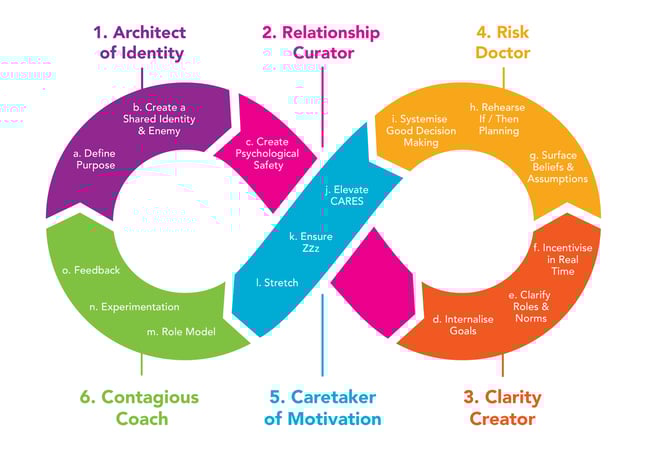
    In a business context, specifically regarding leaders and teams, there are three areas in which every leader can start to focus on to promote high performance, and this relates to the fact that the brain is always doing three things:

    1. Looking for meaning and purpose

    The brain is always searching for meaning and purpose in life and in work. If leaders can create a team environment where a team is connected to a purpose that really motivates them, then the brain is naturally going to be in a far more comfortable and motivated state. If these conditions within the environment can be created by leaders, each member of the team will be moving more towards a higher purpose and Finding their Why. It’s incredibly important for a team to be able to do this collectively by creating a shared team identity, much like sports teams who achieve success, through songs, uniforms, shared history. If leaders can do these things, it starts to activate empathy and dopamine and helps build the foundations for high performance.     2. The brain hates uncertainty

    Uncertainty means we don’t know what is coming, and that is a survival threat to us. If leaders can create an environment that has as much certainty as possible, then this is an incredibly powerful way to stop the brain from worrying about uncertainty. This means that more focus can be applied to higher-order tasks, such as decision making, complex problem solving and interpersonal and social connection.

    An example of what can be done to reduce uncertainty, is scenario planning to cover different eventualities of what ‘might’ happen, so when it does happen, it will have been anticipated and not perceived as a threat. For example, if a business is about to move into a new market, this may bring about a great deal of uncertainty for team members, whose brains will go back to the primitive survival techniques of ‘what if?’, and persistently worrying about outcomes. Scenario planning enables leaders to act out scenarios with different eventualities. Consequently, when these eventualities come up, uncertainty will be reduced among the team.

    1. The brain always wants to grow and progress

    Our brain is always wanting to grow and to progress. As a leader, it is hugely important to make sure that team members are generally, professionally, and personally growing. Incorporating things like stretch goals to ensure that team members are getting better and can feel the progress that they’re making will ensure that they are engaged psychologically and subconsciously, in line with this innate need from the brain. Great leaders will coach and support their team members in their constant growth and progress.

    coloured shead

    Inclusivity within teams

    We know the paramount importance of ensuring that organisations are inclusive. Andy says that, by definition, a business cannot have an exclusive team and be high performing.

    Again, we can go back to the brain and its innate needs. Human beings are incredibly socially driven and have a need to be around other people. The level of social nuance that is picked up on both consciously and subconsciously is phenomenal – much more than any other species. Therefore, if we detect that we are not part of a group or cannot be our true selves, this activates hyperarousal in the brain (a symptom of the fight/flight response). This, consequently, means that we are not able to focus on higher order functions.

    Teams need to focus on how to create the conditions for inclusion within the workplace. Leaders need to create an environment which fosters inclusivity. This is about making sure that everybody within the team knows each other and has psychological safety, where people can be their true selves, can share different opinions and have good, challenging discussions and debate in a healthy way.

    Leaders must ensure the conditions are created which enables everybody in the team to contribute – meaning that they feel as though they are part of the team and belong to the group. If leaders do this effectively, not only will it result in high performance, but as a building block for organizational culture, because how we experience our organisation is how we experience our team. Ultimately, teams need to capitalize on the cognitive diversity that everyone brings in, and this will be the grounds for creating cultural change for the organisation to be more inclusive.

    Andy’s views on how to build and foster company culture

    Companies can build a culture that they want, intentionally, from the start. Founders need to identify what are the key values that are really important to the organisation. To do this, you need to establish what these values mean today, are they the values we want to have now and are they the values we want to represent us in the future, to ourselves and to our clients? Once your values have been broadly established, really get to the bottom of each of them… do they represent us? Are they authentic? Challenge these values as a team collectively. Get to the point where everybody within the organisation believes in them and feels passionate about them. Once established, organisations should start designing people processes around behaviours linked to these values and incentivizing these behaviours through performance management. This will help to develop the right type of habits across that the organisation wants to build, which will align with this culture.

    Organisations also need to make sure that employees are being held to account (leaders in particular) for being consistent and authentic with these behaviours and values, and the processes and incentives that have been brought in to foster them – because if organizational culture drift comes along, it’s incredibly difficult to reverse this – particularly among fast-growing organisations.

    Finally, it’s hugely important that organisations constantly and intentionally monitor the overall organizational culture. Make sure that the values, behaviours, and attributes that we have in place are still what we want. Organisations should review this at least annually.
    ÔÇóMIN3364_Infinity loop_(1)_w copy

    teamup products

    teamup has designed and built four innovative psychometric assessments, which are all based on the teamup proprietary model of applied neuroscience to develop high-performing teams and leaders. I’m incredibly proud to say that the Evolve platform powers these psychometrics for teamup. Andy has given us some info about all of them – and you can access more information by following this link.

    Neuroselfie

    This is a short self-report in which team leaders can self-assess against the teamup framework, using likert questions. Upon completion, users will receive a custom report to show where they’re tracking against the six areas of high performance.

    180/360 degree feedback

    teamup has built a 180/360 degree feedback. This looks at whether a leader is creating an environment for others to thrive, again, based on the teamup model of applied neuroscience. The 360 will provide leaders with feedback against the areas of high performance, which is delivered via a teamup accredited coach.

    teamup For Teams (TUFT)

    teamup’s flagship product, teamup for Teams, is a team assessment. All members within a team will answer a diagnostic questionnaire and get their own customized team report, that shows how this team – with its collective accountability and responsibility, is performing, and what can be done practically in order to improve that.

    The psychometric tools that Andy and his team are incredibly powerful, and have already been used by large clients on a global level.

    To find out more about any of the teamup products, or how Andy and his team can support, please contact him on:

    Andy.longley@teamup.inc

    Andy’s LinkedIn

    The teamup Website

    Thanks for reading/watching!

  • The Importance of Account Management

    The Importance of Account Management

    Account Management – Why is it so important?

    ‘Customer/Client Success’, ‘Account Management’, ‘Customer Service’; No matter which title you use, looking after your customer base is arguably the most crucial function to sustain growth within your business. It’s no secret that a business needs an excellent sales and marketing strategy to be successful, but who looks after all those exciting new clients you sign up?

    Account managers become the main contact for new clients and are responsible for focusing on customer retention to create and nurture long-lasting, profitable relationships. With current customers spending on average 67% more than new customers, this is where your best growth opportunities are hiding!

    Being an account manager can involve many responsibilities. Quite often we take on the role of project manager, software tester and occasionally therapist, but these are the things that make this role so rewarding. Engrossing ourselves in a holistic understanding of a client’s solution allows us to provide consultative recommendations that are right for the business. Sometimes these recommendations may be at a cost to the client, but based on a strong relationship they will understand that investing additional funds now will allow for a mutually successful solution in the long term.  

    How often do you find yourself turning to Facebook, Google or TripAdvisor to leave a review after experiencing bad service? We are 10 times more likely to leave a review after bad service than we are with a good experience, and with customer feedback so readily available online, a bad review can damage your business reputation. That’s why in this digital age we need to ensure we do all we can to ensure our customers have a great experience.

    At Evolve Assess we pride ourselves on providing the best possible service for our clients, delivering a tailored solution and approach to meet each individual client’s needs. If you would like to know more about what sets us apart from other assessment platforms, you can contact us at info@evolveassess.com.

  • How to Reduce Attrition Rates

    How to Reduce Attrition Rates

    High attrition rates can result in increased business running costs, productivity losses, low team morale and even a damaged reputation. 

    Recognising that your organisation is suffering from high attrition or that you have an issue keeping staff in certain roles is the first step towards fixing the issue. The next steps are a mix of understanding why people leave, optimising the evaluation and recruitment process and improving the communication during the hiring process. 

    By taking these different steps and ideas into account, it’s possible to reduce attrition rates, aiming for a sweet spot of around 10% attrition across the company.

    Assess The Current Situation

    In order to go about reducing employee turnover, it’s crucial that you understand why people are leaving the business. 

    This can be achieved through two main methods: one is to speak to existing staff to learn more about how attrition impacts them and how they view the situation, the other is to ensure you have a strong exit interview process in place. 

    Using a combination of the two methods, you can begin to unpick why the attrition rate is high. 

    Start by asking current employees (anonymously) if they think the organisation has enough quality, well-trained staff and what the effect of someone leaving is on them. 

    As for the exit interviews, try to use these as a way to dig deeper into what’s making people move on – this is usually best carried out by an independent interviewer, so not the leaver’s line manager. 

    Optimise Your Evaluation Process

    Bad hires lead to higher attrition rates – either through people being let go as they can’t perform in the role or because people leave the company unsatisfied with the job and the company. 

    To avoid this happening, make sure you’re hiring the right people using a Situational Judgement Test (SJT) or similar. 

    An SJT is a psychometric assessment that presents applicants with role-specific scenarios that they might experience after joining the company, in order to gauge how they would respond when in these scenarios. 

    With an SJT, you can evaluate:

    • Attitudes – how candidates think and feel, ensuring that this aligns with what you are  looking for
    • Behaviours – how staff will conduct themselves within the working environment
    • Values – do their values match those of your company?

    As well as SJTs, consider getting someone involved in the recruitment process that already works in the role being interviewed for – this will help the hiring manager to understand better the qualities and values that are needed to succeed in the role. 

    Improve Your Communication During The Recruitment Process

    This isn’t so much about how you contact the candidates during the process (although that’s still important), it’s about what you communicate and how well you communicate the true nature of the job. 

    While it’s great to provide the benefits of a role, don’t over embellish or paint a picture that simply isn’t true as it will only leave the eventual hires feeling unsatisfied or even feeling cheated if the role doesn’t match up to the description. 

    It’s important to communicate both the favourable and unfavourable parts of the job, for example:

    • Favourable – reward schemes, holidays, benefits, culture
    • Unfavourable – fast-paced culture, tight deadlines, high pressure, long working hours

    Even the best jobs have parts that are less favourable and that’s not something to hide, it’s just about balancing the good and the bad and allowing people to make an informed decision as to whether the role is right for them. 

    Providing this detail will also improve the candidate pool as those that do apply are likely to be more interested in the role. 

    As well as carefully considering how to communicate the actual role, think about how you talk about and describe the culture of the company. Does pizza and beer on a Friday actually translate to ‘everyone stays an extra couple of hours doing work before some food and drink are provided?’

    What you see as a ‘fun’ company culture might not translate that way to others, so be honest and describe what it’s like to work at your company and keep in mind that it might not be for everyone!

    By taking the steps above and learning more about why attrition happens, optimising the evaluation process and improving communication during the hiring process, you can begin to reduce your organisation’s attrition rate. 

    Find out more about identifying attrition in your organisation and how to reduce it in our guide: The HR Guide to Employee Attrition (with Scorecard tool). 

  • Measuring People in the Workplace, with Ben Williams

    Measuring People in the Workplace, with Ben Williams

    I recently had the pleasure of talking with my colleague Ben Williams to discuss how we can measure people in the workplace. Please watch the video above for the full discussion, or if you’d prefer, we’ve captured the key points here:

    About Ben

    Ben is Managing Director at Sten10 and I’m delighted to say he’s now a Director here at Evolve Assess, having a major input towards our strategic direction and platform development to ensure optimal performance for psychometric test delivery. Ben wrote a brilliant piece on our partnership together recently, which I’d recommend checking out: Sten10 and Evolve Assess Partnership. The main purpose of our discussion, was to talk about some of the key terms when it comes to psychological assessments. But first, a little about Sten10… 

    An introduction to Sten10

    Sten10 is a firm of business psychologists, set up in 2012. The business was fuelled by Ben’s personal passion of trying to map out the human mind – specifically in business and recruitment. Sten10 design bespoke psychological assessments and are independent, trusted advisors to clients who make assessment recommendations based on clients’ unique requirements. Sten10 work in very close partnership with Evolve Assess, designing many assessments that are delivered via the Evolve platform.

    In addition, Sten10 also develop assessment centre materials for later stages in the recruitment processes and design competency frameworks for their clients.

    How do we measure people in the workplace?

    Ben has always been fascinated by the idea of measuring a person’s psychological make up. For example, when psychologists look at personality, time and again 5 distinct factors are identified in the research, regardless of age, culture, gender et c. Similarly, when it comes to cognitive reasoning, psychologists have found people can generally keep about 7 chunks of information in their memory before they start to forget it. Ben was fascinated by the fact that you can measure something that’s as seemingly intangible as people’s psychological makeup – and that’s what he loves about the challenge of his job as a psychologist.

    Why it’s so important for businesses to know about personality and psychological makeup

    The idea that everyone has their own unique blend of personality traits, reasoning skills and motivation hasn’t always been widely recognised. Businesses more often now recognise the value of this deeper understanding of people’s makeup.There are a wide range of benefits for the organisation itself in being able to measure people’s traits:

    • When matched to the role, it is likely individuals will perform better and stay longer.
    • it is able to match those who may have a ‘halo effect’ on others around them, as they’re more likely to be a valued member of the team through coaching and supporting others.
    • It helps to feed into the company’s culture, values and brand.

    There are benefits for the individual, too:

    • It is better for mental well-being.
    • Nobody wants to be in a job that they are ill suited for – staff who are expected to be constantly behaving contrary to their natural preferences will be more likely to leave.
    • It allows for better career development when they’re better matched.
    • It’s more likely that an individual’s skills will be recognised.

    Tools for measuring people

    There are a number of tools that can be used to measure these traits. Sten10 develop a range of psychological assessments, which – broadly – fall into two categories: tests of typical performance, and tests of maximum performance.

    Tests of typical performance

    These are tests that may be used when businesses are looking at personality or motivation. This is how an individual will typically tend to think, feel and behave, or what tends to motivated to work harder, or demotivated, resulting in them working less hard.

    Tests of typical performance are usually self-report, so users must have a reasonable degree of self-insight and be completely honest when answering them. We tend to refer to these assessments as questionnaires rather than tests, as there’s no objective right or wrong when it comes to personality or motivation. These questionnaires are untimed and should be answered by candidates based upon their initial response, rather than thinking about it too long.

    Tests of maximum performance

    These types of tests are most frequently used when more of a particular skill is required. For example, more verbal reasoning or numerical reasoning skills, or greater attention to detail. Unlike tests of typical performance, these tests are typically timed, and are not self-report – they actually involve giving people a sample of problems to solve, based within a realistic workplace context.

    Tests of this nature are often called ‘reasoning’ or ‘ability tests’.

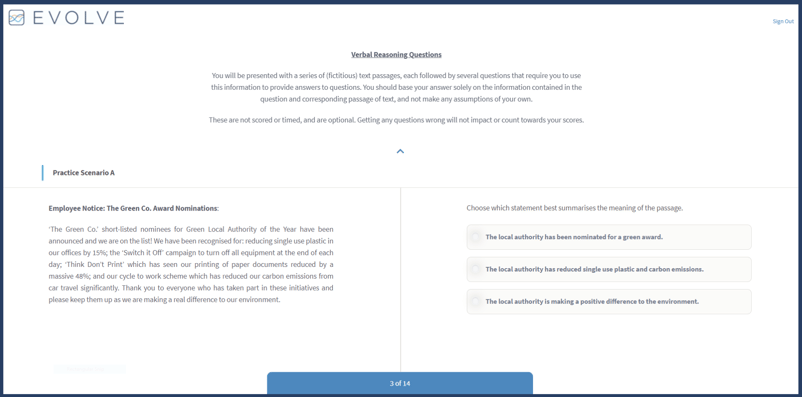
    These tests assess an individual’s intellectual horsepower. You may of heard of IQ tests, which are a general measure of reasoning skills. However, in business, we look to focus more on the skills that are relevant for a particular role. For example, if a company is recruiting for a role that requires them to have high numerical reasoning skills, a test can be designed that asks candidates to look at some data, make some calculations and draw a logical conclusion as a result of it. With verbal reasoning, candidates are usually given a passage of information and asked to read and interpret implications of the different parts of the passage. There are also measures of ‘pure reasoning’ skills, which are completely independent of language. These are called ‘abstract reasoning’ tests, and candidates are provided with a series of abstract shapes and are asked to identify which shape comes next in the sequence, for example.

    Pictured above: an example of a verbal reasoning test question

    As opposed to personality questionnaires, which look to assess what is happening underneath the surface of a candidate, behaviour is what you actually see candidates doing. For example, an individual can have a personality trait which makes them more introverted or shy than others inside, but that candidate may have developed a repertoire of behaviours and coping strategies that mean you are a very effective presenter, for example.

    In a testing sense, in order to look at people’s typical behaviours you may look at a Situational Judgement Test (SJT), because you’re providing candidates with a hypothetical scenario, and gauging how candidates would be most and least likely to behave. These tests are carefully designed to try and link to the behaviours within the job.

    Demonstrating how predictive a test is

    In order to prove that a test or questionnaire is predicting what it should be, we have to take an individual’s test score, and then we have to take a score which represents that person’s job performance (or some sort of criteria for success) and the two must be correlated. This correlation identifies the strength of the relationship between two things. An example of a correlation would be: sales of umbrellas tend to go up when it’s raining. In a workplace setting, we are looking for a correlation between test performance and job performance (i.e. the better someone performs in a test, the better the job performance).

    The challenge is how to measure job success. You can do this through ‘hard criteria’, here are some examples:

    • How long candidates stay in a role (attrition).
    • The value of sales made.
    • Error rates on the production line.

    The other way to measure job success is through ‘soft measures’.

    This could include things like:

    • Manager feedback or a full 360 feedback. For example, managers could rate their employees on a scale (e.g. 1-5) on certain skills.
    • Customer satisfaction.

    When Sten10 build an online assessment, they will work closely with clients to identify success criteria right from the outset, so that the test is built to predict exactly what the clients wants it to predict.

    When it comes to predicting job performance of individuals who have performed well in an online assessment, it is advised that this is done after at least six months within the role, but more commonly this would be between 12-24 months. For attrition, you can start measuring right from the beginning how long staff have been in the roles.

    How many different tests should we use for selection?

    Ben, with a psychologist’s hat on, would – of course – like to measure every single trait possible. However, in the real-world, for candidates, it is probably not recommended to put too many assessments in place because competitors could be quicker to offer a job, or candidates may drop out because they find the process too onerous; there’s a law of diminishing returns of with the number of assessments included and how much predictive power this provides.

    The research says that an ability test predicts performance the best, as a single measure.  SJTs have been shown to predict performance over and above Personality Questionnaires, and they tell us something different.

    Personality questionnaires are more towards the acceptable level when you look at multiple scales. SJTs have been shown to predict performance over and above questionnaires and ability tests and they tell us something additional. For this reason, the last 5 years have really seen an explosion in the use of SJTs.

    What is a Situational Judgement Test?

    Companies were wanting to go for the perfect blend of automation and predictive power, Ben would recommend using an ability test and an SJT, with the SJT being completed first. Although they’re not quite as predictive as ability tests, they have a huge benefit in that, because they give the person applying some insight into the company they’re joining – meaning that they can self-deselect from the process, saving a huge amount of time.

    Although there are some SJTs that are available off-the-shelf, if businesses don’t go bespoke with SJTs, they are missing the huge benefit of giving people an insight into the role. An off-the-shelf SJT will have a set of generic or ‘vanilla’ scenarios that are could be applicable to a range of businesses; the scenarios will not be tailored to your business and, as such, candidates won’t be able to get a realistic insight into the role or company , and they are potentially less valid as a result.

    A good example was an SJT designed for use with a large regional police force. They were facing a lack of applications from people from ethnic minority groups. In order to help with this, an SJT was designed with instructions written to evoke a positive motivational mindset for everyone taking the test before they begin. As a result, not only did drop out rates between different ethnic groups equalise, but also actual performance in the test. 

    Ben and his team at Sten10 do work across an array of organisations, from health care, to public sector, banking to utilities, and we’re delighted to have partnered together by providing the assessment platform for many of these projects.


    If you’d like to contact Ben, you can do so via ben@sten10.com.

    Thanks for watching/reading!

  • Hiring for Cultural Fit

    Hiring for Cultural Fit

    The concept of ‘company culture’ is a very hot topic these days; as we’ve previously discussed, it’s of huge importance for companies to fully establish and define its culture, well in advance of hiring for cultural fit, but there are many tips and tricks that can be implanted by hiring managers to hire for cultural fit. We’ve highlighted some thoughts below: 

    The majority of what needs to be done in hiring for cultural fit is to ascertain whether the individual’s values align to those of the company – and remember, that’s their beliefs, vision, and preferred working environment.

    It’s generally considered good practice, once a company has established a values model, to then create a core set of competencies (competency framework) and associated behavioural indicators (actions or behaviours that exemplify the competency in practice). This will provide a framework in how to assess somebody’s cultural fit during the application process. Additionally, a series of Realistic Job Previews (also in the list below) will help candidate’s gain a realistic gauge of life within the organisation – transparency is always key!

    Cultural fit interview questions

    In interviews, start with describing the role and the company environment generally. Ask candidates examples of times in the past that they performed tasks or behaved in ways that are aligned to your values, core competencies and behavioural indicators.

    For example, let’s say you’re interviewing a candidate against the core competency of ‘communication’ – the behavioural indicator for ‘communication’ may be ‘have the ability to receive feedback from others and learn from this feedback’. Ask candidates for examples when they have received feedback in the past and what was done from this feedback.

    As you can probably see, these types of questions start to profile how the candidate has behaved in the past, and how they are likely to behave in the future. This question may ultimately step from the core organisational value of ‘transparency’ or ‘integrity’. By asking these types of questions, you can start to ascertain how aligned to your culture the prospective employee is.

    Accurate job descriptions

    Unfortunately, many job descriptions are a little ‘best-case scenario’ and often fairly unrealistic. This certainly does not provide a RJP to job applicants and does little to demonstrate the culture of the company. Make sure that, when creating job descriptions, it is done so by ensuring that the day-to-day responsibilities are an accurate reflection of the reality of the role. Furthermore, the ‘About us’ part of any job description should be information not just about what the company does, but how it does it and why it does it; steeped in organisational values – it’s a great opportunity to be demonstrating your company culture. If you’re a creative bunch, get creative with your job adverts/descriptions, if you’re fun, be fun! It’s hugely important and a very easy way of communicating the company values and culture.

    Employee testimonials/day-in-the-life videos

    Who better to get a flavour of an organisation and its culture than an existing staff member? By getting existing employees to create testimonials and day-in-the life videos, they will be able to document what it’s like working for your organisation on a day-to-day basis. This includes the good, the bad and the ugly. Show these videos and testimonials to prospective applicants alongside job descriptions and before they apply, which will help to provide that final rubber stamp of approval that they are certain this is the role for them!

    Situational Judgment Tests

    Situational Judgement Tests (SJTs) are a type of psychometric assessment that look to gauge a candidate’s behavioural fit to a particular role. They do this by presenting the candidate with a series of role-specific scenarios and ask them to choose their most and least likely courses of action from three/four options. It’s a great way to let the recruitment team know if a candidate is likely to fit in with the organisation on a behavioural level. 

    However, that’s not all they do: SJTs are designed to be bespoke and specific for each role/organisation, meaning that you can provide, within the scenarios, a Realistic Job Preview to candidates. This means that the company culture can be communicated to candidates through the scenarios within the assessment – it’s a beautiful two-pronged approach to ascertaining cultural fit: for both the hiring manager and the candidate and should certainly be considered as a RJP tool to gauge cultural fit.

    Don’t forget – it’s hugely important to establish and define a company culture well before it can be hired for: it’s the fairest way all round, and is much better in the long term.

    Please don’t hesitate to contact us via info@evolveassess.com for any support in helping you hire for cultural fit, through the use of online assessment.

  • 3 Myths of Attrition and The Impact It Has on Your Business

    3 Myths of Attrition and The Impact It Has on Your Business

    Attrition, sometimes referred to as employee churn or turnover, is a part of everyday business. Whether it’s voluntary or involuntary, the idea of someone leaving a job isn’t anything unusual, and in some cases is even good for business.

    Where it does become an issue is when an organisation has a high rate of attrition. The actual point at which an attrition rate is considered high will vary depending on the industry and type of work.

    So, differences aside, what is the impact of high attrition on an organisation?

    The impact of attrition on your business

    Firstly, it can increase business running costs. The hiring process can be expensive in terms of money and time, especially if your business works with recruitment agencies, as additional fees apply. 

    Each time a staff member leaves and you choose to replace them, you have to go through this process every time, and if your rate of attrition is high, so is the cost of keeping jobs filled. 

    Secondly, there are productivity losses as multiple people in the business may need to be involved in the hiring process – that could be heads of departments, managers and various people in HR. For anyone where recruitment isn’t their main role, it’s taking time away from potentially more valuable tasks. 

    Further to this, each time someone new joins the team, there is a period of onboarding where someone might need to take time from their days, weeks and even months to support the new hire – if you have to keep going through this process, it can have a huge impact on productivity. 

    Next is the impact on team morale – if you’re working within a team where people are often coming and going, or even being released by the company, it can affect morale for others in the business and can damage the potential for strong teams to bond. 

    And finally, high levels of attrition can affect your reputation as a business. If your organisation becomes known for not being able to hold on to its staff, it becomes harder to attract talent into your business.

    With a better understanding of how a high attrition rate impacts your business, it’s good to know some of the myths:

    1. Attrition isn’t a significant problem
      As seen above, if you have high attrition rates, it can impact the business in multiple ways. It’s best not to be ignored and organisations should be looking carefully at why anyone leaves the business (for good or bad reasons).
    2. You can’t do anything about attrition
      If this was true, businesses would regularly grind to a halt with no one to do the work. There are definitely circumstances where it’s beyond a company’s potential to keep someone, but there are actions a company can take to reduce attrition across the business.
    3. You don’t want to deter people from applying
      Quality, not quantity. The more people that apply for a role, the more you have to turn down – plus, for every applicant, there is work involved with assessing whether they’re the right person or not. Unless the role you’re hiring for doesn’t require any skills at all, then you’ll always want to deter bad fits from applying. 


    Learn more about the impact attrition can have on your business as well as how to get started with reducing attrition in our guide: The HR Guide to Employee Attrition (with Scorecard tool).

    Download it here:

  • A ‘Week in the Life’ as an Apprentice at Evolve Assess

    A ‘Week in the Life’ as an Apprentice at Evolve Assess

    Personally, I like reading about what other people are getting up to in their week. Is it because I’m a little bit nosey? Possibly… But seeing how others organise their week makes me feel an almost second-hand productivity, as odd as that may sound. So, I thought why not write one myself!

    Firstly, I’ll introduce myself; I’m Morgan, and I joined Evolve Assess as a Business Admin. Apprentice in March this year. For me, this is a completely new realm of work, as previously I’ve predominantly worked in the equine industry. Finding a new way of working, suiting a new routine with a new staff team was a slightly scary prospect to me – but now? I wouldn’t have it any other way!

    Enough about just me, let’s talk about what I’ve been up to this week!

    Monday

    We start our week with a team meeting, have a catch up on what was achieved last week and what we plan to work on this week. I update the team on not only my planned tasks work wise, but also where I’m up to with my college work and any pressing assignments I have that I may need help with. So, what does this week hold for me? Content uploads, a slightly beefy college assignment, HubSpot Academy courses, testing and marketing scheme plans!

    Tuesday

    The majority of today was spent uploading assessment content to our platform. Our Devs have recently created a new function to improve our multilanguage campaigns, meaning a lot of content requires translated. Now on the surface, that’s easy, right? With a good sum of questions (doubled, accounting for the 2nd language), making sure they’re in the correct order, they match their scoring types, they all have the ‘require an answer’ box ticked, pop ups work et c. – as you can imagine this kind of task ends up taking some serious concentration and a generous amount of time!

    Wednesday

    Testing day! For me, this means a day of testing through our existing campaigns and, essentially, trying to break them. Now when I say ‘break’ I mean find how they could be broken (accidentally of course!) by any of our clients and their candidates. So, I run through the tests as a candidate would with a very attentive eye to make sure that none of our new content uploads or dev changes have had a negative effect on any of pre-existing work. Nine times out of ten, this runs through seamlessly – however there will always be the odd occasion where there are bugs to fix (thankfully, I just pass that over to our trusty Devs and they work their magic from there!).

    Thursday

    When all goes to plan in terms of testing, and minor bugs that may appear are fixed – we deploy. Once that’s done, we plan our next Sprint. We work in fortnightly Sprints, and to plan them we account for admin and development work required over the next two weeks. Generally, this isn’t too lengthy a process. So, after our morning Sprint plan, I got back on the task of uploading content for updated campaigns.

    When I’d uploaded all the content, I got on with some college work. My most recent assignment fell under documentation. I had to show how I use IT programs, create documents and how I communicate with others – whether that be colleagues or clients. A few screengrabs and paragraphs of analysis later and that was sorted!

    Friday

    I started the day proofreading my college assignment and sending it away with a generous amount of time before the due date for any possible tweaks that may be needed. After that, I picked up where I’d previously left my HubSpot Academy course – after completing a Digital Marketing course, I thought I’d look more specifically at a course on Inbound Marketing. This took up most of my day, other than a break here and there to do some content changes as per client requests when they arrived!

    Working for a small business means no two days are ever the same. Being flexible and adaptable to whatever the day has in store is so important. With a great team around me, I know I’m supported daily and I’m always ready for the day ahead.

  • COVID and innovation in recruitment processes

    COVID and innovation in recruitment processes

    Coronavirus is changing the way we all do business and will continue to do so for the foreseeable future.

    Businesses, like ours, had to quickly adapt and change the ways they operate – and for some, this was easier to do than others.

    At the beginning of the UK lockdown, many sectors froze recruitment drives, made redundancies and relied on using government initiatives, such as the job retention scheme, to make safely through to ‘the new normal’.

    It was reported that the number of permanent job vacancies fell at their sharpest rate in April this year, and for job seekers, the future looked bleak.

    However, some smart businesses realised a need to maintain their hiring efforts for key roles that would support business continuity and drive them through the toughest times we have ever seen.

    This undoubtedly posed a challenge for those looking to recruit – face to face assessments went out of the window and online interviews via Zoom and Microsoft Teams took their place. Removing unnecessary physical meetings and searching for alternative, digital methods of recruitment is now commonplace.

    Online assessment functionality is highly useful for recruiters with large volumes of applicants. Early stages of the recruitment process are often already digitised using software, and it likely this could extend to a 100% ‘zero-touch’ process, where candidates are only ever recruited online.

    Online assessment platforms can be tailored entirely to your recruitment requirements and take your applicants through a series of assessment questions (compiled by you). Based on these results, you can quite literally ‘whittle down’ your applicants and take the best ones through to the next stages, without the need for face to face communication – perfect for social distancing measures.

    Most platforms will also contain some form of reporting dashboard where you can view all your candidates’ results. Here you can measure key competencies and select the best calibre of candidates for your roles in one streamlined solution.

    To put it plainly, there is software and technology out there to significantly digitise the recruitment process, enabling you to operate better virtually in these unpredictable times. This software creates time savings, streamlines processes and holds all information centrally.

    We know a thing or two about online recruitment/assessment platforms, and our solutions are helping HR and recruitment teams in a variety of sectors better manage their candidates through a mixture of ‘off the shelf’ solutions or bespoke assessment solutions. Get in touch with us today to find out more.

  • Penetration testing and the importance of cyber security

    Penetration testing and the importance of cyber security

    Last month we blogged about our new ISO 9001 compliance certification which, naturally, we’re extremely proud about.

    The desire to become more compliant, as discussed, was brought about – initially – by two principle reasons, external and internal:

    Externally, there was a requirement from a couple of our larger clients (ironically, to remain compliant to their own internal processes) to ensure that all of their suppliers are compliant and have appropriate and robust quality management systems. This expedited the process for us.

    Internally, however, we’d always wanted to become ISO 9001-compliant. As a small business, there’s always a very long list of things that (in an ideal world) you’d have right away. Although we’re a small business – and we don’t purport to be anything other – we have a big business mindset when it comes to process and compliance. After all, many of our clients are large corporate organisations who need the same level of process from their suppliers as they demand on themselves – so we’re delighted to be able to offer that extra level of protection.

    This brings about the point of this whole blog: to talk a little bit about the importance of penetration testing for software businesses. From day one, we’ve always wanted to ensure that our platform and internal systems are as robust and secure as they possibly can be.

    We’re all patently aware how important cyber security is, today more than ever.

    With an increase of in hacking during the pandemic (read this article here), and as a company processing personal data on behalf of our clients – we need to make sure that we’ve taken every step possible, and this meant paying for a company to undertake a penetration test on our systems…

    What is penetration testing?

    Pen testing is often called ‘ethical hacking’, which probably needs no further explanation. Suffice to say – a process is undertaken by an external company whereby the company tries to expose and exploit any and all vulnerabilities within a system.

    How is it carried out?

    When you decide on your penetration test partner, there are a few things that need to be ascertained:

    • Which system(s) are being tested
    • The pages in the system
    • User types within the system
    • The objectives of the penetration test

    Once the above has been ascertained, including the agreed testing methodology, the penetration tests are carried out.

    Penetration testers will replicate threat actors, such as malicious users and pre-meditated hackers in order to detect system vulnerabilities which could result in data breaches and reputational damage for organisations.

    Reporting

    Upon completion of the penetration tests, which are recommended to be undertaken for all aspects of the system, organisations will receive a detailed report identifying any and all risks that have bee identified, which gives the organisation an opportunity to put remedial action in place before re-testing. All risks are identified from Critical to Low.

  • Our ISO 9001 certification

    Our ISO 9001 certification

    Evolve’s ISO 9001 certification

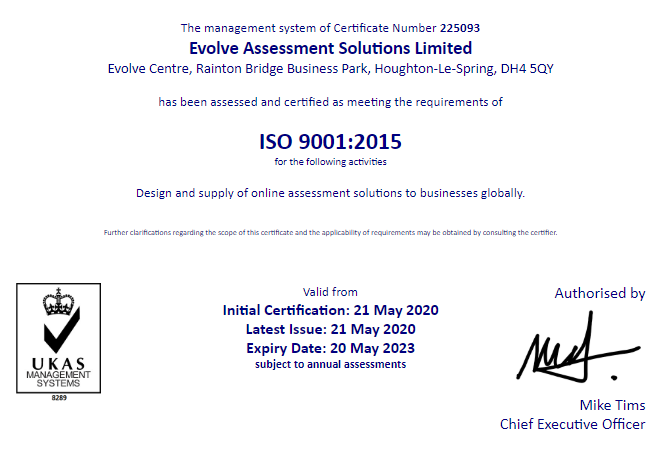
    Evolve is proud to announce that it is now certified as ISO 9001 compliant – an achievement that ensures that our business and its processes meet and exceed the needs of our clients through an effective quality management system.

    How did we achieve this?

    Our ISO 9001 compliancy journey was hard work – but well worth it.

    Our team underwent a comprehensive evaluation process into our current quality management system, including a review of supporting documentation, policies and procedures. This initial diagnostic test was undertaken by an official auditor from the British Assessment Bureau.

    We took the auditor’s feedback and worked hard to fine-tune all of our quality management systems and processes. After that, we were audited officially and passed with no non-conformities. 

    So, what does it mean to be ISO 9001 certified?

    In a nutshell, being ISO 9001 certified means that we have a robust quality management system in place that demonstrates our commitment to providing high-quality products and services to our clients, which is compliant with industry-recognised standards. 

    At the heart of the ISO quality standards are several principles that Evolve follows, to ensure that we remain compliant. These include:

    • Encouraging involvement and knowledge sharing so the team knows exactly what their roles entail and how they fit into our quality management system and beyond.
    • Developing a strong management team that has a clear vision of our future, and the needs and requirements of our clients. 
    • Creating a process-driven culture within the business to ensure we plan, execute and manage our quality systems effectively to ensure complete compliance with the standard.
    • Committing to constant improvement and reacting to opportunities in all areas of the business, not just quality.
    • Making decisions based on facts – not speculation, and making this information readily available to all who require it.
    • Developing great and mutually-beneficial relationships with our suppliers to build successful business strategies that will ultimately benefit our clients.

    Why is it important to us?

    Head baffled by all that jargon? Don’t worry.

    All we want you to know is that we took the feedback from our clients seriously, and reacted to what many were asking for – and that was for us to be ISO 9001 certified. This is why it is important to us.

    It provides our current and new clients with the added assurance that quality and integrity are at the core of our business and everything we do. 

    A job well done

    The business landscape is saturated with negative news, speculation and worry, and our certification is some welcome news in these unique times.

    Our hard work, enthusiasm and positive attitude have enabled us to accomplish this fantastic achievement, and we’re excited to see the positive impact this has for all the team at Evolve moving forward. 

    Want to know more about and how our online assessment solutions can engage your employees or candidates, and maximise your assessment process? Click here to contact us – we’re always available for an informal chat – albeit virtually for now!