The Centre for Health and Disability Assessments (CHDA) is operated by Maximus and is responsible for recruiting and training healthcare professionals.
The Challenge:
CHDA needed an additional stage in the process for recruiting clinical assessor staff, which often entail challenging and complex roles.
CHDA wanted to provide candidates with real-life scenarios of key responsibilities in the roles to provide them with a better understanding of what they were applying for. The team wanted to retain successful candidates by providing better transparency into the difficulties and challenges they could face if they were successful.
The recruitment team also needed to be confident in knowing that the select number of candidates that were brought forward for a formal interview from high volumes of applications were the most suitable for the role in order to make the process quicker and more efficient.
When undertaken manually, this process proved to be highly time-consuming and incredibly laborious. It also relied on human judgement to assess whether applicants were suitable for an interview – and on a large scale, this was not effective.
The Solution:
Evolve partnered up with some of the UK’s top Occupational Psychologists to develop an online situational judgement test (SJT) which would be used to support the recruitment team. This highlighted candidates who demonstrated the best fit for the variety of clinical assessor roles advertised.
SJTs are a type of psychological assessment that asks candidates questions around realistic job scenarios that they could be faced with if they are successful in securing the role. The results from these assessments are then made available to the recruitment team at CHDA who could then make better-informed decisions around the best candidates to invite to an interview.
Evolve and the team of Occupational Psychologists worked closely with CHDA to build a custom SJT that was entirely tailored to its needs. The test included niche questions and examples that were provided by the client and was built on an intuitive and easy-to-use online platform built by Evolve.
The Impact:
The impact was simple. A streamlined, online process for recruitment that easily allowed the team at CHDA to identify candidates that they wanted to advance to an interview with reduced time and resources.
As well as identifying the best candidates, the platform gave candidates a clearer understanding of the role they were applying for and empowered them by giving them the ability to see early on in the process if the role was really suitable for them.
CHDA is now also able to undertake validity studies, which track and monitor correlations and patterns between those candidates who are successful at the SJT and who then go on to excel in the role and the business. The results from these can then build the ideal candidate profile for future recruitment drives.
The mutually beneficial advantages of this SJT project between recruitment team and applicants have transformed the recruitment process for CHDA. SJTs are fast-becoming a popular choice for recruiters in a range of different sectors – specifically those with high volumes of candidates or roles that require additional screening stages to find the best people for the job.
What the client said:
“The custom SJT we now have helps to guide us on a candidate’s suitability based on the answers that are provided within the assessment and, as recruiters, it has made our lives so much easier.”
“If we did not have the SJT in place, we would have had to undertake a highly manual task to find out whether the candidate would be right for the job. It offers us a reliable fail-safe to make sure that we are only taking on candidates who we are truly confident in.”
“The return on investment that we received from this service was significant and the account management from Evolve Assess was excellent.”
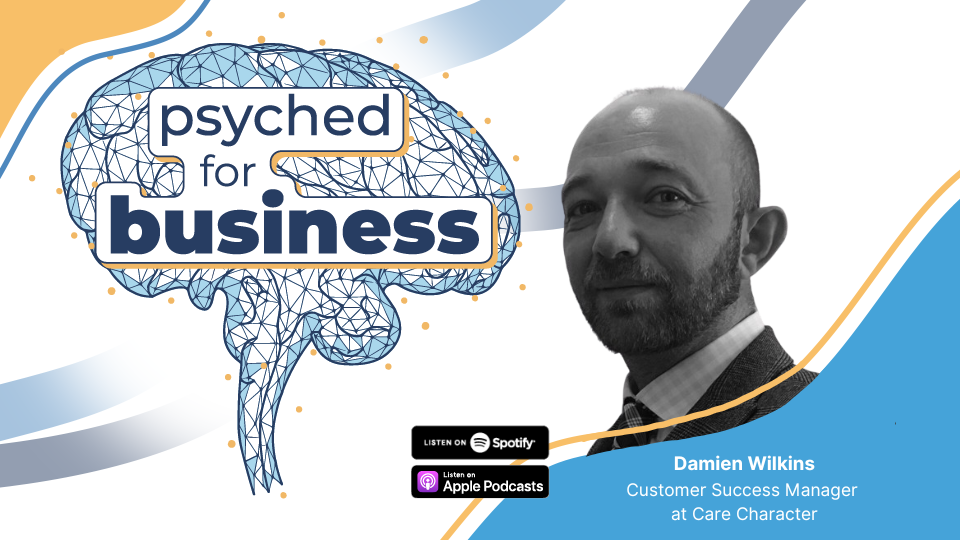
In this episode, we’ll learn more about the Care Character Tool including the traits it assesses, why 7 is the magic number and how it promotes Values-Based Recruitment. We will also delve into why the turnover rate of care staff is three times higher than in any other sector, and the importance of giving applicants developmental feedback.
Subscribe to the podcast on your favourite platform:
Voiceover 0:00 Welcome to Psyched for Business, helping business leaders understand and apply cutting edge business psychology principles in the workplace.
Richard Anderson 0:13 Hi, and welcome to Psyched for Business. My name is Richard Anderson. In today’s episode, I’m joined by Damien Wilkins from Care Character. In the episode Damien shares a ton of knowledge about the care sector, what needs to change in order to ensure that the right stuff are recruited and retained in such vital roles. We also spend a lot of time talking about the Care Character psychometric tool, which has been built specifically for the care sector. I really love recording this podcast with Damien, he’s such a passionate man who genuinely cares about the work that he does. I hope you enjoy listening as much as I did recording. Thanks again. So Damien Wilkins, welcome to Psyched for Business. Thank you for joining me, how’s things?
Damien Wilkins 0:52 Wonderful, very excited to be here. And thank you for having me on a this very cold day.
Richard Anderson 0:57 We were just we were just moaning about that. Before we started recording, I’ve got a I’ve got a gilet on, because on the second of July, it appears to be absolutely freezing outside. But don’t we just love it? British weather which I was on holiday,
Damien Wilkins 1:12 We love to have to have a complaint? Don’t we,
Richard Anderson 1:13 We do we do indeed. Brilliant. Okay. Well, that’s fantastic. I’m really, really appreciate you joining me, I think it’s fair to say that we’ve gotten to know each other probably quite well, certainly over the last probably three, maybe six months, six, maybe even a little bit longer than that. Since we’ve been working together. I think it’s fascinating what you guys are doing at Care Character. And I thought, Well, why not create a podcast and let’s get that rolled out to a few more people who are normal, be interested in the tool itself, what you’ve been up to why it’s been built, all of that sort of stuff. So I thought, well, let’s maybe do a little bit more of a deep dive around the Care Character concept and the tool that you’ve built from the original concept. But I thought, before we maybe get stuck into that particular part, if you’d be happy, maybe just to introduce yourself Damien. And just to give the listeners a little bit of background, kind of who you are and what you do.
Damien Wilkins 2:07 Yeah, absolutely. I think I wear many different hats, how to say the least. And my main priority is bringing Care Character to the sector’s attention. Because it’s it is a new innovative tool that doesn’t, hasn’t hasn’t existed historically, I’m ultimately client success manager. So I’m helping people get the most out of our product, and make sure it’s rolled out. And ultimately, the main thing is making sure people get better care at the end of the day by finding the right people in the beginning of the recruitment process.
Richard Anderson 2:36 Yeah, fantastic. So you mentioned that it hasn’t been around for a great deal of time. So how long has it been around Damien Care Character? And yeah, when was it? When was it originally built? Where did the idea come from? Yeah,
Damien Wilkins 2:48 So it’s a really nice story that goes behind it, actually. So I found out about a company called Cohesion Recruitments, some time ago for somebody that worked in the organization. And, you know, to get that little insight from somewhere in the side, this company is amazing. And at the time, I was a director for a care agency. And there’s a bit of a story that goes behind that. But I felt like a bit of a devil being the guy that was running an agency and I wanted to do the better part, of care. And the time came when it was right for me to change. And I managed to get a job as a business development manager at Cohesion. But I’m super passionate about what to do. And I’m more of these people who are looking for, like 1% gains in a process. You know, it’s not, it’s not about flipping something on its head and completely changing. It’s just some sometimes these little improvements and I was in this period of change coming out of COVID, where I think a lot of people saw business change, people change the way society seemed to change. So I was really on a bit of a crest of a wave with Cohesion, looking at different innovations of process. And that went from writing a job advert and the words you use and how many words you use and how you optimize the advert through to engagement and onboarding of people. So I spent quite a while doing that. But in the background, one of the things that attracted me to Cohesion is the two owners Will and Amanda are absolutely the hardest working CEOs I’ve ever known in my life. But certainly their their commitment to the care sector because they specialize in the care sector. It was above and beyond any, anything I’d ever seen from an organization. So they were trying to find ways to improve things for the sector. And one of the things that we understood was with such high turnover rates and the case that’s about three times higher than the rest of the UK. Something’s not quite right in the way and the type of people we’re attracting. So PhD study was done by Dr. John Barrett, and through wealth connections, more of our CEOs. He is a very good friend of Dr. Steven woods, who’s sorry Professor Steven Woods who’s leading world psychologist to get based on the Ph. D study based on recruitment and selection in the UK. The candidate assessments were designed is a way to effectively understand the people that you’re recruiting the recruitment process, either the right people that have the right values for a role in care. And it was born through Cohesion. And we’re no standalone company, which is absolutely amazing. Fantastic.
Richard Anderson 5:13 Well, it is. It’s tremendously innovative, what what you’ve been doing there for sure. And it’s interesting to hear a bit about the backstory, because you and I have never really kind of gone into that in in any detail. So that that is interesting. So you talked about the care sector? Was it? Did you say three times higher turnover than than any other industry in terms of staff? What were the or the principal? Or what are the principal reasons? Do you suspect for that? Is that is that based on values? Damien, would you say?
Damien Wilkins 5:40 This is the this is the thing, Richard, I am, I’m kind of on a mission, I have been for a few years to really champion values based recruitment. And I was in a webinar the other day, and I said, when I used to, you know, go back three years, and I’d be in a room of people doing a talk and say, can you put your hands up? Who does values based recruitment? And nobody put their hands up? Well, you might get somewhere, you know, very oh. Not too sure. If I should be putting my hand. Yeah. And then you say to people who recruit without experience, and you see a few hands go up and you go, Well, that’s exactly the same thing, you recruiting based on the value, not an experience. Now, when I go and do a talk, you should see the amount of hands that pop up with values based recruitments people are getting it, and most of the care but you know, personally, I’m championing that this is there’s, there’s a massive issue in this sector, as there is in lots of sectors at the moment. But I hate to say it so crudely, but if you boxes don’t get packed in a in a warehouse to get delivered, that’s not critical to someone’s day. But caring for people is absolutely critical. Absolutely. We can’t just think, Oh, we’ve got staff shortages, there’s an absolute complication that follows that. So you know, for me, the passion is that we can only attract more people to our sector, if there aren’t enough people with experience, and we need to find people with the values. So it’s been this ongoing campaign of this is how we’re going to solve this. And Cohesion has always been a values based recruitment company. So just to give you an idea around Cohesion, because quite, quite often word recruitment, and I think you just recruit people and try and effectively sell them to organizations, Cohesion, nothing like that, they will not take over a company’s recruitment process and run it for them. So if you’ve got the care provider and apply for a job, you think you’re dealing with that company, it’s actually Cohesion, giving you all that amazing process and engagement and touch points. So they’ve always championed values based recruitment. But what we then see is organizations can’t translate what they think they’re trying to achieve. So you’ll get a recruiter that goes, Yes, I’ll take anyone with experience and the right values. But then the manager of the service actually just wants someone with experience. So there’s, you know, there’s this breakdown in what’s actually going on in the world. So again, another reason why Care Character was created just to prove that you can take people in without experience to have the right values, and, ultimately, are just more suitable for holding care. And the great things which are, which is, you know, a lot of a lot of employers don’t really understand this is, when you use something like values based recruitment, it’s not just getting more people into organization, you actually find him better people more suited for a role. So people get cared for better, they turn up to work, they’re happier, they align better with things like compassion and empathy, funnily enough to have reduced levels of absenteeism. So, you know, it’s just, it’s just, it’s just this vein of the better way to do things. And there’s also a need and a requirement to do things that way, and Cohesion has been fully committed. And it’s been a joy to be part of that journey.
Richard Anderson 8:24 Yeah, I mean, it’s, it’s really, really interesting. And I have to say, from everything I know about Cohesion, which is a lot more these days than it was kind of six months ago, before we started working together with a fantastic company hugely passionate about values. I know about that. Let’s, let’s maybe take a step, step backwards. Just really quickly, Damien. So what I often do on on these kind of podcasts is probably ask a few silly questions. So I’m going to apologize in advance for that.
Damien Wilkins 8:24 But as long as you don’t mind silly answers, Richard.
Richard Anderson 8:55 I appreciate them, and I welcome them. So I think we’ve talked about values based recruitment. And obviously, you know, I’m very familiar with what you’re talking about, but just just to make no assumptions based on kind of who’s listening, what do we mean, specifically by values based recruitment? And why why is that? Why is that? I know, You’ve touched on it, but why is that kind of an important part of any recruitment process?
Damien Wilkins 9:20 So if you see, we do a lot of focus groups, obviously, what the kind of work we do, having psychometric assessments and delivering a product to people have to constantly engage what’s going on in the market, what are people saying? But we strip it right back. We know that when we do our focus groups that are good care service is driven by culture. We see this time and time again, if the managers got good culture, it just seems to work it seems, has to be led and driven like that. Now, if you haven’t already got that in place, then you probably find your retention rates quite quite low, and people coming in and out the service fail probations all these types of things. So when we started looking at the actual values of people coming into an organization, they’re the beginning foundations of building culture in the right way. Now, I think it’s dead easy to cover an assumption here that a lot of people would have that we’re probably only good for elderly care, or we’re only good for children. So we cover all different types of services, because the values of a person in care are very consistent and aligned. And we see this time after time after time. Yes, there are specialities you know, if you’re gonna look after children versus somebody at the end of life, you’re going to need slightly different skill sets that come along with those skill sets are consistent. And we’ve done a PhD study on these. It wasn’t, we didn’t sit in the pub one day think you know what? No, like, there’s a hell of a lot of validity going into these studies. And what we now start to see is, if you want to improve the culture in your organization, you can’t change the people that are there. You can’t just say to someone, can you just have a different culture on Monday, next week, please, it just doesn’t work like that. And you know, those people already in a culture that you obviously want to change. So the best way you can change culture is by injecting people with the right values and behaviors to support the culture, which supports a service, which supports the people. So you know, I know that sounds really simple right at the end, but it starts with the values. Now, I get to see lots of assessments come through. And we do some interesting dynamic datasets sometimes. And just because someone’s been in care for 10 years doesn’t mean that they’ve got all the right values and care, it could be that they’re the ones that are the ones that always pick up the shifts are the ones that always dealing with a difficult resident. So they appear to be a better carer and not saying that the people shouldn’t do that. But what we’re trying to find is consistent set of people that are consistently providing good quality care to people. And it starts with the values. Yes, and really, really want to stop there, please feel free to ask more questions, because I can just go on and on I’m so passionate about it.
Richard Anderson 11:50 I mean, you’ve put your your passions or, you know, it’s always been palpable, I’ve always kind of noticed that. And I think it’s a fantastic trait to have, I think, what really stood out about what you said there was, you know, it doesn’t matter at what stage you are caring for somebody, whether it’s kind of end of life care, whether it’s caring for young people, or whatever the values are principally principally the same. So and this is presumably across, across across the board Damien this is like, not just be a UK thing, this will be this will be a global thing when we talk about these types of values for anybody in the care sector.
Damien Wilkins 12:23 Yeah, I mean, we have to look at the you know, there may be different slight alignments in different parts of the world in our societies are different the way that people act, the way they see themselves in society. Now, this is different outputs and inputs, if you like, however, I would be very shocked if you went to a different country, and the values of care were significantly different. However, we don’t supply outside of the UK at the moment, that is something we would like to do in the future. Yeah, we’ve we’ve had a few conversations with some people in the States, for example, because we know they’re very closely aligned. However, the majority of our assessments are for people that are already in the UK for domestic recruitment, or people coming from other countries into the UK. So we are very much aligned with what the UK needs, as you know, as a set of care.
Richard Anderson 13:05 Brilliant. Yeah, yeah, that’s really interesting. So so let’s let’s dissect a little bit more around the values that obviously all of this academic research is gone into. And all of this validity we were talking about before, so why don’t you if you’re happy to maybe talk through, you know, a couple of the values or all of the values, if you want the you’ve you’ve established a really important in the care sector. And let’s, let’s do a bit more of a deep dive.
Damien Wilkins 13:29 I’ll give you the magic number Richard? Seven, we never meant for this to happen, okay. So just just to give, you have to share that assessment takes on average, seven minutes to complete. And there are seven traits, which I’ll tell you in a moment. And people that score seven or above are the ones that are offered for a role. So like seven is our magic to be that way. Yeah, but we have seven values that were identified in the PhD study, and, again, was doing a webinar the other day, trying to educate people that their values don’t generally look like the sets of values that appear on our assessments, but they always align, we do what’s called trait mapping. And we look at the values of a client versus the values of character, and you can consistently see alignment. So if someone’s, you know, they’re talking about inclusivity, and respect, the probably don’t use those particularly words of the use of phrase, but for most company values, and we see it consistently, they do align. So our values that were identified in the PhD study, and not in any particular order, some are way more important than others, but they’re all very important in every care setting. Something that’s massively important today, adaptable and resilient. Resilience is something that seems to be disappearing, by the truckload, and inclusivity and respect as well. We’d have to be we have to be inclusive in society. Naturally, compassion and empathy. Believe it or not, the trait that gets scored quite highly is procedural compliance. With then have dutifulness obviously, making sure you do what you’re supposed to be doing teamwork and working well together. But the one that always gets me is communication. Yeah, it’s such a defining trait when we’re talking about care. So, again, we’re talking about finding the right people for the sector. But then the sector is broken down into different kinds of settings, you know, you could be working in a care home, or you can go in and work in in somebody else’s home and everywhere in between. So we quite often find that communication is one of the lower lower scoring traits, because generally caring people aren’t boisterous and buoyant, and you know, going to work wanting to speak to everyone that come into care for people. So generally, you know, they’re not that comfortable, if you like starting new conversations or introducing themselves to people, caring people want to be cared for, funnily enough, yes. But quite often, you know, if somebody and this is the whole point about understanding how an assessment works, and the values based recruitment is the beginning of a much better processes, if you’ve if you’re interviewing someone, and you can see that they’re lower down the trait on communication, and probably not too comfortable having lots of new conversations, and probably shouldn’t be a domiciliary care worker going from one home to another and meeting new and different people. Yeah, on the road. So you found a good carer, but don’t put them in the wrong setting, because they’re not going to enjoy it and are going to leave the care sector, and we’re going to lose someone really valuable again. So let’s understand, do we have a different setting to put them in? If the answer’s no, well, then support them from day one. You say to them, I know you’re probably not comfortable having these conversations. So for the first week, you’re going to sit down with Damien, unfortunately, but he’s going to like all the introductions and take that, you know that that fear of anxiety away from you actually support you, rather than not realize what your situation is. And then in three months time, when you’re leaving us, we discover that you wasn’t, you know, one of those many things that adds up to why somebody would stay or leave. Yeah, it just identifying more about a person and allows you to support them better from day one. And again, I’m just going to say, and I’ll probably get you probably say Damien you said it 10 times now, a massive core theme here that caring people want to be cared for. So if you can find caring people, you bring them into your organization and you reciprocate that care back to them. It’s a massive trigger that people feel so much more valued. isn’t that surprising?
Richard Anderson 16:56 No. Well, yes. Isn’t it just, isn’t it? Yeah, no, you’re absolutely right. It’s really, really interesting stuff. So I mean, when we talk and you’ve taught, obviously talked to through the values, and I bet you didn’t read them out, but you know them off the top of your head by now.
Damien Wilkins 17:11 Do you know what I always seems to forget dutifulness for some reason, which is really bad, because it’s dutifulness.
Richard Anderson 17:17 The irony? Excellent. So, so you talked as well. And what I find really, really interesting is, I know how much research in academia has gone into underpinning the tool and the validity side of things. I think it’s fantastic that you’ve managed to build it around the seven values and still managed to keep it short. And engaging your talk that it takes on average kind of seven minutes to, to complete. So, you know, obviously, I know the answer to this. But for the for the listeners, how has it been? How has it been built in the sense that you you get a number of questions, presumably, that sit within each value that people will sit as part of that recruitment process?
Damien Wilkins 18:07 I wouldn’t say it’s quite as you will certainly wouldn’t identify during the assessment like that what happens is, as a candidate is is quite surprising, because we we come from the recruitment world, we know that any part of the process that isn’t engaging is disengaging. So you’re either warming somebody up, or you’re cooling them down in the process. Yeah. So one of the biggest concerns that people always say to us is does this turn candidates off? Well, no, it actually enhances candidates. And I’m gonna go off on one again, here, but our clients are screened people out 30 to 40% of the candidates do not complete the assessment. But they’re the same candidates that wouldn’t engage with the new process anyway. But you spend a lot of time and resource trying to engage send an email sending texts, putting phone calls in. And what this actually does is you could candidates come straight to the front of the process to take the assessment, the demonstrating that they’re good at the role, the demonstrating they’ve got the right values, and you engage with them, and they engage with you. And it sounds super simple. But you’ve also got to remember that Cohesion is a bunch of amazing people in the recruitment world that get candidate engagement. Professor Steven Wood’s designed the assessment to be easy to read. Yeah, I have this issue around marketing that, you know, we provide psychometric assessments, the candidate assessments, and then we know that sometimes people are going, but do I need to be trained to use the not at all the super simple to use. One report just goes to the candidate, you know, that’s going to a load of people that applying for jobs has to be dead simple and easy to use. Recruiters have a lot to do, and giving them something extra to do that is of no value, absolutely not going to be taken well, so it has to have value in it. And one of the biggest things we always get feedback is your reports are so easy to use and to understand, but it shouldn’t be it’s not we’re not going to create rocket science here. We’re trying to create an additional tool that helps you make better hiring decisions in your process.
Richard Anderson 19:49 Yeah no, I mean, it’s a really really good point because I think that you know, some of the, of course, you know, depending on the use case, there is obviously need and requirement in certain industries for certain use cases to have really lengthy reports that you need to have qualifications in or certifications in in order to administer. But I completely hear you on that one. And, you know, I remember when we started, Evolve up, and a lot of a lot of the pushback that we had when we were trying to sell well, in our case assessment technology. But in general, it was concerns of recruiters not wanting to put another another hurdle in place, as you’ve just said, and I think if you can make sure that it’s engaging, but your argument, there’s a really good one in the sense that if people can’t be bothered to sit a seven minutes assessment, are they really going to be the right the right person for for this particular role? So that’s really, really interesting. So in terms of the reports been easy to digest, I know that you’ve developed because I’ve been fairly close to the project. Of course, I know that you’ve developed a number of different reports for different applications, if you like, Would you mind just talking through those in a little little more detail, Damien, so essentially, what what your clients or your partners that you work with, who use the Care Character tool, what they get in terms of report and how they are typically used?
Damien Wilkins 21:09 Yeah so the moment the only live product we’ve got this is for frontline care stuff. But what we are currently working on and again, there’s a lot of validity goes into these things, and we’re gonna flip them around in a month or two. Now, of course, the current project we work on is the registered managers assessment, because we also understand that one of the biggest factors that can be changed is new starters, having meaningful and valuable conversations with the manager in the first four to eight weeks, which we would all think was pretty standard in any job anywhere your role, but managers are very stretched. And I don’t always have the time to do that. So creating the kinds of assessments super good to get people into business. But if the managers aren’t doing the right things with those new starters, then it’s not going to be as effective as you’d like it to be. So the next thing we’re working on is the managers assessment. So we’ve been holding focus groups for that recently. We’re hoping to release that in the next few months. So that’s the next one. And we’ve now been asked for assessments such as for nurses, and for senior management within organizations. So what’s the what this is starting to, you know, our clients are basically saying this is working really well here. But it hasn’t solved with the recruitment areas, because it is not applicable there. So these are the new tools that we’re starting to develop for the sector, we do have a few clients that use our assessments across the board for recruitment, whether it’s a senior manager coming to the organization, or it could be someone in the kitchen staff, it could be somebody in housekeeping, because the way this organization sees is you’re in a care company, we want you to be a caring person, and you probably still will interact some way with residents. So they don’t use it necessarily to say, Have you got the skills for the job, but do you align with the values that we need as an organization, so it is still quite dynamic on that basis. But we want to be nice to think that if we give you a tool, you want to get something super valuable out of it, benefit your organizations. But what we found really interesting during the focus groups, I think is interesting for people to hear is when somebody new comes into a business in most roles, whether that’s entry level or senior level, as you get on boarded into the organization, there’s a whole podcast around on boarding. But, you know, you assume that the company is your business, and you need to get more support that you need. Obviously, having assessments helps you to identify what support the need even. But what the big thing that consistently came up is people get promoted from a role into managers roles, with the assumption that we’re going to be, okay. And the, if you like, the onboarding disappears, because it’s obviously it’s been promoted, you can do the job. So people are promoting. So you end up with accidental managers, people eventually going to roll just because they were good at the previous role. And they may be good for the role. But if they haven’t been given that support early on it, and then you’re kind of setting them up for failure, and they get in assessments just help you to understand what’s going on with your person, what strengths in areas of development that support them. That’s what they’re there for setting people up for success.
Richard Anderson 24:03 Yeah it is. And I’ve seen that sort of thing happen, almost the world over and one of the specific examples, it’s outside of the care sector. But the reason I’m mentioning this is because it just struck a chord in my brain, it’s when, you know, when you’ve got that fantastic top performer in the sales team that does, you know, brilliantly every single month, and eventually they become the sales manager never had any experience brilliant salesperson, potentially an awful sales manager, because not probably because they haven’t got the chip because they haven’t had that level of support. And just assume because somebody’s doing, you know, however much per quarter on top of the you know, on top of target, then they’re going to be a great manager is not always the case. So when you’re talking about that in the care sector, it’s 100%. resonates, it’s interesting that it obviously occurs occurs there there to one of the things I’m interested in and I don’t know whether you’ve got an answer to this to me, but I’ll ask it anywhay. And have you seen anything in terms of trends because presumably you’re had a number of completions of the Care Character tool now? Well, I know you have. Have you done any kind of analysis? Or is that something that’s to come around? You know, what, are there any typical trends where, you know, a lot of people seem to do better on certain values than others, there’s maybe value values gaps in expression for those sorts of things. Have you ever done any looking at that type of thing just yet? Do we need to get better at certain things, as you know, as people within the care sector?
Damien Wilkins 25:30 Yes, one of the, you know, the ultimate thing that we’re trying to achieve here is people turn up to do role in care and do the job better and stay in organizations longer. That’s the ultimate thing that we’re trying to achieve. Yeah, for us, one of our difficulties is getting retention data, because companies don’t really want to share retention data, especially when it’s as bad as it is. Now company, no company is going to turn around and go, Oh, our turnover is X, Y, and Z and then and then and then tell you that they’ve got a 5% improvement, but it’s still only at 25%. So it’s very difficult to collect that data. So one of the projects that we’re we’re actually currently in the process of reaching out to some clients at the moment to do a project where we’re actually stitching in the whole process with our exit retention, and the K character assessments. So you get to see the fuller, bigger dataset as well. One of the things that we do see is, if you’ve got a service, for example, in looking after children services with challenging behavior, you know, the thing that people are looking for there is being adaptable and resilient. Absolutely. Time and time again. And I think I’ve touched on this earlier that, you know, resilience and adaptability in society seems to be dwindling away. So you know, when we’re dealing with very challenging circumstances, and people need lots of support, it’s very good to identify these things that are beginning of a process, again, for palliative care, compassion, and empathy is very high on the scale, I think, to answer your question is people make better decisions, and they don’t always identify the great result. But what they do see is less bad results. So, you know, we, we employed someone and we sat in a room with somebody in the you know, the last moments of the life and then that take a week off work, because they were struggling mentally as well. Well, have you put the person in the right set into to support them that, you know, it’s all about these making better decisions to get rid of less bad decisions effectively.
Richard Anderson 27:22 So just to go back to one of the things that you mentioned before Damien that really resonated with me, and obviously I said it at the time was was trying to educate people that you’re not putting another unnecessary step in the recruitment process that this is adding a huge amount of value. And obviously, I know that you’ve been doing a really good job on that with some of the new clients that you’ve brought on board and, and all that sort of stuff. But from those people who have been using the Care Character tool, today, what sort of what sort of general feedback are you? Are you are you getting? And because obviously, it is, although you’re not putting another step or an unnecessary hurdle in the recruitment process, it’s going to be different for them if they’ve not been assessing before for value. So what How’s how’s it going down in general?
Damien Wilkins 28:07 It’s an it’s really strange that sometimes the feedback you get is not what you expect, and it’s really negative, that’s actually really positive. So yeah, because it’s quite a dynamic to it, you know, in its most basic form, it’s, it’s people take an assessment in your recruitment process, score, the right score, and above, you’re going to engage with them. But what it actually does is, is gives a massive efficiency in the recruitment process, because, you know, when this clickbait world, where, I don’t know, I’m going to give it away a little bit here, but I remember when I applied for jobs, I used to have to write a cover letter. I’d write it you know, my application would go in in first chapter and verse what color socks we wearing last week? Absolutely everything. Now, it’s, you know, you’re signing up on Indeed, you can look at a job, which I’ll click on, apply for a job, click apply for another job. And there’s a massive danger that comes with that. And I think we’re all seeing that. And at the moment, lots of companies are seeing really high application numbers, because it is so accessible. And the problem is, if you don’t click click, click on jobs. And then the first thing you get sent is an application form to fill out, or you’re not going to engage at all, absolutely disengaged straightaway. So, you know, the whole idea is what, what’s in it for the candidate. We do all these wonderful things about these processes. We have applicant tracking systems, we have different ways of engaging different communications. What was the candidate actually getting out of it? And I don’t think quite often people look at it from the other side. They think, all we know people love to read this, what do they know and actually read it and they won’t give you any feedback. They didn’t really engage in anything better. Well, we’ll put another there’s so much investment of understanding what’s going on in the world that I think a lot of people miss. So for us, one of the biggest things we give the candidate a report back so the candidate gets a chance to reflect on their suit ability firstly, and prepare for the interview. So you’re actually giving them something. I know that sounds really bad. But most recruitment processes are just giving you hoops to jump through, and nuggets of information that you probably don’t really care about, then all of a sudden you do this assessment, and you’ve got, I’ve got something about myself, yeah, candidates are kind of going, I never knew that about myself, or I didn’t realize that there was a value that was you know, around inclusivity, and respect, but now we can see it and read it and reflect on it, I can now do something about it. So you get this self fulfilling prophecy of improvements? And then me and you’d be terrible to each other, like, what have you scored on communications? If you’ve got this, right, I’m having a seven. So you know, there’s this kind of thing that happens in the workplace. But what what some of our customers do is, you know, the, the one I love the most is we recruited someone that we would never have recruited before, because the application form or give us experience, they hadn’t got any. And now we’ve just employed an amazing worker. And we’ve got great feedback about them that would never have got this job with
Richard Anderson 30:56 Yeah, without without the assessment.
Damien Wilkins 30:57 I love reducing bias, we’re looking at numbers, we’re not looking at a CV, we’re not looking at experience, I’m looking at a number and assessment and starting with decision making on did they align well enough with their values. So seeing those kinds of things, I think is so powerful, but one of the reports that we create is the actual development report. So we know that it sounds really bad, but it’s actually good that you new starters in care generally want personalized learning and development above and beyond what we call manager training in the sector, which another training you have to do. They also want to train themselves personally, and this isn’t necessary to be promoted. Sometimes people want to become just better carers or specialists for, for example, dementia. So what we what we’re actually doing at the beginning of this onboarding process, give a report that still based on that initial seven minute assessment. And still based on those seven traits goes, here’s a learning and development plan based around these particular traits, which is based on using individual. And it gets the managers to sit down at weeks, four weeks, eight trigger points that candidates want. caring people want to be cared for, it’s just showing that demonstration of this is the organization values, here’s our culture, funnily enough, we’re going round in circles. It allows you to plug say, also onboard people better and give them the support from day one. So this is my point, when we you know, we get things where people go, we improve proficiency at 30% of the front end of the process, and we’ve got reduce failed probations. That’s all great. But for me, the magic is when we see these other benefits that come out of a recruiting, somebody’s never recruited No, got a career in care that’s going to go home. And God, you know what, this is amazing. I love the sector and start promoting assets to other people, because they had a great experience.
Richard Anderson 32:36 Yeah, for sure. I couldn’t agree with that more, I think that’s, that’s a really vital part of the process is recruiting somebody who would have never got a job historically, because the process was different processes changing significantly, you know, across the recruitment space of that of that, I’m sure. But what I really love it, as well as the fact that you know, the making huge differences to organizations is, is the path for the candidate to so you talked about getting the report, we’ve all sat psychometrics in the past, where you press submit, and then your results go into the abyss, you might never hear from the business again, you don’t know how you’ve performed or anything. And it’s just not a nice process for the candidate. It’s disengaging, it’s all that sort of stuff. And I think, you know, when you when you see your report, and it really resonates, there’s nothing better than that. Because even if you’re not to get the job, then you’ve got something tangible you’ve got so Oh, actually this organization implemented this part of the process. And it you know, I’ve come out with their thing, and well, actually, they’re a great organization, they’ve given me they’ve given me this. So I think after winning, so
Damien Wilkins 33:36 Sorry just to interrupt it’s just like, it’s where do you go for, I don’t know, let’s just say and anyone that’s listening now decides not want to go and try something different in my career, Grant, go for it scary as that is. But let’s say you wasn’t successful, is that you don’t then, you know, if I want to become a chef, let’s say I’m definitely not going to become a chef. That right. But let’s say I wanted to become a chef. And I don’t get the job, what I just go hungry, I didn’t get the job. If someone gave me a report going, you didn’t get the job. We don’t say you didn’t get the job. Obviously, these are the areas where you need to improve. I want to become a chef, I can go away and try and improve myself. Yeah. Without that. It’s just it wasn’t engineers. It’s just what was the benefit young people something but you know, we’re in the care sector, we should be showing ourselves as caring anyway. So give me a little bit about where we want more people to come into the sector. So if someone wasn’t quite right for us now. Let them try and work on that and then come back and get a job and be great at being cared we want that was people Yeah.
Richard Anderson 34:33 No Damien, you go off on one as much as much as you like, that’s not a problem at all. No, but you’re absolutely you’re absolutely right in what you’re saying. So, obviously, you mentioned right at the beginning the weather but your big part of your job is eulogizing, of course about Care Character, but about kind of what’s gone into Care Character and what it’s for and solving problems for people now. Do you suspect that over the next I don’t know, let’s say a year, two years, five years, whatever it might be that there’s going to be a lot more values based recruitment within the care sector, because obviously, from what you’re telling me that that’s the bit that seems to work for. For most most organizations within recruitment, do you think we’re going to see more of that across the board, whether that’s using Care Character, and hopefully the majority of people by that point will be but, you know, just in general, do you think that’s going to formulate part, you know, big part of the process?
Damien Wilkins 35:28 There is? I don’t know the other answer. If we don’t do it, Richard. I’m not going to start squirting statistics out. But we’re, you know, there are hundreds of 1000s of jobs needed to be filled in the sector. The scary news is less people are receiving care now than there was five or six years ago, which most people can’t even get the head around. The only way that we can support the growth of the sector is by getting more people into the sector that don’t have experience. Yeah, you know, for me, that just encompasses values based recruitment. Now, I do have scary moments when I speak to companies and scares the living daylights out of me when someone goes, if they can walk and talk, I’ll take them. Oh, my God, whoa, whoa, whoa, don’t use our assessments, then because they’re not going to help you.
Richard Anderson 36:18 It’s worrying that and alarming.
Damien Wilkins 36:20 But what you also get there is you get panic recruiting. And we’ve, we’ve gained from our focus groups to get real, you know, if you’re sat down in a room and have the conversation, you probably come to the same assumption anyway. But when you hear it resonating is how do people today make a decision in the recruitment process? We just call it the mum question, which of these personnel can have to your mum, the person you’re interviewing now? And if in your head, you’re thinking, Yeah, I’d have you look after my mum. And that’s kind of your decision based on other things, safeguarding relevant things. But ultimately, how am I making this decision, and it comes down to gut feeling of gut instinct. And then we have the discussion molecule 10 of the best recruiters in the world, whichever sector it is, and you gave them the same profile, the same job to fill, the company will have slightly different gut reactions and instincts as to the person that they’re interviewing. So what are we actually doing in the care sector of recruiting, we kind of make taking massive guesses and gains. And I’ve been recruiting the sector for many years, no one’s ever come and actually worked out how good I am at recruiting the right people, they’ll just go, we need this many people this month. So we give him a gauge a tool. And it might be a really bad analogy. But if you’re driving down the road, in your car, you’ve got a speed or you probably don’t speed, because you’ve got a gauge, you can keep looking at it and just checking decision, you take that speedo the way, it’s a very risky journey you’re about, you’re probably not going to break the speed limit because you’re aware of your decision. But you need a gauge to help you go when making the right decisions. But then you take it a step further on Chrome and what your question was, which because again, I’m going off.
Richard Anderson 37:54 It’s essentially just talking about the kind of the future of the care sector and recruitment, generally, they mean, but you’re not going off on.
Damien Wilkins 38:02 So the point is, we’ve got to find more people. Absolutely. Now, I am just going to champion the assessments here a bit because my if I got to the end of my days, and I’ve got to achieve one thing this would be it could be doing could UK campaign across the UK. And the government just said, you can jump on a website, you can take an assessment. And if you score whatever the score is, in this instance, as a seven, that then you know, you’re suitable for a role in care highly suitable for rolling care how many people out there out there that might go, Oh, I didn’t realize I could do that job. And all of a sudden, we’ve got loads more people applying for roles in our sector because they realize that they can be good carers, think about all the mums that have cared all their life and their families are the best people we could ever want to come to the care sector. But they might not realize that they’re actually really good carriers. So how, you know, we really need to promote more to children in schools that this is a sector. And there are brilliant opportunities to develop yourself as an individual professionally, personally, you’re making a difference to people’s lives. But you know, the Science, Tech, manufacturing industries, they’re the ones out there out there promoting their sector for being wonderful. We’ve got a massive job ahead of us, we need to work together as a sector. It’s such a big job for us to do it there. And you know, these tools just help you get it. right first time really,
Richard Anderson 39:27 I’ve got no question that that’s the case. And I have to say, Damian, as well as a little compliment here, but I’ve never heard somebody speak so passionately. I think I think every about of these still so I mean, but you know, it’s clear how passionate you are. It’s clear that it’s making a difference. And it’s, you know, it’s clear that you know, we need to get as many people using this as we as we possibly can always obviously, that’s a big part of your job, of course.
Damien Wilkins 39:53 Let’s just touch on that. I think it’s really important to understand, oh this guy is passionate You know, or is it fake? Or is it whatever, there’s a reason why I’m passionate. And I’m not going to go off on this one. But I was in foster care for 15 years of my life, and it wasn’t a great time. Then, I’m lucky, I met my wife that I’ve been with for 20 years. Otherwise, I don’t know what would happen to me, but she could put me on the straight and narrow. And unfortunately, her mom became very ill, and then ended up having her leg amputated. And we basically turned our front room into like a hospital room, and some of the care that I personally experienced. And I witnessed my mother in law experiencing acceptable to the overwhelmingly sick to my stomach about what was happening with the care sector, very much disenfranchised. So unfortunately, my mom passed away, let’s a time came around. We’re like, what, what we’re doing myself my career Well, someone that used to work for me reached out and said, Why don’t you want to work for my agency? And I went, I absolutely am done with the care sector. And what I’ve seen, and they’ve got me didn’t know they couldn’t make a difference. And, and it was like, you’ve got you’ve absolutely, you’ve just done me. Yeah, they used to sell for me, so obviously did a good job in training, it seemed to me. And so I went to work for the agency and ended up running the agency by the time I left. And the most amazing thing I saw happen, and we have many success stories. But I live in Lincolnshire, it’s a very rural county. So we have the added problem that you do have to drive because there’s nowhere that’s transportable by bus routes. So there’s an added issue in the whole recruitment process that even if you have got people that want to do the job, you’ve also got to be able to drive, you got to be able to cover shifts in different locations. So it was a huge challenge. And one of the things that we were doing was creating carers. And the council kind of helped with this a little bit because we did an induction to care program. So we’d bring people in values based recruitment, people that want to do care, but have no experience. And then we train them for two to three weeks with a fully registered nurse that will do the training, given the care certificate, and then send them out. Now we made a huge mistake. When we first started doing this, trying to be an honest business, you say to people, these guys have got no experience. So can you make sure you support them in the first few days? I can totally understand like a care company going, I don’t want someone with that experience. But then we used to get really good feedback. Yeah. So then eventually, the time came when you’d stop saying there were new people, and you just get great feedback, because we were molding people to be the carriers that we wanted them to be. So that began, my passion began there when I’m watching, hate someone and turn them into someone amazing. And then someone’s care improves, and all of a sudden revenue, happier into the day in the life has changed for the better. And it all started with finding the right people. So every day I wake up, I’m on this mission to have seen or felt it have achieved it. And I want everyone else to have a piece of that as well. Yeah. So that’s why the passion is there. Because I’ve seen the difference it makes.
Richard Anderson 42:51 Well that’s it you’ve had you’ve had your personal experience that you’ve talked through, you’ve seen the difference it makes for other people. So I think it’s it’s absolutely fantastic. What you’re doing Damien genuinely is, but I want to give you the opportunity, just just to kind of wrap up the podcast just to give anybody I don’t know how you want to do it, if you want us to, to kind of link your LinkedIn profile, maybe as part of the blog. This goes on, but if anybody is interested in how do they, how do they get in touch with you to talk in more detail about Care Character?
Damien Wilkins 43:20 Well I think first and foremost, we’re here to talk, recruitment, anything we can do to help people have a better day recruiting my people anyway, you don’t have to buy our products, you know, we want to help the sector anyway. But you know, it’s a waste what I’m saying if anyone’s a virtual cup of tea, talk about values, talk about onboarding, talk about writing adverts, more than happy to do that. But it’s dead simple with that. Our systems are dead easy to utilize. They’re not complicated, happy to give people pilots and free credits to trial. You know, don’t don’t take our word for it, try it for yourselves. See how it works. In reality, our website is www.carecharacter.com . You can go on there, you can book a demo, if you want. You can drop me an email. I’m damien.wilkins@carecharacter.com . Feel free to reach out. Our team are here to make your life easier at the end of the day. So even if your recruitment’s going great, I can probably I’ll be getting it a little bit better. So reach out, there’s nothing to lose.
Richard Anderson 44:13 Fantastic. Well, well, like I say, yeah, we’ll put all those links that you talked through and your email address as part of the blog post that this sits on Damien and I suspect it will be next week, which will be the kind of week beginning ninth, I think or eighth of July, this will go out. Yes, let’s Yeah, let’s hope so. But listen, I really, really appreciate you making the time I’ve thoroughly enjoyed the conversation, as I always do when we get together and chat. But obviously we’ve never done it in this type of arena before but it was really interesting because I’ve learned a huge amount over the last kind of 40 minutes or so. thanks for making the time Damien and yeah, really appreciate it.
Damien Wilkins 44:52 Thanks for having me. It’s been a pleasure.
Voiceover 44:55 Thanks for listening to Psyched for Business for shownotes resources and more visit evolveassess.com
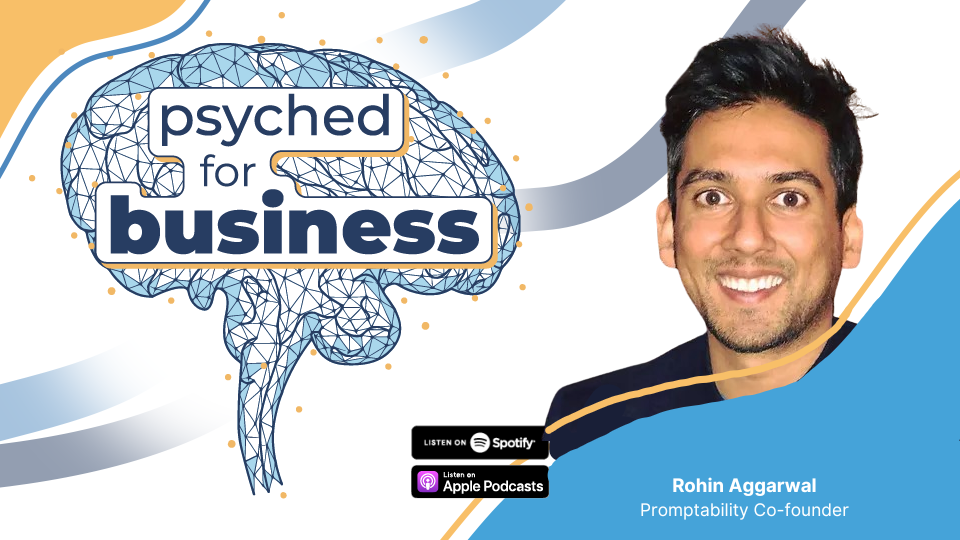
In this episode, we’ll learn more about how to write prompts to get the best results from generative AI tools plus, the importance of practising prompt-writing skills. We will also delve into the inspiration behind the Promptability tool, and who it is most suitable for.
Subscribe to the podcast on your favourite platform:
Voiceover 0:00 Welcome to Psyched for Business, helping business leaders understand and apply cutting edge business psychology principles in the workplace.
Richard Anderson 0:13 Hi, and welcome to Psyched for Business. I’m Richard Anderson. In today’s episode, I’m joined by Rohin Aggarwal, founder at Promptability. In our discussion, we talked about all things generative AI, what we already know, the direction of travel, and the importance of being able to use AI to perform at the highest level in the workplace. Thanks again for listening. I hope you enjoy the episode
Rohin Welcome to Psyched for business. Thanks for joining me, how are you doing?
Rohin Aggarwal 0:41 Yeah, good. Thanks, Rich. How are you?
Richard Anderson 0:43 I’m very well, thanks. And I’m delighted, I have to say to have you on, I feel like I’ve gotten to know you fairly well, over the last couple of months. And we’ve been doing lots of work together. And Promptability is a really exciting tool. It’s a really exciting concept. I’m really keen as part of this podcast to get into the the nitty gritty and how you started that and why you started it and all of that sort of stuff. And we’ll go into that in a second. Rohin. But would you mind just really quickly, maybe introducing yourself kind of who you are, what you do? Maybe a little bit about your background?
Rohin Aggarwal 1:14 Yeah, sure. Yeah. And again, thanks for having me on Rich. So my background broadly is in education skills and employment. And I’ve come at it more from a strategy and a tech point of view. So over the years, kind of I used to be a management consultant and worked in finance for a bit. And since then I haven’t had kind of a real job, you could say, for nearly a decade. And I started off with a careers tech platform called ThinkSMART, which where we could be, it’s actually very relevant to what we’re going to go on to, but we crowdsource problems from people in different jobs, got them to solve them, and then help them to figure out what path might be for them, whether they’re kind of 16 or 64, then, because of COVID, actually, that kind of online learning landscape really accelerated as you can imagine. So I ended up doing a lot of advisory work for clients, in loads of different areas, from anywhere from online high schools, to online degree programs to online products that might help the unemployed get back to work. So that that’s been really the core of my background over the last kind of six, seven years is strategy in tech products in this landscape. And then yeah, we can come on to what kind of, you know what maybe inspired the next step. So now at the moment, it’s a balance between what we’re going to come on to and still some advisory work with those clients.
Richard Anderson 2:27 Brilliant, brilliant. It’s really, really interesting, interesting background there. So Promptability is the late I’m guessing is the latest tool, unless there’s anything unless there’s anything that you haven’t told me, not yet. Not yet. But we’re just looking on your website here. Rohin. So what we do our mission of Promptability is to understand and improve people’s use of generative AI, such as chat GPT, and Bard for the benefit of the organizations that they’re they work for. Tell me a little bit more about that. And maybe, let’s assume that the listeners might not know what generative AI is, they may not have a great deal of experience or knowledge with Chat GPT. Although it is ubiquitous, everybody’s talking about it these days. But let’s make no assumption. So tell me a little bit more about kind of what inspired Promptability and a little bit more about what you do.
Rohin Aggarwal 3:16 Yeah, of course. Thanks, the so the initial inspiration was when I’d worked in the data science market a little bit looking at training companies that help people upskill in data science. Similar thing that was kind of the trend, the hype cycle for a while was everyone was talking about it. And I was looking at it thinking well organizations chief execs, senior people, they hear these buzzwords, but they’re thinking, how do you actually make this practical before I start investing loads of money and tools or loads of money and training and so on. And I thought at the time, there wasn’t really a quick diagnostic or assessment in data science, I don’t think there is still even now but I kind of had that in the back of my mind when this chat GPT hype was kind of going and I was very lucky to get a bit of a head start on it with a company I was involved with, called Auto Gen AI where the founders there have made amazing strides in helping people to better write bids and proposals using this technology. So the technology itself, essentially is like having a personal assistant. Next to you, it’s got the world’s kind of published work at your fingertips. And it predicts you ask a question, and it will then go to that library and predict the best fit words essentially, based on your question. So it’s not as really important. It’s not Google. People have to always remember, it comes up with text that is very convincing that a human could have written it. But that text is not sourced directly from any material. It’s almost like an art or a brain that’s coming up with a plausible set of words based on what you’ve put into it. So it’s a very, so you could you could actually chat to this for quite a long time. And the danger is you kind of It looks very, very real. And so with with this curve, hype curve, you’re seeing all the business press and like you said, it’s kind of you feel like it’s everywhere. But actually, if you’re a business person responsible for a team or companies, I think he’s still thinking and lots of the surveys, just insane. Where do we start?
And that was, again, where I went, and we can come on to sort of, I don’t have the expertise of business psychology but but then he you know, very well, my business partner on this was someone I said, Look, if this is the problem to solve, could we become one of the first in the industry to produce kind of a low stakes assessment to help people understand where to even start? Yeah.
Richard Anderson 5:40 And and, and when you had those conversations with Ben, were you thinking of using, you know, the this tool or this idea that was obviously embryonic at the time? Were you thinking about using that with existing employees and organizations? Or were you thinking of people to recruit based on based on these types of tools? Or what was kind of your mindset at the time?
Rohin Aggarwal 6:05 Yeah, we I think the target is existing or was existing employee. So from what I understand, and again, the psychologists will have kind of a better answer on this maybe, but the burden and unsure actually with your work, which you’ll see you’ll see this as the burden of the validation and what you have to go through if it’s in a recruitment context. It’s very different to a kind of national development context. And I think that’s where we were. We don’t all set things in this industry in generativity are changing every day. So people may have seen the videos of like, first there’s chat GPT, then there’s stuff that’s able to create videos for you and Google have brought out something called Gemini. So we were thinking, it’s probably not fair or right, at this stage to make it a recruitment test, although we are hearing from clients actually, is that possible? The first step was, a lot of people are worried a lot of people actually scared about it. A lot of people feel quite pressured into starting to use it, how can we help enable them to use it? And that was where exactly to your point, it was about existing employees? And then helping them to figure out what training and what steps to take to get them upskilled.
Richard Anderson 7:12 Yeah, because as you say, I mean, it’s incredible. The types of things that you can do with it, there was a colleague of mine Will, who, who first brought Chuck GPT, to our offices, whenever it was, whenever the kind of launch was kind of middle early part of of last year. And he was saying they could do really cool things that can write poetry like that they can do doctors Seuss and all of this sort of stuff. And he was showing off to the office. And I think at the time, there was a tremendous amount of concern, I think, among among the staff internally, and as I understand that that’s probably shared across across the board, or certainly was shared across the board. These tools Rohin, in your view, are there? Are they’re there to enhance or support us in a work context or replace us or so have you got any views on that side of things?
Rohin Aggarwal 8:02 Yeah, that’s a really good question, because you got the Sci Fi angle haven’t you. And that where we sort of think the bots are taking over. My view of the technology as it is today is that it’s like, it’s kind of gives you a bit of a superpower that if you use it right, and you use it well, it should help you do your job better, quicker, hopefully increase your quality of life, because a lot of the mundane tasks, where employees, I’m sure some of your employees may say the same way think it’s quite repetitive, or they’re stuck for ideas, and so on. That’s where it can help really nicely. And without the clients, we have the conversation we’re having increasingly it’s not that this is going to take your job, somebody who uses this better than you, or really takes the time to become fluent, may well look more attractive to employers and do their job better. You know, the statistic we’re still gonna have to see how this plays out. But I My gut feeling is you’d be kind of going into the into the job with one arm tied behind your back. It’s a bit like sort of saying, I’m not going to use Google, I’m not going to use the iPhone, if you believe this is a fundamental technology shift. And I think, which is that that would be my view is that you’re in danger of maybe losing out to in the labor market, or don’t see yet. I think it’s that classic thing of where people overestimate maybe the short term, but underestimate. Maybe like the five year stretch. If we had this conversation in 5/10 years, maybe it’s slightly different. And you know, maybe electric cars are a good example of actually how many cars are driving on their own round the streets that may not. You know, that’s mainly and there’s some analogies there maybe.
Richard Anderson 9:44 Yes, so you were talking about Rohin and people using it or people potentially using it better than you and I think that’s a really, really crucial point. Because you get out with these things, what you put in so tell me about a GPT and what we’re talking with ChatGPT as an example for the listeners. Because I’ve certainly noticed firsthand if you give it or prompt it with a bit of a wishy washy prompt message, you know, give me X, Y and Z, you’re probably going to get some stock. Yeah, response. It’ll be good to a point. But it might not be what you’re exactly looking for at that time. So it’s really, really crucial how you prompt these tools, how you ask the questions, and how you give it the information that it needs in order to get back what you need. That’s a that’s a key part of this, isn’t it?
Rohin Aggarwal 10:34 Yeah, it’s a great point. And actually, as he was describing this, I was thinking in the day to day workplace, before chat, GPT, and so on, if you sent a poorly constructed email to someone in your team, there wasn’t, they probably have the right to come back to you and say, like, you know, Rich, that wasn’t very clear. I really don’t know what you’re what you’re wanting from me, was kind of analogies a little bit like the Chatbot. You got to is the same thing. If you put a poor instruction in or poorly worded prompt, it’s going to do the best it can a bit like on of your employees, but you shouldn’t expect it to kind of have the 100% answer. And I think, yeah, the last pillar of the prompts ability assessment, when we looked at it, you know, in order to come up with the assessment, we interviewed experts to research as to what is important in order to prompt well, is about that prepare, review, you know, make sure you do the right steps and take more time at the start. That will save you time afterwards. And I think that’s if you prompt badly, it could actually be counterproductive. Yes, longer you get frustrated with it. So exactly. You’ve got you know, adding examples, adding context, all these things are features of a good prompt writer. And actually, if you go back to the email, probably not a bad analogy. If somebody sent me an email with that was really clear. You know, phrased well, maybe with example, maybe with context, you probably can understand it better.
Richard Anderson 11:57 Yeah, well, you are absolutely. And I like that analogy. I think it’s a really, really good one. And I was I was just thinking to myself, when I started using chat GPT, which I use multiple times a day. Now I have to say it just makes my life. Tremendous amount easier. Work wise, even things like just to digress slightly even things like you know, blog writing and support, maybe with LinkedIn posts and little things like that. I remember once there was a colleague of mine a couple of years ago, who had written a brilliant blog and brilliant article, but was struggling for ages on a conclusion of that it sounds so simple a conclusion. But trying to conclude the article and trying to give some really interesting next steps. These days, if you put a decent prompt in the in to chat GPT, you had inevitably a really great conclusion build from that. So So yeah, I’m I’m much, much better than I was. And I think that’s through trial and error. It’s through practice. But I’m still nowhere near the level that I think I could or potentially should be. For the prompts that I give, where do you think we are as a, you know, let’s just use the UK, for example, and UK businesses a very generic question, maybe, but where do you think we are in terms of our ability to prompt Well?
Rohin Aggarwal 13:12 Yeah, so really, it’s really interesting, actually, when you say that ability, so I think our ability is probably pretty good. Because the fundamental skills it requires in terms of logic, actually, a strong component is English language skills. So the UK, in some ways, have an advantage because these models are trained on English language. People who’ve done the assessment early kind of thing Oh, actually, I didn’t realize that a lot of the good writing skills, business writing, logic, they’re actually quite transferable. So I think the UK business probably does have ability two bits that I would add to that, though, to counter is the knowledge of risks, limitation, biases, hallucinations, you know, when it does things that you don’t expect, or you think that’s wrong, we’re noticing that element is probably lacking, because that’s about awareness and about people wanting to investigate things. And I think the point is, the average employee probably hasn’t even immediate employee probably hasn’t even logged into chat GPT it’s not there necessarily that problem or their fault, it’s about raising awareness, then realizing the benefits. So I think the opportunity may or may not be there depends on the workforce culture and the company, some of them Barnett, sorry. Whereas actually, the, if you get on the playing field, we think the ability might well be there. So it’s the opportunity, the motivation.
Richard Anderson 14:42 I mean, it’s a really, really good point. That’s probably I’ve made a couple of assumptions that are wrongly that I think maybe Rohin, just because I work in a small business and there’s, you know, we’ve got a handful of stuff, you know, primarily in the office together, and we’ll talk about these things and just make assumptions that people are always using chat GPT because we’re always talking about and it’s a big part of what, what what each of us do individually. But for a lot of I would imagine bigger organizations, then, as you said, there’s there’s people likely not using Chat GPT at all.
Rohin Aggarwal 15:13 And some will ban it, you know, for good reason. Some maybe the trouble is, it’s okay, banning it. But that timeline the organization’s are taking to figure out how to use it. That’s the bit when you still need to kind of increase awareness. And you could still do certain things that allow your workforce to get, you know, to get upskilled. Yeah.
Richard Anderson 15:32 How do we put a bit of a maybe a broad question, but how do we increase awareness? Would you say among those organizations that maybe either will ChatGPT, for example, hasn’t come on their radar yet, or?
Rohin Aggarwal 15:47 Yeah, I think the early adopters point someone was, someone asked me this question yesterday, I think it’s almost like the positive, and the kind of maybe less optimistic view that one is showing good examples of where it actually makes an impact in the business environment. So there are early studies showing productivity gains, and so on. But I think the jury’s probably a bit still out. There’s these early studies, we need more and more data and more and more examples of success stories. And the other, which is slightly in some geographies, this plays better than others, where there’s more of a risk aversion is to say, if you do believe this is a fundamental shift, which I think it is, it’s important not to use it badly. It’s almost like a compliance angle, that there’s also importance to raise awareness that it’s a great tool, but you can’t just go and quote, an academic paper from it, because that academic paper might not exist. And then that has huge implications if you use it in the wrong context. Yeah, yeah. Interest phase two, you know, I think I think it’s both actually, it can be reused really well, to improve productivity. But it can also be used very badly and cost you so it’s kind of two sides. Yeah.
Richard Anderson 16:57 So it’s making sure that people are aware of both of these things and how to use it correctly. I think thing most importantly, so obviously, that’s a lot of the work that you’ve been doing. Alongside alongside Ben with with Promptability. Obviously, you’ve created a, a tool and assessment that gauges somebody’s ability to Yeah, somebody’s somebody’s ability to how good somebody is, at prompting these these types of tilt tilt. Tell me a little bit more about that, if you wouldn’t mind going a little bit more more depth about what you’ve actually built.
Rohin Aggarwal 17:32 Yeah, thanks. So we few steps to the process was firstly, doing our own research of what does a prompt engineer, its a grand title, it’s more of a skill of writing with these chat bots, what do they do? What tends to characterize good ones. And then we put together an expert panel of some prompts engineers, for the markets and data scientists, some teachers, actually, actually, it’s really useful to get the angle of people who are teaching these kinds of skills. And we put together a profile, and then this is, you know, I’ll defer to the psychometricians, who know this better, but essentially, they were able to say, We think these four pillars make for somebody shows good ability. So we had knowledge of limitation, risks and biases, which I mentioned, because that’s an important to know the limitations that motivation, motivations, super important, because actually, doesn’t matter how good you are, if you’ve not got the right role models, people around you opportunities, then you’re never going to use it. Yeah. And actually, we thought, maybe that’s less relevant. But in conversations with firms, they’re really interested in that, because it gives them a so what, because actually, that’s a clear area you can work on if your employees are not motivated.
The other area is about essentially business writing skills, English language, which makes sense in terms of what you said, Rich. And then lastly, specifically for prompt writing. How well do you go about your business of writing that Prompt? Do you prepare for it? Do you think about examples again? Do you spend time thinking about the email before you send it to us to use that analogy? How well do you think do you put an attachment in it? You know, do you? Do you add some context? Do you give examples. So those four pillars, we use to then create the tests. And obviously, we thanks to you and the team that vav assess, we then needed, you know, a platform in which to take that. So we created the test, put together, you know, a methodology of scoring, so that everybody gets an individualized report with some recommendations. And everyone can take that see their data, see their outcomes through the vault assess platform that we partner with.
Richard Anderson 19:35 Yeah, brilliant. And I think it’s, it’s really, really interesting that you you’ve defined four pillars and as you talk through them, they all make complete sense from from my, you know, fairly limited knowledge, I guess, of these types of things. But but the the recommendations I think that’s that that’s really important as well, because presumably the idea for this is that you call it at the beginning kind of low stakes assessment for somebody to go through around, you know, their ability to prompt. How important are those recommendations? And what what, what what sorts of things are you? Were you giving people in terms of information? Is it based on where they’ve, where they’ve maybe displayed like a development areas to see and pillon? pillar number one, you know, knowledge of biases? And is it is it if you haven’t score particularly well on that, you’ll get recommendations about how you can improve?
Rohin Aggarwal 20:25 Yeah, I think that’s spot on. Really, it’s, and actually, and that’s the thing with assessments isn’t it is depending on what they useful, generally, it’s kind of the so what, okay, I’ve got, I’ve got this, you’ve shown me areas for development. Some people may take that and know what to do, or they’ll kind of be self starting. And that sense, others will appreciate in the report might say, go and practice this, go and find some people you could speak to about it, and so on. Then, the other bit, which we’re developing a new area is our training offer, because enough clients are now saying, well, actually, do you think you could show us a one on one demo, so we’re creating some sort of asynchronous materials, and we’ve got the ability to run some live workshops to which exactly to your point, which hopefully tackle they’re not going to tackle every single item across the four pillars, but gets gets you going. And I think, final thing, final thing I’ll mention is, I think this is something it’s all about practice. So you could have the kind of chalk and talk or the lecture material, but it seems really, really, really is believing on this. You’ve mentioned it you said about team members, when you see that prompt result in an image or a video, or it’s quite a wow moment. I think it’s really crucial. Employees see that for themselves.
Richard Anderson 21:36 Yeah, I quite agree. I think I think it’s one thing doing these tools. But to be able to get those those recommendations and potentially training interventions and all of that sort of stuff that you’ve you’ve talked through maybe based on development areas, then that’s the that’s the real crucial part, because I guess, then if they do the assessment, again, after they’ve gone through that intervention, or whatever the likelihood is that they’re going to improve in that area. And they’re going to increase their their knowledge. She mentioned right at the beginning about increasing awareness and potentially getting people using these types of tools. So in terms of the Promptability tool that you guys have developed, I mean, you talked about it being as part of the staff development process, do you have any particular? Is there a particular sector or vertical that might get the best use from this? Or is it? Is it genuinely a tool that can be used across the board?
Rohin Aggarwal 22:31 Yes, really? So it’s a really timely question, actually. Because just a couple of days ago, overnight, we got an email from a potential partner in Malaysia. And they asked him that, and they set up a really interesting is getting a lot of hype in Malaysia, what sectors? What type of person, you know, where would you use it, and I sort of thought it felt a bit flippant, so well everyone because that was my first reaction. But actually, I think if you are in an office, job related job, or actually, and depending because it’s, you know, it’s multimodal by that, I mean, you put in a prompt in text, but you might want to get image, you might want to get a diagram, you might want to get text, you might want to get video, you can then imagine, basically, all of the workforce needs to work with text image, you know, even translating into foreign languages. So I was kind of thinking, it’s actually relevant for everyone. But if I was to say where, you know, but maybe where are we seeing some early traction, or people that are really thinking about this as a professional services, so your lawyers, your consultants, your bank is because, you know, they charge high fees, they’re looking at value add for clients, and spending as much time with clients as possible versus maybe some of the mundane? Interestingly, we’re seeing oil and gas and telco. So that shows you maybe within the firms are looking at efficiencies.
You know, as I said, it started working a lot in education. And that’s got huge implications about maybe how teachers create lesson plans, how children can get one on one personalized tutors, how you can produce content at scale. So I think, hopefully, it’s a roundabout way of saying it is, I think, applicable throughout industries. And even throughout the organizations we’re seeing chief execs say, well, actually, we need to know about this. Yeah. Even if you’re not going to be using it day to day, you know, you mentioned yourself using it and then you’ve got and then you’ve got kind of right through to people entering the workforce and fat younger people are growing up with this now. Yeah. So you know, this is this is a bit like them growing up with the iPhone or something.
Richard Anderson 24:37 Yeah, no, no, you’re absolutely right. It’s it’s funny because like even even in our, the world in which we operate, or kind of small software business, we’ve got, you know, various different people who would be a department in our organization. And I know I know for a fact that we’ve created user stories for for software features using ChatGPT, something along the lines of the prompt might be assume the role of a grid near Silicon Valley business analyst and creates user stories for the following. And what it did for him was absolutely incredible. And it was just like, scenarios, stories all written in Go, and you copy that, and you and that at a time. And obviously, you know, you need to thoroughly review and all that sort of stuff, but at that one time, would have taken like, a day a day and a half to pull together and did it like in three minutes or different it just like, created all of these these things. And and I’m, I’m, I don’t know this for a fact. But I’m sure I was speaking to a developer fairly recently, who said, I don’t know whether it rah rah this chord, but give him a big support with with writing code and highlighting bugs and all that sort of stuff as well.
Rohin Aggarwal 25:50 Yeah, just on that, I think. So I don’t come from a software engineering background at all. But more and more I see and what I hear parently that like things like GitHub, copilot, or even chat cheap, see, the implications, it’s hard for speed of writing good code parent is quite exceptional. And so some people say, is that language next language of coding, actually kind of English, again, because you’re writing scripts, but I’m hearing huge productivity gains. Someone said that they were you doing a PhD? Were coding as part of it. They reckon they could have shaved nine to 12 months off of it? Don’t you know, these are anecdotal, but I’d sense that. Yeah, huge implications. I totally agree.
Richard Anderson 26:30 Well, maybe we can be software engineers after this as well
Rohin Aggarwal 26:33 Well I mean that that’s just a really good observation of like, what did you previously think you couldn’t do? Didn’t have the confidence and have the awareness? It’s just a good question. I hopefully for students in the classroom stuff. It allows them to open their eyes more. I mean, it should hopefully be empowering. I know, there’s a lot of you know, and rightly regulation, and it’s to be there and knowledge of risks. But yeah, to your point, why not?
Richard Anderson 26:59 Well, yeah, you would, it is actually really interesting to sit and think about that I, you know, I could never be and I would, you know, if I had my time again, I certainly sometimes flirted with the idea of what I’ve gone into software developer would have become a software engineer, because I really liked that side of things. I’m like one of these people who would love to be more techy than they are in reality sort of thing. Obviously, I work for a software business. But I would love to have been able to do that. And just think that’s interesting. Maybe we’ll use ChatGPT to build an application of some sort of who knows.
Rohin Aggarwal 27:30 What I can say is something like website building. I mean, you’re an entrepreneur, you’ve probably points thought, right, I need to knock that up. I need to, I need some things like that. Now, I wonder, you know, is the script that it comes up with good enough? Can I yeah. Can it empower you to do more basically?
Richard Anderson 27:47 Yeah, really, really interesting. So? And I know, it’s a really difficult question, this one might not be something that you’re able to answer at the minute, we kind of touched on it earlier, who knows what’s going to happen in kind of 5/10 years time? But what what do you see in terms just in the short term future with these types of tools, presumably, they’re just gonna get used more and get better?
Rohin Aggarwal 28:06 I think that, basically, I completely agree, I think what he said It’s spot on is, is, you know, version three, version four, version five, and then a bit of an arms race we’re seeing with the Amazons, the Googles, and so on. Moves use more. Yeah. And I think what I’m also seeing is, and rightly so companies thinking but bit worried about just using chat GPT, and our organization, what that confidential information, whatever. So these almost local large language models, or if you want to sort of, say, an ability to use the Chatbot, that safe to your company’s context, with much lower risk, I think that might be increasingly going to is going to be the case, I think the cost of doing these things is falling. So yeah, back to your point, I think more frequent and more advanced. Yeah.
Richard Anderson 28:54 It’s funny when you talk with the cost as well, because I mean, I think chat GPT three, or whatever is the typical go to for me, which is, which is free. I don’t pay anything. I mean, what would you I mean, it’s, it’s not quite as as a rhetorical question, what would you pay for something like that? If if they were to say, Look, you need to pay, you know, a few 100 quid a month or whatever, for the value that I get from it. I’ll be, it’ll be difficult to say no to that.
Rohin Aggarwal 29:19 I think that’s spot on again. And that’s you being as a business owner, I think that’s, that is ultimately the mindset and it’s your thinking, does it allow my employees to do more? Does it allow them if someone’s quality of life, actually, you also want to have a happy workforce if it allows them to spend less time the return on investments there? So I think that’s the thing actually, to your point, if you can prove the return, you pay for it. Yeah.
Richard Anderson 29:45 Quite quite agree. Brilliant. We’ll Rohin it’s been really fascinating to talk through these different areas. It’s an area that I have to say I’m really interested in as you know, because we talked about numerous times in the past. I also love what you guys have created the Promptability tool I think it’s I think it’s a fantastic tool. It’s so innovative, I don’t think there’s anything else like it out there. But as I always do with these, these types of podcasts, I want to give you the opportunity to, to kind of, if you want to give a little sentence about how people can contact you, if they’re interested in Promptability, how to how do people do that? Yeah,
Rohin Aggarwal 30:22 brilliant, Thanks, Rich. So we’re at hello@promptability.io. Or, hopefully, when the LinkedIn posts are shared, and so on working, you can reach out to me directly on LinkedIn as well. And Ben Williams, my business partner, so there’s few different ways in which you can contact us, we are ready to use we’re very lucky actually, because as test authors, you’re always thinking where to host it, we with Evolve Assess, we’ve got a ready to use user friendly, safe, secure environment. So you know, people can be rest assured in terms of data, the quality of the output. So we have a full a full solution there actually, and we are happy to discuss with you the number of licenses you may wish to use. So just to explain or talk to you about your needs, figure out which employees may like to use the test. And then we can discuss with you the different kinds of plans we have, and actually really exciting should the training offer be of interest. We can also discuss that whether that might complement things so yeah, we’re ready to go we’re already being used and yeah, we’d love to we’d love to discuss with you more about how we can help your organization get on the playing field with Gen AI
Richard Anderson 31:30 Absolutely no that sounds brilliant Rohin and Yes, this will be will put this podcast out on LinkedIn will be a kind of a blog post maybe even written by ChatGPT who knows how to go alongside it and we’ll put your your LinkedIn profile in there Rohin input Thanks ever so much for making the time to talk to you as always and and yeah, hope you enjoy the rest of the day.
Rohin Aggarwal 31:52 Yeah, you too. Thanks Rich for having me on.
Richard Anderson 31:54 Cheers Rohin, take care.
Voiceover 31:57 Thanks for listening to Psyched for Business. For shownotes resources and more visit evolveassess.com
Richard is joined by Becca Brighty, who is a business psychologist and ADHD coach from ADHD Impact.
In this episode, we’ll learn more about what ADHD means for different people plus, what employers can do to help neurodivergent employees. We will also delve into Becca’s personal journey with ADHD, and why her diagnosis was so important.
Subscribe to the podcast on your favourite platform:
Voiceover 0:00 Welcome to Psyched for Business, helping business leaders understand and apply cutting edge business psychology principles in the workplace.
Richard Anderson 0:14 Hi, and welcome to Psyched for Business. I’m Richard Anderson, thank you very much for joining me. In today’s episode, I’m joined by psychologist Becca Brighty. Becca talks to me all about ADHD. She explains what ADHD is. She talks through her own personal journey with ADHD and the diagnosis what the benefits of course of a diagnosis are. And what can employers do crucially, to help neurodivergent employees? I hope you enjoy the episode. Thanks again for listening. Rebecca brightly thank you for joining Psyched for Business. How are you?
Becca Brighty 0:49 I’m good. How are you? Richard?
Richard Anderson 0:51 Yeah, I’m really well, thanks Becca. And I’m really appreciate you giving up the time to do this. I’ve followed you quite well. I’ve seen a lot of your LinkedIn posts over the previous weeks. I know that you talk a lot and very passionately about the subjects of ADHD resilience. neurodiversity generally. So I’ve been really keen to have this conversation. It’s nice to do in a podcast format, as well. So Becca, I’m gonna ask you to introduce yourself, I guess probably in a second. But I know that you’re a business psychologist, you’re an ADHD, ADHD. Coach, you do a lot of work around culture resilience. Tell me Give me Give me a proper introduction, how you’ve gotten into the position that you are now.
Becca Brighty 1:32 So even after eight years of having my own business, the elevator pitch is still about like seven minutes long. You really need a really tall building. And but so yes, I am a business psychologist and ADHD confidence and resilience coach. And so my main ethos is about mindset that at the root of most problems business or or in personal life, it’s often a mindset issue. And so the lot of the work that I do, whether it’s about confidence, resilience, impostor syndrome, ADHD, is looking at your mindset, and seeing how you can shift that to then you can shift move towards whatever goal it is that you’re wanting to pursue, or overcome whatever issues is that you feel like you’re facing.
Richard Anderson 2:16 Brilliant no, that well, that was perfect. That wasn’t seven minutes was really brief, really brief, really interesting. Good stuff. So um, I know that we’re going to probably focus the majority of this conversation back on ADHD as we as we talked about before. And I know that this is something that you’re incredibly passionate about, I guess, from a personal perspective, as well. So I’d be keen to learn, I guess, maybe let’s start with a bit of a blank slate, because we’re hearing more and more about ADHD. And I’ll come to why I hear about it in a few minutes time. But I’m certainly seeing it more and more on LinkedIn. I think it was only yesterday, Steven Bartlett had announced that he’d been diagnosed with ADHD, which I thought was really interesting. We’re learning more and more about people that have been diagnosed with this, we’re learning more about neurodiversity. But with a specific lens looking at ADHD, what do we mean firstly by ADHD? And I wouldn’t, you know, I’ll be interested if you’d be happy to talk through a little bit of your own personal journey with that as well.
Becca Brighty 3:12 Yeah, absolutely. So ADHD means it stands for attention deficit hyperactivity disorder. And so already, I’m like, that’s a really mean title for a condition to have the word deficit and disorder within one within one title like it’s already given off a negative kind of negative connotations. I don’t know of any other disorders that have two negative words within the title of the disorder, but basically, it’s a neurodevelopmental condition. So what it means is that you from birth, your brain, develops in a slightly different way to neurotypical people. And then there’s different types of ADHD so there’s hyperactive ADHD, inattentive ADHD, and then combined, so inattentive, ADHD, and that’s the kind that I have. That’s where people are more. That’s the people who can’t really concentrate and they get easily distracted. And they lose focus easily. They have gone to the emails and like, Oh, what, what, why, why me in here, the eyebrow activist, probably more of what you stereotype people might think of people with ADHD. So they’re, they’re more like the people with the fidget toys and quite difficult to keep still and always need to be doing lots of different things. And then combined is where you have both in the inattentive symptoms and the hyperactivity symptoms.
Richard Anderson 4:40 Brilliant, makes perfect sense. What made you learn about this particular subject?
Becca Brighty 4:46 And so I have a friend called Michelle Minnikin, and she is a business psychologist. And it’s funny because the first time I ever met her, we connected through LinkedIn and then I met her we just got on really well. straightway a few times, yeah, yeah. Michelle. Yes, she’s loved. And so I saw she done that there was an article in I think was the Sunday Daily Mail on Sunday or something about when it’s not early onset menopause. It’s actually adult ADHD. And I read this article, and I was like, oh, it’s like my life, basically. So that like, piqued my interest, and they’re, like, spoke to her about it. And like, it didn’t have quizzes online, she was like, Well, you never know. And I wonder now, like, did she actually know because you kind of got this like radar once you know. And so that would kind of piqued my interest. Then also around that time, I spoke to a company in the Northeast called celebrate difference, who help people with access to work applications, and you can have access to work, which is a pot of money from the government to help people with different disabilities. I was applying for it because I’ve got a back problem, which costs me a lot of money like sit stand desk and chair and had to buy a new car. And sometimes like taxis and stuff like that I got told by my sister, oh, there’s this pot of money that government have to be able to help you to work more, because I can only work a certain amount of time at a desk. So I was like, Oh, great. Like if I can get some help with that. So I spoke to them. I was telling them all the different coping mechanisms I had, because of what I thought was for my back then when I love the thing you’re describing. These are like things we see a lot in our clients with ADHD. Yeah, I’ve wondered about that. Um, so that was part of it. And I started listening to this podcast called, Is It My ADHD, and it’s this, it’s really, really good. And it’s this girl and she found out she was had ADHD as an adult. And she interviews different people about different topics. So it’s like ADHD, and education, ADHD, has parent ADHD as a business owner. And every episode I would listen to was like, oh, it’s like my life. It’s my life. And then through ADHD fashion, I like hyper focused on researching about it and just became completely obsessed, like, due to couldn’t do anything else. But it was quite, it’s quite good because of my job as a business psychologist, I then I can make an interest even My only interest really is people. But being a self employed business psychologist, I can then make that interest into a product. So I then created neurodiversity at work workshops. So then I could really immerse myself in it because it had a purpose and a reason why I was doing it wasn’t just for me. So I learned loads about it for that. And but still didn’t know, do I have it or not? And so then I was like, tried to get diagnosis privately because I’ve got Bupa health care, but they don’t let you do it through Bupa because it’s not something that’s curable. So they contact the doctors and they’re like, yeah, yeah, you can go on the waiting list like two to seven years. Like at that point, I think, imagine how much I would know as I was kept researching at the rate I was. So then I just got private diagnosis.
Richard Anderson 7:49 Brilliant. And are you pleased you did?
Becca Brighty 7:51 oh, my goodness, it’s like the best thing that I’ve ever done. Completely, completely changed my life. So like, if I’ve gone through my whole life, feeling like, I’m a bit different. But like, I used to always say to my mum, and this sounds extreme, but I used to say I want to go to a mental institution for a holiday, just so I don’t have to pretend so I can like not pretend to be normal for a few weeks. I didn’t know what that was. I didn’t know why I felt like that. It just felt like it was pretending to be normal. And whatever normal means Yeah. And I’ve said that to her so many times, I’ve said it to other people. And then to to find out what that feeling was. And to be like, yeah you’re not normal, you’re not typical. You’re normal within a section of people are just like you. And the reason you find that life is more challenging is because of this, this deficit. And it’s like the, if you can change your environment, then it will be much less difficult. Yeah. And if you can just be self compassionate to yourself. And if you can understand why certain things are challenging and get people to help you with them, or automate different things or not put yourself in these situations, then you can be much happier, much more productive. I used to have really bad anxiety. I’ve not really had anxiety since I got my diagnosis. Okay. Like for a lot of years since I was 17, I got diagnosed with generalized anxiety disorder when I was 17. And then on and off since then, I have really bad periods be on different medications for anxiety. And then pretty much since my diagnosis, I’ve not had anxiety. And I think it’s that it wasn’t anxiety, it was overwhelm, I think at one period when it was really like bad and fear. I had like a lot of fear. I think that was when I was 17 probably till 18 But after that, I think it was overwhelmed. I think it was sensory overload. And so by changing my environment, I don’t have that anymore. And anyone who’s ever experienced anxiety I don’t know have you ever have
Richard Anderson 9:52 Yes, I have. Yeah, I was everything that you’re saying. A lot of what you’re saying is resonating and I have to say but one yeah To
Becca Brighty 10:00 anyone who’s ever experienced anxiety, if I said to you, there’s something that you can find out about, you can make changes to your life and you won’t have to experience anxiety anymore. Would you think that was a good thing?
Richard Anderson 10:12 Oh, absolutely. Yeah.
Becca Brighty 10:14 So even that even that one thing of not like anxiety is, like horrific. I’ve had physical like, my back problem was horrendous pain, like I was on morphine. And for years, I was in agony. But I would take that any day over anxiety. So to have find out something that means I don’t experience that anymore. Just that one thing, nevermind all the other things that have happened, and how much better I understand myself, however, managed to change the way I work, how I differently I parent differently. Just the one thing of the anxiety that in itself is completely worth it.
Richard Anderson 10:48 Well, it’s really interesting, because I think that’s that’s one of the things that hasn’t confused me. But I’ve probably wanted further clarity around you’ve just answered it perfectly as what are the benefits to getting a diagnosis and I’m not trivializing it by any means. But there’s been a long period of time probably, I reckon, the last four or five years where I’ve had colleagues say to me, you’ve definitely got ADHD, there’s no question you’ve got ADHD. And I’ve put them in my wife even says it, you know, close colleagues I’ve worked with for a long time. And they’ll say a little bit tongue in cheek, and it’s not. Again, it’s not to trivialize it, it’s just to say, look, you’ve definitely got ADHD, and I’ve thought in the past about getting a diagnosis for ADHD, but I was never sure about what would be the benefit to me personally, because I feel like, I do feel like I’ve, I’ve often been different with a lot of things, I’ve got very stressed and very anxious throughout several occasions, you know, in my entire, you know, adult, and I guess Child Life. But it was just okay, well, for me, I see a lot of the attributes that might put, you know, pertain ADHD or whatever that I have as a strengths as well as deficiencies or limitations or whatever it might be. So I think it’s a it’s a really interesting one. But I can definitely see the benefits in knowing if you if you do have ADHD, based on what you’ve just said there. But just to touch on the point that I’ve just made there. So I don’t know you and I’ve talked about this before is about people in business, people in life who have ADHD, but it can’t be viewed as a negative it this is, we’re talking here about a real strength for a lot of people on me.
Becca Brighty 12:37 Yeah, so I think for the individual, it’s a challenge. And I think in life, it’s a massive challenge having ADHD. And it is, like, I don’t see myself as disabled, but it is classed as a disability. Okay, but so it’s not to trivialize the experience of having ADHD and say, like, oh, this whole superpower narrative and stuff. But I believe it can be a superpower within the world of business or within the world of work, if you can harness it. And if you can, like you just mentioned that you see a lot of the stuff that you would associate with ADHD, you think they’re your strengths. And then I think that the strength based approach for ADHD is really, really powerful. And so I think that there’s within the world. And until two years ago, I would have probably thought of it that ADHD was a bad thing, and that you wouldn’t want to hire someone with ADHD. Because the one though I don’t know they wouldn’t be able to concentrate, they’ll be wanting to bungee jump off the roof or like it, there’ll be talking to way too much, or whatever, that whatever the stereotype is, I would have probably, like, thought that I don’t even know if I’ve ever in my life had a conversation about ADHD before two years ago. And yeah, it’s just, it’s crazy. But absolutely once you can get rid of, because one of the things that’s holding people with ADHD back is they’re spending so much energy on their weaknesses. So once you know, that’s one of the things about the diagnosis, is that once you know you’ve got it and you understand, like, you’ve got weaknesses, that that’s fine, because you’ve always got these amazing strengths. Yeah, there’s something called a spiky profile. I’m not sure I’ve come across it.
Richard Anderson 14:20 I’d like you to explain it if you if you will. Yeah. Yeah. So
Becca Brighty 14:24 for neurotypical people will have strengths and will have weaknesses, but they will. It’s difficult to describe it on audio, but there’ll be things that they’re good at, say, a plus 10 and things like they’re better at like a minus 10. Whereas people neurodivergent people with a spiky profile will have things that they’re amazing at, say plus 100 and things that they’re really, really terrible at at minus 100. It’s like the strengths are massively amplified, but then the weaknesses are massively amplified. So it’s it’s like my there was no one else I knew at school whose GCSE results ranged from A stars to U. Everyone else had like, either like, I don’t know As to Cs or A stars and Bs, it was all around the same. It wasn’t like amazing and in some subjects and terrible other subjects. And so that’s the thing like you don’t know why, why you like that and you’re just spending so much energy on like trying to get those, the minus 100 up to minus 50. You don’t have much energy to make the 100 up to 100 200. Yeah. So that’s one of the great things as well about finding out is like, yeah, I’m really bad at supermarket shopping. But Tesco online exists. So, that’s fine. Like, I’m really bad at like managing my email. But I’ve got a virtual assistant. So it’s like, now I can use all that energy I was wasting on trying to get my minus hundreds of to a minus 50. On taking that 100 to 200. Yeah, it’s much more fun and much less tiring (play to your strengths) Except that’s that’s a mean, like, that’s one of the main things that ADHD is, yeah. In general. That’s one of my most commodify approaches for coaching is like, yes, some of your weaknesses, you probably need to tweak a bit. But if you play to your strengths, you’re just going to be so much more successful.
Richard Anderson 16:20 Absolutely. And how important would you say because when we were talking about being diagnosed with ADHD, and it’s been enlightening for you, and it’s enlightening for probably the vast majority of people that get a diagnosis, it makes sense, you know, all suddenly that makes sense. But what about people that you work with? Is it worthwhile? I mean, how does it genuinely I don’t know, how does this typically work? Do people who are diagnosed with ADHD, do they tell the the typically tell the business to the tell their close colleagues, you know, this is a condition or technically a disorder that I’ve got that I’ve been diagnosed with, cut me a bit of slack here, this is what I’m good at. This is what I’m not what normally happens in those instances,
Becca Brighty 17:01 So it really depends on the business that they work for. Okay? This is a massive, massive thing. For a lot of people like finding out my whole like, it can be a really positive thing. But it’s also can be like, for a lot of people a really negative thing. So for me, I’d had prior to my finding out about 18 months beforehand, or maybe a year I’d had a really bad burnout. And as a result of that I’ve done a lot of work on like self awareness and mindset. And I’ve created a resilience model. And I’ve done a lot of work on like self acceptance. So then when I got the diagnosis, it wasn’t this massive, awful thing. It was still really like a lot to deal with. But it was like, Okay, that makes sense. Yeah. For some people, it’s like, life, like, at first blows their whole life up. Yeah. So to get that, and then the next day, go into your work and be like, Okay, so I’ve got ADHD, and this is what it is. And these are my strengths. Like, that’s a lot. It also depends on the organisation. So one of the questions I often get asked is like, what can businesses do to help neurodivergent employees? Great question. Yeah. And one of the things I would say is the number one best thing you can do is to educate your workforce and what new agents actually is. Because if you’re, if you’re a person, you’ve just been diagnosed with something and you know that everyone thinks it’s this thing that like crazy people who like I say want to jump off buildings can’t stop talking. If you think everyone’s got that perception of ADHD, and then you get told you you’ve got it. Are you really gonna go in and say, I have got this thing that everyone thinks is terrible? Yeah, probably not. But if you’ve had education, on, this is what ADHD is. This is the challenges it poses for people. This is the challenges that will pose for you if you’re working with someone, but these are the strengths. Yeah. And it’s a very different conversation, like saying, like, well, it’s not that people are lazy, or whatever it is that people might be perceiving about this person. And then when they get told, or they’ve got ADHD, oh, well, it makes sense why they’re lazy, then it’s like, no, it’s not lazy. It’s a dopamine deficiency. So once you understand it, like, once you educate your workforce on like, the science of it, it’s just a different, it’s a completely different thing for that person who has been diagnosed, to go and disclose because they’re disclosing it to people who understand, okay, this is like a brain chemistry thing. It’s not a choice. Yeah. It’s not a craze is like a real thing that we all know about, and how can we help you?
Richard Anderson 19:32 Yes. And I know that we, I’m guessing here, Becca and jump in, you know, if I see anything that you disagree with, but up but I guess we’re getting better generally, at educating people across the board with things like neurodiversity. I only say that because I know more about it. And I haven’t Well, I’ve researched it a little bit on occasion, but I feel like I’m much more educated generally from places like LinkedIn and kind of anecdotally and speaking to businesses and kind of how they’re approaching these things. Obviously we we specialise in assessment and reasonable adjustments and accommodating assessments for people with neurodevelopmental kind of conditions, all of that sort of stuff. But I would imagine, although we’re getting better, we’re still quite far away in terms of being able to educate people on mass with these things. Is that fair comment?
Becca Brighty 20:19 Yeah absolutely. So I think me and you might live in like a bit of a bubble. In terms of the people to work with business, you work with psychologists, work with psychologists and coaches and the type of businesses who come to me I want to genuinely want to learn and want to support people. So don’t know if I definitely think things are improving. Absolutely, completely. agree with that. And
Richard Anderson 20:44 skew it to my LinkedIn connections, which are in the majority psychologists and coaches and people like that
Becca Brighty 20:50 Yeah, yeah, exactly. So I think, I think like it’s massively, massively improved. I also think it’s really difficult with invisible conditions to understand. So it’s like, even if you get told something, it’s like, I don’t I genuinely, like even for me, myself, I understand it. But I still don’t understand sometimes why? I can’t, like, I’ll go, I’ll go somewhere, and I can’t get out the car. I’m just like, paralysed. It’s like if I’m really stressed, or something. And even though I experienced that, and I know, all the reason, going into a thing and said, Sorry, I’m 15 minutes late, I could not get out of the car. Even for me like I’m like eh like why? Like, why are you why are you literally stuck in the car. So I think even like the most open minded person, it’s a challenge. To understand something that you can’t see. We have to be as, as neurodivergent people, I think that sometimes it’s a bit of a narrative of like neurodivergent versus neurotypical. But it’s really hard thing to understand. If you’ve never experienced anything like that. You’re a person who’s never experienced depression, or anxiety or any form of neuro divergence, trying to understand these types of things. It’s really hard to with all the best will in the world. It can, you can still make mistakes. So I think it’s just like everyone’s learning together kind of thing
Richard Anderson 22:15 Course. And I would imagine it probably and again, jump in if I’m wrong here. It manifests maybe differently for certain people. So you talked about the the Combine stuff earlier on, but I’m thinking for myself, and by the way, I don’t know whether I’ve got ADHD, like I say, I mean, other people diagnose me all the time, I don’t know, possibly. But I think for me, what frightens the life out of me, as my business gets, grows a little bit, and I get busier every day is keeping on top of things in terms of responses to emails and diary management and those types of things. This might sound crazy, but I use a diary in outlook as I would imagine, most people do, or Gmail or whatever, but I use an outlook version, I get reminders from that diary that pop up. And they don’t process in my brain. So I’ve got a set two additional notifications. I’ve got one that’s native they’ve been slack, which has been it’s been a bit of a revelation, because a minute before a meeting pops up other bones. Oh, yeah, that’s where I need to be. But the other one is the mobile phone and the amount that I put a post on LinkedIn, I think you might have even liked it a couple of months, well, longer than that about. I mean, I must have it must drive people nuts in the office 10/12 alarms going off every single day and reminders to do things. But I would imagine if I did have ADHD, that’s probably how it manifests in me is like forgetfulness, concentration, not finishing. I mean, I did the Belbin I was kind of non completer finisher, you know, the sten one or sten 10 or whatever the years. Anyway, sorry, I’ve gone off on a bit of a tangent there. But that’s probably how it it manifests in me was for some other people, I guess it’s it’s different. And where I’m going with this is we probably need to educate across across the board because it might not just be okay, these are the symptoms or this is how it manifests in, in people generally, because it might be very different.
Becca Brighty 24:08 I guess it’s like saying, how does a neurotypical person act? Like, it’s all it’s a, it’s a type of brain wiring. That means that in certain situations, you act differently to neurotypical people or you find certain things more challenging, but you can’t, there’s not just going to be a standard ADHD person, just like there’s not going to be a standard neurotypical person or a standard autistic person. We’re all just people, different experiences, different wiring, different upbringings. And so there’s this typical challenges and there’s the executive function. So that’s, I’ve not found a more eloquent way of describing this, but your executive function is your brain, the bit of your bits of your brain and the connections in the brain that make you do complex things. And Um, and for people with ADHD, they have an up to 30% delay and their executive functions interested in executive functions are activating. So that’s like make it like doing stuff responding to stuff. Focus, quite self explanatory focusing on things. Energy. So managing your energy having energy using the right amount of energy, not using too much not using too little. Managing your emotions, and memory. So that’s working memory. So find a lot of people with ADHD can tell you about a holiday that that went on 20 years ago, and a person that they met in a bar and what that person wedding day was like, because I had immense conversation with, but they can’t tell you either in the emails, or what they brought in their bag for their lunch, which is, so it’s a different day. And then taking action. So, and monitoring yourself when you’re doing something. So it’s about like actually making yourself doing stuff, but also that challenge of getting out of something. So sometimes for me if I’m really into something, having to stop even to do something else, like it’s really difficult, of course, and so on a nighttime when I’ve been working, especially if it’s something I’ve been really enjoying, and I’ve really got into, I find it really difficult to go like back into family, mum, wife mode. Yeah. And so you’ve got a delay. So if you’ve got ADHD, you’ve got delay across those areas. Yeah. So, but how that manifests and how it shows up will be different for everyone, of course. And the thing about people with ADHD has had interest based wiring, whereas neurotypical people have important you’re laughing is this you? A little bit? Yeah. So yeah, so interest based wiring is basically if you are neurotypical, you just do something because it’s important you understand the consequences of doing it or not doing it. If you have ADHD, you need something to be interesting, novel, or you need to be fearful of the consequences of not doing it, or reason to emotions are an interest. And again, that’ll show up differently. Now we’re all going to have different interests, and we’re all gonna have different things that motivate us, like I used to have, be really hyper focused on certain things, and always try really hard. But the interest for me was an interest in not failing. So it wasn’t necessarily the topic for me, I had this like, thing where I couldn’t fail I didn’t ever want to get negative. Yeah. And so that made whatever, even if it was really boring, you’d be like, no, no, I need to do well at this because I don’t want to fail. So a fear can also be fear can be an interesting, emotions can be interesting. But it’s that difference between just doing something because it’s important, or doing something because it’s interesting.
Richard Anderson 27:52 Very, very interesting. So I’m just thinking of a recent project that I’ve done a bit of work on, and typically Becca my job, but I kind of, if you want, I’m the founder of the company, I run the company, whatever. But normally, I get involved in the new exciting projects, the new exciting tech functionality, new businesses, new clients, partnerships, all sorts of things, generally speaking, in delivery. So once we get clients on board, it’s with the operations team, and the client success team and all that sort of stuff. And if we ever have any issues, and it might be a bug in the system, or something that’s causing a delay or lag or a problem with people automatically, even though I find that that sort of thing bores the life out of me, fear of failure and the fear of and I’ll I’ll drop everything I’m doing to jump on that is what you’re saying is really resonating. And so it’s, it’s really interesting stuff. Okay, so just what I’m keen to get into, and I’m very keen for you to, to kind of talk about the work that you typically do Becca. But before that, how do we, how do we continue? Or how do we get better at educating people about this, because as you said, it’s still not brilliant, it’s better, but it’s still not brilliant, there’s still a lot more that we need to do on all these people like yourself and Michelle and other people in my kind of local network. And obviously, now that we’ve got people like Steven Bartlett coming out and saying that he’s been diagnosed with ADHD. So LinkedIn is probably one thing screaming and shouting about it from the rooftops. How else do we? Yeah, how do we get better at this?
Becca Brighty 29:22 So I think it’s just about being interested. So like, I think like a lot of the people I coach when anyone in their business comes to them and says, Oh, I was reading about ADHD, like they’re so touched. And I listened to a podcast on ADHD and I wanted to ask you this question. They’re like, Oh, my goodness, like this person is showing an interest in this kind of this thing. That’s a massive part of my life. And that means so much to people so like one of the great things about being diagnosed is you find your tribe. So you find the author of ADHD-ers, and that’s amazing, but another thing is really amazing as ADHD allies to the neurotypical people who are genuinely care. You just like it’s really, really nice. So I think people just have an a genuine interest and wanting to know about it. I think I do think businesses complain and make like such a big role in it. So I’m an ADHD coach. But in the day, the maximum people I’ll coach is, three people, okay? For my own energy, and to make sure I can give them the best that I’ve got, I could go to a so I’m speaking, I am a recruitment event in a few weeks, and there’s going to be 40 HR people there. Okay, I’d spend that half an hour teaching those 40 HR people about neurodiversity, and about ADHD, they can then go back to their business. And they can then disseminate that information and make changes in the business to help all those people. So it’s like that, I think, act kind of think of it as like that Teach a man to fish thing. So I think we’re in an amazing position to make a like to make a change for neurodivergent people. So a lot of people who found businesses it is because they’re really passionate about that thing. And they want to make a difference. But I don’t necessarily know if businesses think about how much difference you can make to a person’s life to a neurodivergent person’s life by making small changes by being interested in them. So I from didn’t myself because I’m, like, literally trained as a business psychologist and a coach. I’ve also had coaching, but I could change the way I worked. And that was kind of like the starting point for me for change in my whole life. Because it’s like, I’ve got my shit together at work now. And I feel like a failure at work. I’m not using up loads of energy at work. So I feel more confident in the rest of my life. So businesses have an opportunity to genuinely change people’s lives by just getting people not just but by getting people like me to come in and talk to the workforce for reading stuff from being from just showing a genuine interest. And everything that you do if if all businesses were designed to cater for on a neurodivergent people, everyone in the business will be more productive. There’s nothing you’d do for a neurodivergent person that wouldn’t benefit everybody. So I think at the education piece is really important. But I think a great place to start is within businesses, because you can they can have such a big impact.
Richard Anderson 32:27 Yeah, no, I completely agree with this. So when you talk about being an ADHD, sorry, an ADHD coach, you’re coaching the businesses about ADHD, rather than the individuals with ADHD is that
Becca Brighty 32:40 I do both you do people with ADHD, okay? To help them with managing their ADHD and work but then that obviously hasn’t a wider Yeah, I’m a workplace ADHD coach, basically. But then I also run workshops for managers to help them to support ADHD is, and then a run like, just knowledge, sharing workshops, which is where anyone comes and their whole business might call. And they all want to learn about neurodiversity, so that all the teams really understand it. Because it’s not just like, oh, we need to support the ADHD-er. So it’s like the ADHD is probably doing stuff that they’re not aware of, it’s quite irritating for the other people. So both the ADHD-er and the non ADHD-ers is can understand each other better, then all teams are going to thrive more, like a lot of conflict comes from, from things like so, as a lot of people with ADHD are people pleasers, but that then builds resentment. So if you’re in an organisation, and you’re people pleasing people pleasing people pleasing, but then you’re not getting it back, that builds resentment. But then if you’re not expressing your needs, which a lot, which most ADHD-ers that I know, I’m really bad at. Then the other person’s like, we’ve never told me, you know, you kicking off with me. So it benefits the teams as well. And so yes, it’s like all different levels in the business that are helped people. So it helped the individuals and help the HR people and help the knowledge sharing in general and help them the managers as well.
Richard Anderson 34:12 So you could theoretically be a one stop shop for all of these types of things with ADHD for businesses for staff management.
Becca Brighty 34:19 Well, that is sort of funny, you should mention that. So ADHD Impact my new my new venture. That’s the purpose of that business. I’m not going to do it alone. But the point of ADHD impact is to be a one stop solution for helping ADHD-ers smash it in the workplace and in business. So I’ve got ADHD, impactful business, and I’ve got ADHD impact for entrepreneurs. And the point of that is there’s so many problems that people come across in the workplace that can quite easily be solved, but it needs to be through an ADHD lens. Yeah, so for me personally, I would never I’ve gone on so many, so I Have a startup I’ve gone on so many like marketing programs and make this work and do this, I’ll be so I’ll be so excited on the day I’ve done it. And then I’m gonna do this. And then like for like three days after that, like I’m really consistent, and then I forget about it. And then a month later, I’m like, I’m so rubbish, I should, I should have kept doing that. So now I’ll only ever do things like for my business that are for specifically for ADHD-ers brilliant, because I know if something’s not designed with the ADHD and brand brain in mind, it won’t work for me. There isn’t really that service that exists for a lot of things. So for example, a lot of people who are coach tell me they really like find networking difficult is in not just what we think of as networking, but like, conferences or big functions that they work. So I want to work with a networking expert to create a course on networking for ADHD-ers my public speaking as in like standing up and doing presentations, that’s something that a lot of people tell me that they find hard. But it’s not just doing a presentation, it’s Speaking at a meeting or Speaking at a meeting or whatever. So I’m going to work with a public speaking expert to create public speaking for ADHD-ers. And so what I want ADHD Impact to be is at the moment, it’s just the courses that I’ve got the things I’ve already told you about, like the coaching, education for managers, the education for organisations, but what I want it to be is if you have a problem at work, and you’ve got ADHD, you know where to go, because at the moment, you just go to the internet, and it’s like, Google has returned 7 million articles. Yeah. Well, I have ADHD. So I have a real problem with filtering information, because I’ve got an executive function problem. And you’ve given me 7 million articles that just want it to be a place where people can come and they can say, this is my issue, and then there will be something there that will help them with that.
Richard Anderson 36:47 Brilliant, well it sounds really exciting. So as and when people want to get in touch with you to talk about that in a little more detail. Is that any way that they can do that? What’s your website?
Becca Brighty 36:58 So it’s ADHDimpact.com Yeah, for the website and
Richard Anderson 37:02 We’ll pop it in the blog as part of this.
Becca Brighty 37:05 Yeah. And then I’m on the can either email me at becca@adhdimpact.com, or contact or get in touch with me on LinkedIn, which is just Becca Brighty and I’m the only as far as I’m aware, I’m the only Becca Brighty got a unique name, which is quite handy
Richard Anderson 37:21 It is quite handy. Absolutely. Well, I’ve listened I’ve found that really, really interesting. I know that we’ve spoken about it previously, but I’ve learned so much in the last half an hour or so. So thanks ever so much for taking the time to educate with me and and the audience and thanks. I really appreciate that. Okay, thanks, Richard. All the best. Bye.
Voiceover 37:43 Thanks for listening to Psyched for Business for shownotes resources and more visit evolve assess.com
Episode 17: The Psychology of Cyber Security with Bec McKeown
Richard is joined by Bec McKeown from Mind Science, who is a chartered psychologist and Human Performance Expert.
In this episode, we’ll learn more about cyber security and psychology plus what makes businesses more susceptible to different types cyber harm. We will also delve into cyber incident response, how data leaks can impact the reputation of a business and why aptitude and mindset are the most important factors when recruiting for cyber roles.
Subscribe to the podcast on your favourite platform:
Voiceover 0:00 Welcome to Psyched for Business, helping business leaders understand and apply cutting edge business psychology principles in the workplace.
Richard Anderson 0:13 Hi, and welcome to another episode of Psyched for Business. I’m your host Richard Anderson. And today as always, we’re diving into the world of psychology and business. In today’s episode, I’m joined by Bec McKeown, the chartered occupational psychologist who specializes in cybersecurity. In this episode, we unravel the psychology behind cyber threats, incident response, and the essential skills needed to navigate in this dynamic field. Discover how cyber criminals exploit cognitive biases, the art of manipulation and why vulnerability isn’t just about traits, but rather how our brains process information. I really enjoyed this discussion with Bec. I hope you do too. And thanks again for listening. Bec McKeown, welcome to Psyched for Business. Thanks for joining me, how are you doing?
Bec McKeown 1:00 Oh, you’re more than welcome. Thank you for asking me. Yeah, doing great. Thank you very much. Looking forward to having to chat with you. About this whole Cyber thing
Richard Anderson 1:09 me too. And I have to admit, I have been extra excited about this one because genuinely and I mean this when I say it, cybersecurity and psychology are two really interesting topics that I have a broad interest in certainly, nor deep knowledge around. So I’m really looking forward to getting stuck in so I know that you’re, you’re a chartered psychologist, you’ve gone through all the BPS accreditation, you’ve been doing that for a little while now. And you’ve got a specific emphasis on the whole world of cybersecurity. I’m really interested Bec and I know the listeners will be as well. How did you get into that world?
Bec McKeown 1:43 completely by accident. I think there’s any psychologist that works in cybersecurity in defense, you probably find they come across it by accident. Happy accident, but certainly wasn’t planned thing. I started off doing a degree in psychology degree with the Open University because something to do what I had a small child never thought I’d make a career of it, then found myself doing a master’s degree in Applied Psychology at Cranfield University. And the plan was to go off and do organizational change and culture type things because that’s where my interests were. Then I ended up not doing that and staying at University and working in aviation because aircraft cabin safety was sort of like well, that’s interesting. didn’t know it was a thing. So did a little bit of that. Then I ended up working a lot with the Ministry of Defense on a contract trusted research. Yeah, chasing tanks around prairies in Canada. And that led me then to working at a defense Academy in Shrivenham, which is UK military base. And I got into working on the cyber master’s program there. Okay. So Oh, okay. I’m a psychologist, what my doing cybersecurity gadgets and techie stuff. And, yeah, so it’s a bit of a meandering path,
Richard Anderson 3:13 not it’s really interested in it. And what a time not to be involved in cybersecurity, I guess specifically, from a psychology perspective. I’ve told you previously, but for the listeners, I’m in the process or my company is in the process of going through the ISO 27,001 accreditation, which you’ll be very familiar with Bec and maybe we can go into that a little more detail, but it’s all about information and cybersecurity. And there are things in there that I had no clue about. And I understand the importance of psychology in that. But let’s not assume maybe that the listeners know everything about cybersecurity. And maybe let’s start with a bit of a broad overview of the terms and what do we mean Bec by cybersecurity? What does it mean, and why is it important?
Bec McKeown 3:58 Yeah. I went on to the website of the National Cybersecurity Center. So that’s the UK is a place to go if you want to information on cybersecurity. And they define it is how individuals and organizations reduce the risk of a cyber attack. So broadly speaking, to stop people attacking you, well, that’s fine. However, what does that actually mean? And I think today, it’s become so important. We all do our banking online, we shop online, our emails, we have social media. And there’s a thing called IoT devices, Internet of Things. Doorbell and all of this, you know, your hive stuff that you have in your home. And I think that there’s probably underappreciated risk that having all of these gadgets has fortress. You kind of know that when you’ve got your own laptop that you need some sort of security product in it. So you buy one and you press it to have a clean up every now and again. Probably about the limit. Yeah. that was my limit, I know that bad things happen. But that was it, really. So I think that’s sort of a bit of an overview about it. But why is it so important, and there’s been some really interesting research done on categorizing cyber harms, okay. And they’re categorized into five different things, you’ve got a physical and digital harm. So physical harm. Think about if there is a cyber attack that looks and prevents people from moving goods around the country, imagine if that ordered petrol tankers couldn’t move to deliver, because of a cyber attack, we’d all be stuffed. So that’s called Digital harm. things called a denial of service attack means that they overwhelm a website and you can’t use it. So if you want to go and do your banking, and they’re being subjected to an attack, you can’t access your accounts. So that type of thing, economic you can have your money stolen, simple as that. reputational harm is a massive big one in the cybersecurity industry. I’ve recently had letters from two different pension companies to say that my details have been compromised, okay. Well, you know, so my, the dark web for any old criminal to apply for credit to my name, or whatever. And they’ve had to deal with that. So obviously, their reputation as an organization is massively damaged by that. psychological harm? Well, I’ve been made to feel quite anxious about this, because I feel quite vulnerable. Now, when I didn’t know until they told me and they’ve given us all a Experian Credit thing, you know, that you can have free year’s memberships. It happens. But that has made me feel a little bit anxious. And then you’ve got sort of social and societal harm, and you think about, we all hear about cyber attacks, you know, with Russia and Ukraine and things like that. And it always seems like it’s something going on somewhere else. But I think the NHS was subject to a cyber attack a few years back. Well, that was just the harm across the whole of our society. Yeah. So to me, I think when you start realizing that that’s the sort of impact, you start to appreciate that maybe there’s a little bit more to this cybersecurity thing than something that’s just talked about. Yeah,
Richard Anderson 7:29 absolutely. I mean, that was one of the things that that I was going to ask you, but you’ve pretty much answered this affects everybody, doesn’t it? I mean, I think there was, I’d maybe had a preconception or misconception, as it turns out, that it will be big tech firms that are gathering lots of data, and maybe government agencies and these types of organizations that will be at risk most for cyber attacks. But really, it could be any type of business. And that’s pretty much what we’re seeing here, isn’t it?
Speaker 3 7:55 Or any type of business or even as individuals and individuals? Yeah, you know, we sort of forget about that. And there’s generally two types of tat attacks as targeted attacks, which is the ones that you’re probably talking about there, where they’ll go after big multinational or a government. And so that’s that, then there’s untargeted attacks, which is these phishing things. And I’m sure that you’ve received links, I know, I certainly have as to oh, here’s, here’s the unpaid invoice that you asked for. You click on it, then you’ve got malware in your system. And it’s probably tracking you it might be tracking your bank details, that sort of thing. You’ve got things that are caught is called Water holing. And you get an email from allegedly from your bank that says you need to go in and change something. And then when you click on a website looks real, you have to be quite good at spotting, checking different things to check if it is real or not. So there’s all of that sort of thing that goes on. So it can be individuals, it can be companies. And you think with ransom, where attacking in a big company to get their details. And you hold that, you know, if you don’t pay me X amount of millions of pounds, I’m going to let this go. But there’s the the untargeted thing is all of that things where they’re just attacking so many people, millions of people across the globe at once. And it’s just the sheer volume of people, that certain percentage will always click on those links.
Richard Anderson 9:21 Yeah, yeah. I’d love to get into that in a little more detail. Interesting, what you’re talking about there with the phishing emails, the phishing with a PH of course, and different phishing attacks. And I remember maybe five years ago when I’d got a phishing email come through and I had to wire somebody a million pounds I got a million pounds in the first place, of course, wire somebody a million pounds or whatever would happen and it was really easy to spot but Bec, let’s be honest, these are getting better now. They’re getting better and better. And even this weekend, or it was Monday morning, I had a colleague said to me, Rich did you send me an email over the weekend, asking me to do something that’s said no, not at all. And the colleague and it said Richard Anderson on the email founder of Evolve Assess. And obviously, it didn’t have my email address and probably didn’t, didn’t look anywhere. But that’s that’s some of the things that we need to to educate people around, isn’t it? Because
Bec McKeown 10:15 much, much better. Yeah. It’s long, long gone are the days of some African king who’s got some money that if you were wise to that one, recently popular one has been within organizations that somebody will get an email from the managing director or the founder. Yeah, like yourself and say, can you release these funds for me? So if you’re in finance department and your MD, asked you to release some funds, chances are you might do it? Absolutely. That type of thing. And the other thing to think about with that is that they’re starting to use social engineering now as well. Now, I find that as a psychologist utterly fascinating. But when are people at their most vulnerable? And when I say vulnerable, I don’t mean that necessarily in the true meaning of the word. But what are you doing on a Friday afternoon at work? When it’s a long bank holiday, or you you know, the Christmas holidays are coming at you finish enough? You want to get out early, your mind already left the office and on to Christmas shopping? Or whatever it is you do? So you find that sort of Friday of a bank holiday, that’s when there’s more likely to something to happen? Because they know people have lowered their guard because of the time. Isn’t all of that sort of thing.
Richard Anderson 11:30 Yeah, of course,
Bec McKeown 11:31 Very much started to become part of it now.
Richard Anderson 11:34 Yeah, absolutely. I think. So there’s obviously a few different ways of looking at susceptibility, I guess, would be the word to a cyber attack, whether that’s an individual, whether it’s a business, whether it’s an individual within the business, presumably, I know that there’s a there’s a couple of different components that you look up there, I guess. One is how we how we maybe prevent a cyber attack from occurring within a business. And presumably there’s tips and tricks and things that we can do within that. And I guess the second component is, if a cyber attack or a cyber risk has occurred, then how do we respond? And how do we react in that in that situation. But if we look to maybe dissect those, those two things, so I made a few assumptions there. But I’m guessing that might be the way that we behave, or the our kind of personality, our psychological makeup that makes us more vulnerable or more susceptible to, to clicking on a phishing email or kind of thinking out loud here, what what do you find typically in organizations is
Bec McKeown 12:38 I think it’s more really not necessarily about personality traits, and all of that sort of thing, because a lot of cybersecurity people say, Well, you know, is there a side? Yeah, what’s the risk of somebody? Can we get them to take a test so we can know what their risk is. And I think that attribute in somebody as a risk based on their personality characteristics is, there’s a whole amount of stuff around that that’s just quite wrong. Okay, it’s more about understanding how the brain works. Because it’s a limited capacity information processor. So it’s all sorts of things. It’s a cognitive biases and heuristics, which your audience will know what I’m talking about, basically, shortcuts that the brain takes. So it doesn’t notice certain things that’s going on. If you’re being very busy, you’ll do something more quickly. And you won’t take as much notice, if it’s something you familiar with, you won’t necessarily look at the detail. So for example, if you’re driving through your local village or town, you won’t look at the road signs, they’ve always been there. Yeah, just ignore, you don’t need to know they’re there anymore. When you go somewhere new, you’re more likely to notice them, because you’re looking at them for cues of where to go and all that. So it’s all about understanding how that works. And then how you can use those things to sort of slip in when people are unaware. And that’s why I said when I mean vulnerable, that’s probably what I mean, rather than vulnerable is they’re just busy doing something else. But then you’ve got the influence side to it. So persuasion techniques. So what language do they use when they’re sending these emails? Because people will, if it’s urgent, and they perceive it to be a problem that needs sorting, they’re more likely to just jump in and sort it rather than think carefully. So I think one of the things that we see quite often in terms of guarding against this, if somebody’s pushing you to do something quickly, that in itself is a cue that you need to perhaps think a little bit more carefully about what’s going on. Yeah. So how to manipulate people really, isn’t it? Yeah.
Richard Anderson 14:37 So this is about being very much being aware. And again, that’s a misconception that I have, because I I probably bought into the whole idea of risk. In truth. I just assume that would be the case that some of us are maybe more risk prone than others. But as you said, there’s probably a whole other conversation around that side of things. Yeah.
Bec McKeown 14:56 I mean, there’s a thing called insider risk. Okay, this Again, if think is of interest to psychologists, when you’re looking at the culture of an organization, you’ve got a lot of people that are very unhappy. They’re not, you know, the insider threat is people doing things on purpose. So well be that they’ve you know you might have a developer who’s developed some code and left a back door open, knowing that it could be easily abused, because they’re about to leave because the company has treated them badly. It’s all sorts of things that go on, so does the insider threat thing. But most of it is really about people making mistakes. And we all make mistakes, because we do. So. Yeah,
Richard Anderson 15:38 It’s about is it about preventing mistakes? Is it about how we deal with the mistakes? How we learn from those?
Bec McKeown 15:45 Yeah, definitely. I think there’s very much been in cybersecurity a thing where sort of the person is the weakest link? Yeah, it’s always that machinery will stop attacks. It’s always the people that let them in. But then you think about that, is that how do people feel about that? You are the weakest link, you’re hopeless? Well, you know, it’s not my job. I’m not IT. You know, so there’s all of that sort of thing going on as well, because people might be the weak link, but if they’re a weak link it’s because they don’t understand. They don’t know. And there’s a lot of assumptions that everybody knows that cybersecurity is not just the IT department Well, I didn’t know that until I started working on it. I will be honest, when I’ve done my mandatory training in organizations that I’ve worked in health and safety, manual handling cybersecurity, what am I doing when I’m doing that mandatory training? I’ve had another nagging email from my manager, I’ve got loads of stuff to do. I’m not really interested in this. I’m going to get through it as quickly as I can tick the boxes, get a pass mark, move on completely forget everything that I’ve learned. Yeah, a session? You know, I think that that that sort of part of it as well.
Richard Anderson 16:58 It is. And I guess while we’re on that topic of learning, I guess it was one of the just to kind of go back to what I said right at the beginning. So the ISO 27,001 certification that we’re going through at the minute, I guess it’s the incorrect me back where I’m wrong here. But it’s it kind of industry standard kind of recognition for adhering to the correct regulations, rules around things like information security, of which obviously, cybersecurity kind of falls under that. And we’re a small business Bec when when we’ve got seven staff. But we’ve wanted to do this for a long time, because many of the clients who we work with, they’re bigger organizations, they take these things very, very seriously as of course, we all should. And as part of tech, either tender processes or procurement processes, I had to fill in reams of documentation, all the potential of this standard, and then it got to the point where it was okay, well, we’ll just go through it. So one of the things that I’m trying to do with the team is to change the culture and kind of educate people across the entire team and make sure that people are taking this seriously rather than a tick box exercise. But one of the things that I struggle with a little bit too in one of the packs that we’ve got is a PowerPoint slide deck where you just walk through and explain it to people. And know that that’s not going to go in, you know, if I if I’m just stood there talking through a PowerPoint slide deck. So what’s your stance on the education piece, and I guess the change and the, you know, the cultural change, I’ve got a small business, you work with lots of much bigger organizations. But I would imagine that’s quite a challenge.
Bec McKeown 18:36 So it’s very much a challenge. And it’s very much acknowledged within the industry that recognition that awareness training doesn’t work. Yeah, there is no direct link between awareness and changing behavior. It’s moderated by seven year, lots of different things. I think it’s the theory of planned behavior, and reasoned action. So for the psychotherapists out there will, hopefully. But what it is, is basically is that just because you’re aware of something doesn’t mean it’s gonna change your behavior, and you’ve got to care about it. To make somebody care about it in amongst all of the other things that they have to care about, is the massive problem. One of the things that we say is that your average slide deck probably isn’t going to cut it. It’s about making it a bit more personal. And it is a lot easier for somebody like yourself, the seven of you know these people well. And they’re probably quite invested in the business in a way that you’re not when you’re working for multiple 1000s. For me, it’s it’s about thinking about like the Internet of Things thing I talked about a little bit earlier, when you start to realize that it can hit you at home. I think some of the good training that I’ve seen is and when it’s how do you explain to my elderly parents so they don’t? Yeah, you know, fall victim to one of these things. So that sort of made me take a little bit more notice because it’s something I care about is my parents welfare. So that was one thing. People like to have gamification, so they want, you know, they want badges for completing levels, they want a leaderboard and all of that sort of thing. So that works for other people. And I think there’s also the thing about having training that’s relevant to you. Because when I worked at the university, I had to do manual handling training. I didn’t manually handle anything heavier than a book, you know. It was just a complete and utter waste.
Richard Anderson 19:48 Tick-Box exercise. Exactly. Yeah, yeah.
Bec McKeown 20:35 So what position in the company does somebody have, what level of knowledge do they need to have, and don’t overwhelm them, don’t just give everybody that’s the quickest way to lose an audience. And more recently, I was working for immersive labs, and they have a crisis simulator. And we’ve started to look at using that. So people who are either in a working in finance or on reception, or in a warehouse, so wouldn’t necessarily be involved in anything cyber, would actually do one of these crisis stimulators and start to realize, now if you’re there, and you’re suddenly responsible, so you’ve had this cyber attack, you’ve got your customers complaining, you’ve got your IT department and wanting to shut everything down. Yeah, we’ve got the money thing direct, say, No, don’t shut everything down, we’ve got our reputation our customers still need, then you’ve got some tweets going out on Twitter. So you’ve started to get in, you know, incoming calls from national press and things like when you put people into that position, and they start to see a slightly different side to it, they take a whole lot more notice, now, it’s not realistic for them, then they’re gonna have to make a decision about how to deal with, you know, PR and all of that sort of thing. But I think that it just grabs attention in such a way and makes you think about things that’s going to sit better with you. And from doing that exercise, you then might take a little bit more notice of the bog standard awareness thing, because you’ve had this. I mean, they’re great fun to do takes about an hour, but the conversations that go on in the room, and you know, it’s not, it’s a safe space, you know, you’re not really under any threat, but it just, it surfaces, all sorts of things. So there’s lots of different ways of doing it. And I think it’s being aware of you can’t make people be interested in everything. So give them a basic level of that.
Richard Anderson 22:30 Yeah, because that’s the biggest challenge. But that’s, that’s really, really interesting stuff. And it’s definitely something that I need to consider as well. Because even even with seven stuff, although you’ve said, Yeah, it’ll be a lot easier to get to a seven than a big organization, there are things within those seven people that I could cover that aren’t going to be relevant, to each one of those seven people, I need to keep it interesting. I think that’s the, that’s the key there. So make one of the, I guess the expressions or topics that we hear about very often within the whole world of cybersecurity is incident response, or Incident Response Management and I know that you do a lot of work in that particular area. I guess we’re gonna, we’re gonna assume it means how you respond to a cyber incident. But I’d be keen for you to go into a little more detail on that. What what kinds of things do you see in organizations when there is an incident? And how do people typically go about responding to those incidents?
Bec McKeown 23:28 Yeah, I worked mostly with enterprise organizations. So they’re large, they tend to have really big ones have dedicated cyber response teams. Yeah, you’ll be pleased to know there is an ISO for crisis management response, Yeah, so what you find is, is there is there is a lot of guidance on how to spot the attack what to do when it comes in. It’s called a playbook. So what do you do when you realize somebody comes up to us as a, hey, there’s something going on in our network, we need to just check that it is actually something going on, because you can’t have you know, an almighty response to something that’s nothing. So that sort of initial early stages of that, of identifying what’s going on, and then it’s sort of trying to work out the impact it’s going to have and then that’s when it gets escalated it to match your response level. Yeah, yeah. And there is a playbook about who needs to be involved. And what you tend to find is that you have a crisis response team. It’s either that’s what they do, or you have people from within the organization who form a team when it’s necessary. You’d have people from the IT department, the legal department, the HR department, marketing and PR. Yeah, because they’ve all got a part to play. That’s great to a certain extent, because when something happens, you know what you’re going to do and you’ve rehearsed it, hopefully, hopefully, fingers crossed. But then what that doesn’t take into account and this is the sort of work that I’ve been doing, is that people’s individual reactions to it. Yeah, cool. The adrenaline starts flowing because you suddenly realize something bad’s happening within the organization, reputational damage all of that stuff I’ve talked about earlier. So then what happens then is well, when adrenaline’s flowing, the rational thinking goes down, there’s deep learning goes up. So then you start to have what’s called cognitive narrowing. So your brain is now focusing on the immediate threat. It’s not necessarily taking in all of the information that you need to understand exactly what’s going on. You’re going to have knee jerk reactions that aren’t thought through. This is where it can massively go wrong, where you can deny something’s happening, and then the media find out that it happened, and then you look bad because you lied in the first place. It’s all sorts of chaos ensues, basically. And the research that I did when I was at Cranfield University was on what sort of skills do you need to deal with that? Is thing called a VUCA. Environment is volatile, uncertain, complex and ambiguous.
Richard Anderson 26:15 That’s the environment when there’s been when you’re under threat,
Bec McKeown 26:18 and that from military research that I’m interested in, but it translates so well into cybersecurity, which is why down that path relief, because you don’t know what’s happening, it’s all very happening very quick, you have to make decisions with high cost, high stakes consequences, based on not very much information. So the incomplete you can’t be sure of it, you don’t know if you’re gonna, you know, make the right decision. Wicked problems, I don’t know if that’s a wicked problem, basically, because whatever you do in one area is going to have a negative impact on another. And this sort of, there’s a thing called cognitive agility, which is a set of thinking skills that help you stop, take a breath and start to be creative in your thinking about do are we sure this is where this information is coming from? Do we know what we’re gonna do? Are we making the right decision?
Richard Anderson 27:11 So that’s that’s the education piece around the cognitive agility that despite the fact that the adrenaline’s flowing, the fight or flight response to catastrophizing, it’s about taking a step back.
Bec McKeown 27:22 And then sort of testing your thinking.
Richard Anderson 27:25 Because the automatic reaction for the same for the majority of people, but especially if reputational damage is on the line, that’s going to be what you know, it’s going to be that fight or flight response here.
Bec McKeown 27:35 Fight flight or freeze, some people just
Richard Anderson 27:38 Freeze, yeah, freeze what do I do Yeah.
Bec McKeown 27:41 Although Yeah, jumping to doing something they think is best without thinking it through. So how to counter that. But the other thing you find that I find interesting is, is that when you see these product management teams in action, it’s about relationships, because you’ve got lots of different people from lots of different parts of the organization, that don’t necessarily work together. And they’ve all got different priorities. Those in charge of the system want to shut it down. Because as soon as that system shut down, you can manage things. Like say somebody from the operation side, or the business side is not going to want to shut down because a bank, maybe student wants customers to be able to access their funds to carry out transactions. The big bank might be responsible for salaries of 1000s, millions of people, you know what, they get paid on time. And then like I say, you’ve got the PR people, you’ve got HR saying, well, actually, we can’t blame, you know, the junior down in accounts because they pressed the wrong button. So there’s a whole bunch of stuff going on. But because each of those people have a different priority, don’t necessarily understand how that fits in there. See the big picture? You tend to get a lot of friction. Yeah, I can imagine. Yeah. So you’ve got friction with that, then you’ve got the friction because some people just don’t get on. And then you’ve got people who are some people are very happy with making decisions in uncertainty. Other people won’t move until they’ve collected more information that in itself can cause friction in the decision making and mean that nothing happens because you’re too busy arguing, yeah, who’s right, who works, what and how to move. So there’s a whole bunch of relationship and team stuff going on there as well. And that is what makes it all so fascinating, really is how on earth do you deal with all of that? Yeah,
Richard Anderson 29:33 I was just I was just about to ask because I can imagine that that somebody there who needs much more information to gather before they’re happy to make a decision, and then somebody who’s a little bit more gung ho for want of a better expression that just wants to get it done. That’s gonna cause tension, but it causes friction. So do you either yourself Bec or the the organizations that you work with for these types of scenarios, big incidents? Do you have like a, like a rehearsal? I can’t think of the word that it would be just to see how the dynamic of the different individuals and the different teams would, would work. So it’s to see where the where the issues are, or whatever is that something that you often do?
Bec McKeown 30:14 the often do they have a lot of people with tabletop exercise, which is exactly that is all from it. Yeah. Great things to do, because it’s very involved. Every he needs to be involved is involved, but they’re very massively resource intensive. So they probably only do them once a year. If that, yeah. That’s a problem, because it’s very much focused on the process. I’m not seeing a huge amount of people focus on the when we do an after action review, like military people do, what else what was supposed to happen, what actually happened and why it either becomes very much a blame game, or you didn’t do your pet, and we did our bit sort of thing, that’s not helpful. So again, that’s sort of about building the right sort of culture. But I think that what I try and do is to encourage people to look at the behavioral side of things and to get people to engage with it. Because if you can learn from it that, you know, this particular group of people have one mindset, this other group have another mindset. And it was those sorts of things that caused the friction, you can then while you’re doing this training, you can have those conversations in slow time where the adrenaline is not flowing, then you can sort out we’re actually if we were in this situation, we would pay a ransom, we wouldn’t pay ransom, you know, those sorts of questions. Because the last thing you need when you’re in that situation is to be having difficult conversations, if you already know the answers to the obvious things. Having those conversations in the safe time will build up those relationships. So they’re a bit more strong when they actually sit in a real real life event.
Richard Anderson 31:56 Interesting. And how much does resilience play a part in this as a skill? I guess is that is that a big thing, resilience in these types of scenarios? Does it tie into The cognitive agility component,
Bec McKeown 32:13 Resilience is a massive buzzword at the minute you see all over LinkedIn, everybody’s talking. Yeah,
Richard Anderson 32:17 that’s why I said it, I was trying to impress you.
Bec McKeown 32:21 Resilience scores and all that sort of thing. And resilience is made up of lots of different things. So in cybersecurity, you’ve got resilient technology, people and processes. So those three things are capability. And the focus in cybersecurity very much is processes and technology, we forget about the people side of things. Resilience, you’ve got to have resilient teams and things I’ve just been talking about. There’s a bond team that even if they’re very different, which is great, because you need that diversity of thought. But they’re more resilient, because they’re a high performing team. And you’ve built that team to be that way. And then you’ve got individual resilience. And the last piece of research I was looking at suggested, I think it was Robertson Cooper, and they suggest that they’re sort of, you’re more resilient if you’re part of a team because you’ve got that social support, so you’re not on your own. If you’ve got the mindset whereby you can look at things that go wrong in a positive light, see what you can learn from them. So the Robertson Cooper model of resilience is structured around four different key components of resilience. So you’ve got social support, which is being part of a team and knowing that you’re not going to deal with it on your own confidence. So the confidence to know that actually, you can deal with this sort of thing. adaptability to learn from your mistakes, and to use that learning in other situations. And again, I think that’s very much linked to confidence, and then also a purposefulness. So it’s really about understanding where you are in your learning journey. So you kind of there’s some sense of purpose that you’ve got for everything that you’re trying to learn. Okay, it makes sense.
Richard Anderson 34:09 Yeah, absolutely. Absolutely. It is genuinely really interesting stuff. One of the things that I’m that I’m, I’m keen to learn a little bit more about, and I think your audience will be as well as when it comes to to the recruitment, or the selection of individuals that you choose to have within your organization, especially when it comes to cyber security. I assume Is it is it something that we need to recruit based on certification levels of experience, those sorts of things? What what’s your what’s your take on on the selection and the recruitment?
Bec McKeown 34:48 Yeah that’s a really good question. Because again, that’s a massive hot topic in cybersecurity at the moment. Yeah. Because I think there’s recognition of how the Harvard experience is when things how many certifications is another Thing. But just because you’ve got a certificate doesn’t make you good job, tick box. And again, isn’t that really awesome? So there’s a move now towards, particularly the technical side of things towards aptitude. So if you have aptitude and mindset that you’re curious, open minded, you enjoy challenge, you know quite tenacious. And you’ve got an interest in cybersecurity, you can be trained, because you’ve got all of those key aptitudes. So I think there’s quite a gap in the market really, in terms of assessment for starting to build those sorts of aptitude tests they’re interested in. And I certainly know that government departments are very interested in that sort of thing and making some strides in that direction. But I think that it’s quite a good time for anybody involved in assessment really to sort of do that research and find out what it is about. And the other thing that I found is I think is a gap is competency frameworks. frameworks that deal with different things that you can do the technical person in cybersecurity fairy, I haven’t been able to find a single framework that deals with the more competency side, the soft skill side, and people don’t like using the word soft skills. Yeah. But those, you know, the leadership, the cognitive agility, the relationship skills, the decision making, problem solving, all of that sort of thing. I haven’t found a single competency framework that sits within cybersecurity for that. And that’s driving me absolutely nuts. I think there’s certain you can transfer across. But nobody has seemed to have come up with a particular one for cybersecurity. The ISO that I mentioned, I think is the only thing that I’ve seen that go somewhere towards that. And it’s more of a framework of skills. It’s not a competency framework. Yeah, I think there’s a lot that psychology has to offer.
Richard Anderson 36:54 Yeah, so new competency frameworks, potentially new ways of assessing people for these particular roles. Because it’s such a big thing at the minute, but you know, in general, you know, what’s ubiquitous, there’s this whole kind of notion of cybersecurity and the importance of this is massive, so we can’t select and assess and recruit against it. And there’s a problem isn’t the so yes. And there’s some really interesting things there. But, but but Bec I mean, I’ve really, really enjoyed this this conversation, a company we’ve been talking for so long already. I’m really keen for you to if any of the audience’s is interested in having a further discussion with you about any of the aspects of what we talked about. Are you happy for us to put your your LinkedIn profile in, in the post? Is there a website that people should be looking at?
Bec McKeown 37:44 Oh, definitely. Yes. my LinkedIn profile, my website is very much work in progress. Yeah, well, it’s always a work in progress. It just exists. So let’s, let’s not go there. But yeah, certainly put my LinkedIn profile on because I think there’s certain there’s a whole bunch of stuff that there’s plenty of space for psychology and psychologists in cybersecurity and it’d be nice to see a few more of us around.
Richard Anderson 38:11 Absolutely brilliant. We’re really appreciate your time back. Thanks ever so much.
Bec McKeown 38:15 More than welcome. It’s been great chatting. Thank you. Yeah, really enjoyed it. Thanks.
Voiceover 38:20 Thanks for listening to Psyched for Business. For shownotes, resources and more visit evolveassess.com
Episode 16: Improving Business Culture in 2023 with Paula Brockwell
Richard is joined by occupational psychologist Paula Brockwell, from the Employee Experience Project, who specialises in helping Strategic HR improve culture.
In this episode, we’ll learn more about how businesses can improve both culture and employee experience in 2023. We will also delve into how hybrid working has affected culture and what kills a business’s culture.
Subscribe to the podcast on your favourite platform:
Voiceover 0:00 Welcome to Psyched For Business, helping business leaders understand and apply cutting edge business psychology principles in the workplace.
Richard Anderson 0:12 Hi, and welcome to Psyched for Business. I’m your host, Richard Anderson founder at Evolve Assess. In today’s episode I’m joined by Occupational psychologist Paula Brockwell, who is a specialist in helping HR teams improve culture across their business. In this episode, we talk through all things culture and employee experience. And Paula offers some brilliant insights in how businesses can look to improve this in 2023. I hope you enjoy the episode. Thanks again for listening.
Paula Brockwell. Welcome to Psyched For Business. Thanks for joining me.
Paula Brockwell 0:45 Thanks for having me.
Richard Anderson 0:47 It’s a pleasure, pleasure to have you on this lovely Friday, overcast Friday as it is in England. And you just told me before we started recording, Paula, that culture is your favorite subject, your favorite topic to talk about? So I plan this all around culture. So you’ll be pleased to be pleased to learn that we have a little chat about culture. Why not? But I think what, and obviously I’ve done an intro kind of separately to this, of course, Paula, to introduce yourself, but I’m never going to introduce you as well as you can introduce yourself. So if you’d be happy to, would you mind telling the audience kind of who you are or what you do?
Paula Brockwell 1:22 Yeah, absolutely. Well, so my name is Paula Brockwell. I’m an occupational psychologist. And honestly, I’ve been kicking about this stuff for a long time, you know, kind of doing everything from leadership development, to culture fit assessments and things like that over the years, but I find my home probably about 10 years ago, in culture change, and really trying to look at how you influence behaviors and influence whole organizations to get people to behave how they want. So I’m a bit obsessed with it. Really, I just love creating kind of happy, healthy environments for people to really succeed at work.
Richard Anderson 1:57 Well, it’s a fascinating subject. And I know that you call yourself on LinkedIn, the Culture Cultivator. Is that Is that right? Yeah, it’s a really, really catchy title, I think. So culture is something that really interests me. It’s something that I’ve always, I always like to think that I’ve prided myself on building a great culture in my business. But I’m always going to say that Paula, of course, I guess, the real, honest people will be my employees. But I guess if we take a step back, and maybe kind of start with a bit of a blank slate, what do we mean by culture? In a company organizational culture? What’s it all about?
Paula Brockwell 2:30 Yeah, well, for me, it’s about how it feels to work here. In all honesty, if we ask the question of what does it mean, it’s that added up bit of what does it mean in terms of how it feels to work here, and how is culture defined, it’s all the systems, the processes, the ingredients, habits, beliefs, behaviors that make people feel as they do, but also act as they do. So culture is this weird kind of self reinforcing thing where it encourages people to behave certain ways, but how we behave also influences the culture. So it’s this strange kind of feedback loop that happens in terms of encourages people to be a certain way. But then how we are actually influences how it feels, which in turn encourages people to behave in a certain way.
Richard Anderson 3:13 It’s really interesting. So if we were, again, blank slate, obviously, great definition of culture, but what if I wanted to, for my business, start to define the culture, I don’t know whether that will be the right term. But if I define my culture, what would be? So if you were to, you know, come into my business? Or if you would even be a fly on the wall? What would you be recommending that I do to define a culture that I want? So the ways in which I want my employees to behave and the spirit or whatever that might be across the team within a culture? What, what should I start by doing?
Paula Brockwell 3:45 Yeah, well, for me, I think, you know, a lot of a lot of the cultural models out there are really complex around looking at different kind of micro pieces of the ecosystem and saying, you know, we’ve got to look exactly, our leadership’s got to look exactly like this, etc. For me, though, the starting point really is harnessing that the idea of employee experience and having a conversation with people about how do we need it to feel here for us to be able to deliver our business results. So I think there’s a big thing about simplicity, that idea of everyday experience, how does it feel is massively uniting easy for everybody to access and really easy to measure and stay accountable against? But I think there’s also a big piece about, how does it need to be here for the business to succeed? So we’ve got to understand that culture isn’t just a nice to have, it’s a tool for the business to thrive and succeed. And so understanding where you’re going with your business, what your goals are, what does that mean in terms of the type of talent, the tone of behavior that you need? And then translating that into the experience that will help that type of talent and that tone of behavior thrive is really important. So understand, where you want to get to and what you’re trying to deliver and what your people need. Yeah, and then connect well, how does it need To feel here for people to feel really happily excited about making that happen. That, for me is the magic of culture. And I think a lot of times we overcomplicate it into lots of different models and measures, but just how do we make it fit on your what does it need to feel like for people to do, what we need them to do is really what it boils down to?
Richard Anderson 5:18 Yeah interesting. So how much of it and again, this might be the one of the maybe the overcomplicated models that you’ve just referred to, but But how much of it kind of ties in to company values?
Paula Brockwell 5:31 Yeah, so I think values are really interesting, you know, if I’m completely honest, and maybe I’ll be a bit contentious here, but I’ve never really seen new values or imposed values work in an organization. I think company values, people try to use values to say this is the intent, this is how we would like you to behave. So it’s trying to direct that tone of behavior, but they’re massively broad words that we can all interpret differently. So you know, what you think is innovative, as a head of a tech company might be really different to what I think’s innovative. As a psychologist who’s, you know, digging into the past and things potentially, maybe not. Probably is different in turn, particularly thinking about innovative tech, we’ll have very different views on that. I’m excited that I’ve got a Calendly link at the moment, let’s be honest. So but, you know, so how I describe innovative will be really different from how you describe it. And so, if we’re trying to use those words, to unite, we’re not going to be able to because everybody brings a different frame of reference to it. So they’re interesting, they’re great if you can capture what’s if the values have already aligned, and you can capture what’s already existing in the business great. But for true kind of culture, transformation and cultivation, I didn’t really think that that helpful, because people get excited about building them, but then they don’t really know how to enact them, and they don’t know how to evaluate them, or encourage them because there’s such a big concept. So for me, that peace around, how does it feel here? That’s our values alive? You know, are they acting I? And are they having an impact on people? So they’re almost like, that’s the back of the same equation. It’s just at the back end of it values and input that’s really difficult to quantify the outcome, the employee experiences the outcome. And I guess I, for me, that shift is massively important within culture change. It’s a bit like the evolution that performance management took, say, 10 years ago, when we stopped saying you need to make 10 widgets an hour and said, and said, you know, make 10 amazing, you know, whatever microphones that people want to buy, or get 10 People buying these things. So inputs versus outcomes, a lot of the HR world and the performance and business world has shifted to outcome focus. But culture still focuses on inputs and values in a lot of places, which for me, is a reason why it’s not doing what it needs to do a lot of the time.
Richard Anderson 7:51 Culture should all be kind of governed by that whole output or outcome focus, or even though the example that you gave before that we might have a different idea of what’s innovative in technology. So presumably, that doesn’t much matter, as long as we’re heading and aiming towards the same goal. And it feels the same for both of us. Absolutely. As far as the vision of the company is concerned.
Paula Brockwell 8:11 Yeah, absolutely. So yeah, you know, if if the goal in fact is that we feel that we are, that we’re both kind of trying new things that we feel like we’re experimenting, that we feel open, you know, that we feel other people are open to new ideas and approaches. So if you if we were working in the same business, and you came to me and said, I’ve got this really great bit of tech that I think would fix things for you. And you should be holding me accountable to say Yes, sounds amazing. Let’s apply that let’s take an innovative approach. But that’s more about making, making you feel like I’m open to ideas and open to your views, and that you’re valued and considered and driving that innovation through input rather than me being something that I probably don’t need to be in the system. Really, it would be your job to bring that to me and me to adopt it.
Richard Anderson 8:59 Of course, but yeah, it’s a really interesting way of looking at like it. So when when, okay, so we’re talking about how it feels to be here and outcome kind of generate? And is that something that is typically kind of, I was going to use the word dictator, that will be the wrong word. But is that something that’s kind of implemented by the owners of the company’s senior management initially? How does that how does that in your experience, how does that typically work?
Paula Brockwell 9:24 Yeah, you know, I think there’s a really interesting thing, again, that’s happening within the HR field, where often culture is seen as something that’s owned by HR and a lot of HR functions are transforming themselves into the people and culture function. That seems to be the the next iteration of, of HR. My view, in all honesty is that HR or the cultivators, the owners, I guess, the champions of culture, but actually the people who really make it happen are everyone you know, it’s got to be owned by the leaders in terms of the tone that definition of what group looks like because they Are the people who are setting the strategic direction, but they’ve also got the ability to influence the infrastructure, the systems, the business model will impact the culture. So if on one side a business model, a tone of decision making resourcing is being set by business leaders, but then they’re asking HR to set a culture that is totally counter to what’s happening operationally, it’s never going to come together. So really, those two pieces of the system need to come together and say, This is what Britain needs to look like, while listening to everyone else, listening to colleagues about what they need to be able to thrive. That’s the magic comes from everybody being part of it, but leaders and HR leaders really coming together and owning that and HRs being enablers of culture, rather than the owners of it, I think,
Richard Anderson 10:46 Yeah, of course, presumably, for businesses who maybe don’t have an independent HR function, it would just be those leaders because I think one of the one of the areas that I’ve got real interest in as in you know, this already is kind of small business and businesses that are growing from being kind of startups or microsized business, particularly in the tech space. Often, you’ll, you’ll see, you’ll again, you’ll notice yourself that a lot of tech companies are global get VC funding investment, and then they’ll scale rapidly and they’ll be recruiting lots and lots and lots of people that can imagine that for those types of businesses, maybe just before they’ve they’ve brought in an HR function, a specific HR function. But then all of a sudden, they’re bringing in a lot of employees, I can imagine that culture drift in that type of organization. And I’m not just saying tech, this will be the world over no doubt. But do you see that quite often that the culture will will drift completely from what it was when the company first started out?
Paula Brockwell 11:42 Absolutely, because I think often in that kind of small startup kind of starting to scale up situation. You don’t have to naturally cultivate it. The team is small enough that direct leadership impact how you recruit the team makeup will self regulate, and set a culture that works. So where it becomes needed to more consciously cultivate it, I think is particularly as well in a systemized way you consciously cultivate it when you’re a small team Anyway, don’t you? But in a more systemized way, if you’re going to do that, as you grow, often what you find is you get dilution or drift as it’s absolutely right. And I think one of the things that great leaders can do is if they know they’re going to scale as capture the magic while you’re small, so define what has made you great, understand that systemize it define that bit around how you want it to feel around here. And then you can start to make conscious efforts in your growth about how do you consciously cultivate that, and I use the word cultivate, because I think culture is a bit like, a culture is a bit like gardening, almost, you know, you choose if you know what flowers you want, you choose the soil, you decide how often you need to water, you figure out what plants go beside each other to complement each other. So if you’re doing that piece, as you scale, you’re giving yourself a real chance to succeed. But you’ve, you’ve got to, well, you don’t have to do it early, but it’s helpful to do it while the magic is still really clear. Because then you can say, This is what our magic recipe for growth is. Let’s see how we protect that as we work our way through.
Richard Anderson 13:12 Yeah, brilliant. So, so just again, just to maybe use me as an example. So I’ve got, there’ll be about six of us. And there is six of us in the team. But let’s say that we want to turn the team into nine or 10 people by the end of this year, I mean, that’s ambitious, like not gonna happen by the end of the year, but still, you know, it’s a, it’s a, it’s a big growth almost, you know, 100% Extra members of staff probably over the coming, you know, let’s say nine months or whatever. Now, obviously, I love my team, we’ve got a you know, what, how I, what I feel is a brilliant culture, again, you have to double check that with them and I hope that would say the same thing. But but for me, it’s massively important that that culture is maintained, because it’s going to be it’ll be it’ll be horrendous if we have a completely different culture, not just for me, but for the employees that have been there up until this point. So if you were if you were supporting me Paula, it will be, you know, presumably after hire for for cultural fit, but what are the maybe what, what’s the what’s the biggest or the most important thing that you would tell me to do in order to make sure that the next four employees that I take on mirror the culture that we’ve built so far,
Paula Brockwell 14:18 What I would suggest is less about culture fit in all honesty, and more about culture. And so thinking about where you’re going and high how your tone needs, because what you do as a team of six versus what you do as a team of nine or 12, or 24 Some of that you’ll really be able to keep and protect, but some of it might need to shift a little bit to ensure that you don’t get you know, small group, there’s a risk as you scale of in group out group etc. You know, that kind of informalness of family that can become with small group becomes difficult when you think about performance management and goal alignment as you get bigger. So recognizing the small bits that you might need to evolve, not let go off but evolve and look at how they might play out a bit differently in a bigger team. I would say is the first piece. And then I would start to think about, well, how do my new hires add to that? How did they help me evolve that systemize that prepare for enacting that in a bigger team and bring my current team along on that journey? Because there will be a transition and an evolution for them? So, for me, I would say the first step is more about, well, where are we at the minute what’s really working, but how might that be challenged? Or, you know, stress tested a bit with a bigger team? Is that really going to deliver what I need? Or do we need to evolve any bits? And then start to think about in that ideal culture moving forward? How will these people really compliment and flavor and build build to the magic that we’ve got, rather than just kind of slotting in perhaps to what we have already? Because it will invariably lead to change a little bit at least?
Richard Anderson 15:47 Yeah, of course. No, that makes complete sense. And I guess I’m just looking at through the lens of a small business owner, there are lots of inevitably huge organizations that this affects massively, I would imagine, how has and so how I’m just trying to think of how to phrase this question, but how has remote working or hybrid working or everything, you know, the the new way of working since the pandemic, has that affected culture across organizations? Or is that just not that isn’t just not coming to play? Maybe I’m overthinking that? Well.
Paula Brockwell 16:23 I think it has massively. A lot of the clients that I’m working with now are really grappling with that sense of connection and communication. You know, those are being really shy for them in terms of how do they support people in that, I suppose I’ve got a bigger question. I’ve always got a bigger question than I. But, you know, for me, I think the pandemic fundamentally shifted people’s connection to work and their expectation of how work fits into the rest of their life. And so some of the challenges around connection are about remote or flexible, working and less, you know, just face time with each other. And the fact that businesses maybe haven’t evolved, how they use that time together, or how they create meaningful connections, they’ve just tried to do it, as they’ve always done and it’s not working. So there’s some evolution that’s needed on that. But I also think that there needs to be an acceptance that work isn’t the be all and end all for a lot of people now and actually creating that more balanced deal and making it feel helping people identify what’s in it for them, and what work helping them really see what role works needs to play for them line moving forward to support that reconnection is important. I think this kind of tendency to just try and pull people back into the office and get them back to the good old days, you know, everybody’s around the water cooler, the magical happen again, I think that’s really missing the mark, because it doesn’t pick up on the fact that actually for some people, their view of work, and their view of how work fits has just fundamentally shifted. And that’s not going to answer it is going to make them go and find a job that’s more flexible, where there still be the same challenges. Really, I don’t know, there’s some businesses here doing it really well. I don’t know if you’ve seen this as well. But you know, like, I used to work in, in recruitment in the very early stages. When I worked in a recruiter I was, I was part of the kind of big scale Assessment and Selection teams for for building government, big government departments at the time. And so I know a lot of people from that time who know I work in big kind of recruitment process outsourcing businesses, and a lot of them do work and have worked for 10 or 15 years virtually, because it’s, you know, multinational accounts, working across the globe. And they do a great job of creating that connection in that team sense. And I think what we actually need to do is look at where it’s already working and learn some lessons from that, rather than deciding it isn’t working. Really. Yeah, no, I my flexible working soapbox.
Richard Anderson 18:47 Well, it’s a really interesting topic. And we can probably talk for ages on it because it’s, it’s, it’s been a challenge for me personally, because when I when I first started, and I’ve talked about this a couple of times on podcasts previously, when I started doing doing the business that I’m done doing evolve, I started and I did it from home exclusively. And it was kind of six years ago, just just six years, I think to the day tomorrow, randomly enough, but um, but at that time, I was working exclusively from home because I couldn’t afford an office that was the reason that I didn’t choose to have an office that was that was the reality at the time. And it wasn’t a choice but but the funny thing is Paula at the time, it seemed to me that every single person I was speaking to was in an office and they were having a good time with colleagues it was just me by myself and as an extrovert naturally, I really struggled and when I started the company out of the first couple of employees Ashleigh who you know for example, she She’s exactly the same she wanted to work in an office and then the next person wanted to work in an office and it was really tricky because when I’ve interviewed recently it’s been very much you know, what’s the flexibility here? You know, can can we work from home and it’s not a problem to work from home we do. I mean, I’m at home as we say no, I normally do kind of three and two, but it’s a really tough one as well because I’m going to have certain People that want that level of Well, everyone wants flexibility, of course, but certain people who want to work at home, some people want to work in the office. And it’s just, yeah, it’s a really interesting, interesting one, what you said, and as you rightly say that there are loads of people who are doing it really well.
Paula Brockwell 20:14 I think there’s a bit in there about curating correction connection point. So I’ve been I’ve got one client who I’ve worked with through the whole pandemic, supporting them in terms of creating that calms and connection, the like, and, and they did very much make the choice of trying to get people back into the office setting a minimum number of days, and they only said two days a week. But one of the things, we got a lot of feedback on that whenever it first started to help them evolve the approach. And one of the things that they heard and responded to really quickly was people being massively frustrated that they were coming into the office to spend a day on teams calls anyway, when they felt like they could have done that at home. And so we were really talking about that definition of how do you use your office days? How do you manage team or cross team diaries to make sure that people have have those connection points. So I think there’s a thing about a healthy dose of purpose and curating your contact with people to build that connection. So if you are, if you have got a team with different preferences, you’re being really clear about what the benefit of coming together or not coming together is so that then people can make the right choices about how to connect or not to connect really?
Richard Anderson 21:21 Absolutely. So So one of the things I’ve you know, as you know, poor off, I follow quite closely on LinkedIn, where we’ve been connected for a little while, it’s nice to see an active poster on LinkedIn, I always try and do the same myself and getting better than I was brilliant. But you talk a lot about employee experience and kind of how that ties into culture. It’s not something I’m hugely familiar with. In truth, I’d love to learn more. But why have you? Why have you chosen the route of employee experience when it comes to your posts and the work that you do?
Paula Brockwell 21:50 Yeah, well I think, you know, having worked in culture for a long time, I think that, you know, I started to really focus on this breadth of culture, while working within the wellbeing space. And I think that, particularly 10 years ago, when I started to work, there, still probably quite a lot, now, people wanted interventions that were just focused on changing individuals behaviors, rather than thinking about how you support people to really be the best they can be. So, you know, kind of, it just frustrated me that culture change often focuses on what individuals need to do rather than the whole system, how it influences them. And I think the lovely thing about employee experience is it uses user centered design to really put colleagues at the heart of figuring out what’s the best thing to do, and what’s the change that what’s the change that they see needs to happen. And for me, there’s a whole thing about you’ve got to activate the whole herd, if you want to make that whole change happen. And employee experience does that like a big part of it? In all honesty, I think there’s, you know, there’s a massive movement happening within it. And a big part of it is about taking the employee lifecycle and designing the key contact points with colleagues to maximize value around those using that user centered design approach. I’m less interested in that if I’m honest, I feel like you know, that’s something that organizations can do pretty independently with a bit of process mapping. What I’m more interested in is all those other moments that people have, and how do you really set your organizational ecosystem to allowing people to succeed, and really kind of those moments to encourage people to behave the way that you want them to? Because they feel motivated and excited to do so. Really?
Richard Anderson 23:29 Yeah. Interesting. So user centric design, would you mind just explaining what what that means for the layperson?
Paula Brockwell 23:35 All right. So yeah, sorry. Yeah, the idea of it really is, is that you, you put the user and their experience at the center of anything that you do. So often, whenever we design processes, we think about the process owners and how things are easy for them and how they get the information that they need. But that really, that design process flips that on the side, or, you know, when its head and thinks about, well, how do the end users of this process? Or, the ultimate recipients of this? How will this make them feel? And how can we maximize positive impact for them? So it comes really from Tech Design kind of user interface, process design around that, it then headed into the customer experience in terms of driving customer experience? And it’s beautifully making its way into the employee experience space, which I think is absolutely right, because we need to think about how we’re making colleagues feel, if we want them to feel like if we want them to behave, how we want them to really
Richard Anderson 24:29 bring brilliant. So I’ve read a little bit, obviously a little bit of preparation, of course, for this podcast, but seen it previously on LinkedIn, the EX index that you’ve that you’ve recently bought, there is a reason I’ve seen it recently. But would you tell me a little bit more about that?
Paula Brockwell 24:49 Yeah, absolutely. Yeah. It is pretty recent. But to be honest, it’s kind of come from that last, you know, 10 years of working with businesses and I think being in a lot of boardrooms, where I’m talking to leaders and really trying to get them to see that connection between the business and the environment that you create through either your own behavior or the choices that you make around operating models, strategic priorities, whatever it may be helping them see how the environment that you create impacts the behaviors that you get. So trying to break through that narrative of being brought in on a consultancy project. And somebody said to me, you just need to make those people more personally responsible, and helping them break down and say, Look, all of these things in your environment are telling those people not to take responsibility to ask you for permission to double check things that it’s risky to make mistakes, because they’re negatively impacted, or whatever it may be, to help people see how the system is encouraging people to behave in different ways. But that conversation can be really loopy and muddy. And people can feel quite defensive in it, because you’re encouraging them to look at themselves, as well as everything else. So I kind of used all that experience and all those conversations and a shedload of research around, you know, what drives certain behaviors and work to say, let’s just break this down. So what the EX index does in short, is it it allows you to kind of say, these are things that are acceptable to us around here, this is the sort of this is kind of what we do, and then gives you back an indication of well, what does that mean across five cultural pillars? How would we, how are you likely to describe your culture? But what does that mean in terms of how people are likely to feel and therefore how are they likely to behave? So it’s a great way, if you’ve either got some really great behaviors that you want to get a sense of, how do I replicate these you can see, probably what’s driving it. And it’s useful to do some more stuff that enables that. But also on the other side, it allows you to identify what I call your culture killer. So the things where maybe it’s personal responsibility, maybe it’s risk aversion, maybe it’s a discomfort with change those things that no matter what you try and do to get rid of them just seem to hang around, what that’s probably telling you is there’s some unconscious stuff in your environment that you’re not noticing, that’s encouraging those behaviors to stay. And the EX index kind of helps you identify those so that you can start to kind of say, right, well, this is the stuff, you know, this is why it’s happening. So I’ve got to go back and look at my system, if I want those behaviors to change, I’ve got to stop blaming those people and tweak my system to get.
Richard Anderson 27:20 So yes, it sounds really interesting. So the cultural killers or the culture killers that you talked about before? Do you ever find that? Are they completely unique on a kind of case by case basis? Or do you find that some are more apparent than others?
Paula Brockwell 27:34 Yeah, do you know, it’s pretty common? To be honest, you know, there, there were some things that, you know, very similar, you know, it really, really is, a lot of human behavior can be bundled into categories. And I think there’s a range, there’s probably, there’s probably four or five other are there for me in my model. Anyway, there’s kind of five categories of, of culture killers that drive things through that are likely to impact things. So, you know, I think people different organizations will have a different mix of those things, because it all comes down to legacy history and those inherent systems and norms that are in place. But I’ve never, I don’t think, well, for a long time, I haven’t been surprised when I’ve seen certain behaviors, because I normally see where they’re coming from and the ecosystem. So it’s a bit like, you know, individual human behavior, we’re all quite predictable sausage is really, you know, you can codify it. So, organizations work the same way, when they’re just massive. They’re just big systems, you know, that. If you push one lever, you can’t, you know, you get something like the other end. So once you start to look at it as a whole system, suddenly, it makes sense, where a lot of I think the challenge that a lot of businesses have is they look at one part of the system. And they’re like, Why, either Why are my leaders doing this? Or why are my colleagues doing this, and they look so much at the individuals that they can’t understand what’s driving it. But as soon as you step back and look at that bigger picture, suddenly you can see what’s influencing through the whole system. That’s, that’s so important to me in my approach is that I just think you can, you can try and train stuff, I have people, but it won’t work. Because the system is encouraging them to do stuff, you know, that bit around stepping back to make a difference, I think is massively important. And I’ve got to a point in my career, where if somebody’s not asking me to do that, I just say no thanks, because I’m not interested in squeezing and squeezing one part of the system that hasn’t got the capacity to change by itself.
Richard Anderson 29:28 Not I quite agree. And I was just thinking of a bit of a random and probably quite a basic example. So when I think and again, it’s a little bit abstract to me, because I’ve never worked in a big organization with lots of different departments, but I hear anecdotally from other people when they have the challenges that maybe they have in terms of culture, and they might have a team are a bunch of teams and you know, nine out of 10 teams might be adopting and you know, have a fantastic culture and then there’s one team there. You have a you know, a middle manager, Team Leader. or whatever, that’s a bit of a bully, that that’s not treating the team very well. And then all of a sudden, that entire team that they’ve got their heads down when they go to work, they’re leaving left, right and center. And if you were doing like an audit kind of culturally, and it was one particular individual, you know, is that is that something? Is that often part of a bigger picture? or can that often just be that one individual?
Paula Brockwell 30:21 Yeah, so sometimes it is just an individual. I think the question then comes when it when I do things like cultural audit, what I will look at is each part of the system, what’s going on and influencing this. And typically, you’ll find that, that you can get isolated behavior, where it’s the challenge for me, the more systemic issues come if that thing has been if that behavior has been tolerated or permitted for a long period of time, then that’s at that point, you might step back and say, right, systemically, you need to have a think about this in terms of how you manage performance, or high, or, you know, one of the things that can often happen in cultures is performance, performance is prioritized over behavior. So a very high performing manager who delivers a huge amount of commercial return to a business or whatever it may be, their behavior is tolerated because of that value. So where that’s normally one of the reasons why those behavioral challenges or those team difficulties are tolerated for longer problem for longer issue or longer time points. But that doesn’t taking that systemic approach doesn’t mean that you don’t sometimes you see that there is something going on within a particular team. In my view, looking at that manager, you would want to think about, well, what’s driven that behavior? What’s encouraged it? Is it is it personally driven? Is it something about the the way they’ve been led? Is that something about the way the system is set up in terms of the pressure of the priorities? Is that about the business model? And what they’re exceeding what is being expected of them, etc. So you’d want to ask some bigger questions to avoid popping another manager in there and finding that the circumstances encourage the same behaviors for them?
Richard Anderson 32:01 Yeah. And if that’s been tolerated for a long period of time, then the issue is far more deep rooted, and it’s culturally across the business rather than that, that one particular individual? Interesting. Yeah, go on, sorry.
Paula Brockwell 32:13 I was just gonna say, I think there’s a thing is there, you know, from that example, it’s a good example of, you know, not complicating it for the sake of it understood, like, absolutely be curious and understand the root cause. So take a broad enough perspective that you understand the root causes, but always look for the simplest answer and the simplest solution. And I think that’s important. You know, it’s yeah, looking broadly doesn’t mean overcomplicating it, it just means making sure that you’re excluding all the possibilities to get to the true answer, I think.
Richard Anderson 32:40 Yeah, quite agree. I think that’s it. That’s exactly here. In terms of cultural audit, I think that’s what we said cultural audit, a culture audit, and do a lot of this sort of thing for businesses, how you know, how we how do you typically go about that polar view, we’re going into a big organization who’s got a few issues around culture, or they’re experiencing cultural drift, and they want to get back on track? What what would be the typical thing that you would that you would do with these organizations?
Paula Brockwell 33:12 Yeah, well, so typically, I kind of use cultural the cultural audit, for me is more about kind of shorter, sharper issues and what’s going on within, you know, either teams or individuals. So I do like remediation work. If If, as you said, you know, a manager or leaders is behaving in a way that’s unhelpful, then often, I’ll do some one to one work to really understand what drives them, what motivates them, what’s going on to drive those unhelpful behaviors and give them some feedback and coaching to support them to move into a different mode, as well as helping the business to support them differently? So I think it depends on what you’re auditing, really, when I work in a larger, cultural, you know, larger organizational level, I try to avoid, avoid, if I’m honest, the the kind of culture audit approach, what I much prefer to do is support businesses to be focused more on Well, where are we going on things? So rather than where, you know, let’s come in and use a standard model to evaluate the gaps because no culture, you know, no culture for me should evaluate against a single model. For me, what we should really do at that whole business level in particular is say, the right back to the start of our conversation, what does good look like for your context, your business goals, and where you want to go set your ideal standard? And then let’s evaluate the gap in terms of where your current businesses so technically, do I then do a cultural audit against that standard? Yes. Do I like using that language? No, because it sounds like we’re just looking at it’s probably it’s probably more about the opportunities. But if you see the journey that people then need to take, what you can then start to do was really say, right, well, let’s have a look at your heaven forbid your whole ecosystem. I love it, don’t I? But I’ve got like a tool that I use, which I’ve grandly titled The Cultural Catalyst Map, but the idea is that it’s estimize that ecosystem kind of creates like a dashboard that saying, Let’s go across all the parts of your organization that are likely to influence where you are live versus where you want to get to. And let’s red, amber, green those against your ideal state. And then basically, what you’re doing is given a single dashboard, that’s saying, well, here’s your reds, and here’s your Amber’s, let’s figure out which ones are gonna give you the most bang for your buck to get closer to your ideal. And then clients really use that to pick off the bits they want to work on, but then continue to evaluate their progress. So for me, it’s really important to support self sufficiency. So I set that up so that they can evaluate that reevaluate themselves and their progress over time. So then they can just use that, you know, again, kind of going back to the tech space, you know, learning lessons from what’s worked, and really big implementations, taking a more sprint based approach. So let’s do a few things, evaluate progress, see where our dashboard is, try few more things that keep going in that way, which I think really, really keeps that focus and clarity in terms of what’s important and where we are knowing rather than, Oh, God, we’ve got this massive thing to do in the next five years.
Richard Anderson 36:08 Yeah I was glad that you mentioned that about kind of monitoring and evaluating as time goes on as well, because it’s one thing to put in these grids, implementing the grid, you process or kind of intervention when it comes to kind of cultural alignment and fit. But if you’re not monitoring that, and make sure that you’re not drifting again, in three months time, or whatever, that’s that’s got to be the most important thing.
Paula Brockwell 36:30 It’s a bit like gorilla warfare, like you, you must find this in leading your own team, you know, sometimes you think something’s going to be amazing, and really take hold, and they go, Oh, yeah. All right, then. And it’s exactly the same in culture, you know, you’ve got to go with where, you know, if you want to move the masses, you’ve got to go with what catches their attention. So often, if you try and create a single linear plan and cultural change, you’re going to be disappointed and frustrated, if you take small bursts, you can see what fires light, and you go with those. And for me that agile approach to finding where what builds momentum and pushing them as that as that ball rolls down the hill, giving it all the support, it needs to gain momentum and direct to get that, for me is the way to make the magic happen.
Richard Anderson 37:12 Yeah, love it. Yeah, really love it. So Paula, I can’t believe the time I can’t believe we’ve already done almost 40 minutes really enjoyed speaking has been really, really interesting. And just to give you the opportunity to tell any of the listeners how they can get in touch with you, if they want to speak about anything relating to their organizational culture. How will they do that?
Paula Brockwell 37:32 Yeah, well, so as you said, I’m lurking on LinkedIn a lot. So if people want to connect to my LinkedIn profile and send me a DM, feel free, I’ll give you have a copy of my, either the free link to my EX index. So if anyone’s interested in just having a look at their current culture, and making that link through then I’ll provide that. And the only other thing is I’m doing a webinar actually in a few weeks time, the 18th of July on Culture killers. So if you check out my LinkedIn profile, you’ll find a bit more on that if you’re a bit interested in hearing a bit more detail about that.
Richard Anderson 38:07 Fantastic. Can I come to that as well?
Paula Brockwell 38:09 Yeah, absolutely.
Richard Anderson 38:12 Get myself signed up. But yes, we will put a link to the E x index and the information about the webinar all in the blog post that this goes out. As part of yes, we’ll make sure that we get it up before that before that date of it. Absolutely. And then we’ll we’ll do by the brilliant while. I’m Paula Brockwell. Really, really enjoyed having you on Psyched For Business. Thank you very much.
Paula Brockwell 38:33 Thank you. Appreciate it.
Voiceover 38:37 Thanks for listening to Psyched For Business for shownotes resources and more visit evolveassess.com
Episode 15: What does validity mean in assessments and how do we evaluate it? – with Andrew Munro
Richard is joined by Andrew Munro for the second time. Andrew is a chartered psychologist with over 30 years experience in the corporate sector, a conference speaker, and author.
In this episode we’ll cover what validity means in assessments and how it can be evaluated. We will also delve further into the methodologies and metrics that can be used to assess validity as well as the importance of transparency and simplicity.
Subscribe to the podcast on your favourite platform:
Voiceover 0:00 Welcome to Psyched for Business, helping business leaders understand and apply cutting edge business psychology principles in the workplace.
Richard Anderson 0:12 Hi, and welcome to Psyched for Business. My name is Richard Anderson. Thank you for joining me. In today’s episode, I’m joined by chartered psychologist Andrew Munro. I’m really delighted to have Andrew back on the podcast for the second time, the first one we recorded was called Why do intelligent people do stupid things? And that’s also well worth a listen. But in today’s episode, we cover the very interesting and slightly contentious topic of validity in assessment. What does it mean? How is it evaluated? And is all what it seems I hope you enjoy the episode. Thanks again for listening. Andrew Munro, welcome back to Psyched for Business. It’s great to have you on the show. Again, thank you for joining me, how are you doing?
Andrew Munro 0:54 All, good. And thanks for asking me back. I enjoyed hugely our last discussion. That was that was great fun.
Richard Anderson 1:02 Yeah, me too, Andrew. And the listeners won’t know this. But I’ll tell them you’re sitting in very exotic country at the minute. Albania you are telling me all about it. And I’m suitably envious after say. So we, we hope you’re having a good time out there. But listen, just to just to I guess briefly recap on the introduction that I that I gave you last time in the first podcast. So you’re a chartered psychologist, of course, you’ve worked in the area of assessment. And I’m going to emphasize the word validity because of course, that’s what this podcast is all about. You’ve done that for 30 years now. You’re a Director of Talent World Consulting you’re also an associate of Envisia Learning. And you’ve also and I must put this in, I very much enjoy your book A to Z, and Back Again: Adventures and Misadventures in a Talent World. Andrew, you know, we’ve decided, and we had a little bit of deliberation, you and I, after the last podcast about what the next one could be about. And we’ve decided to yeah, we’ve decided to make it all about the topic of validity.
There’s a few reasons why we’ve done that I’m really looking forward to getting stuck into this topic. We both know, it’s a slightly contentious one, to say the least it splits a lot of opinion. So yeah, I’m really looking forward to getting stuck in. Good, good. Okay, so if you’re happy for me to, I’m going to kick off by summarizing a small section of its A to Z and Back Again, your book. So I’m going to open quotes now and say:
A Conjuring act pulls the White Rabbit of validity out of the hat of a data set. Here, the magic depends on missing the sleight of hand that one generalizes with a puff of smoke and well positioned mirrors from a data set that is small and unrepresentative sample. Number two waves the wand of statistical trickery and corrections to astonish and baffle. Three saws the glamorous assistant in half, but avoids cross validation with a different data set. Number four climbs the Indian rope to disappear out of view, without reference to any independent replication. At this point, even the rabbit look surprised that it managed to jump out of the magician’s hat to appear in a test publishers manual. It’s very amusing. It’s very hard hitting. There’s a lot going on there. Start off Andrew if you’re happy to by giving us an unplugged summary of validity, please.
Andrew Munro 3:42 Okay, Richard, thanks for that passage, I think Masoud my co-author and I think we both got a bit carried away with that conjuring analogy. Wee bit overblown. But the point is, validity is in a bit of a mess. This is an unplugged podcast. And we can put in the technical stuff, definitions, methodologies, and so on into the transcript notes. For my working definition for this conversation over the next 30 minutes or so. Is there validity establishes if an assessment does what it claims – as simple as that. And without a specific claim it becomes a very slippery construct. And it’s one that’s open to all sorts of interpretation and endless circular debates.
Richard Anderson 4:35 And I’ve certainly seen that I have to say but why don’t we kick off with an example of what you mean if you’ve got one
Andrew Munro 4:43 A vendor is selling a language based assessment. He uses text textual analysis to generate insights into personality. And the website announces our science is validated and has over 20,000 citations on Google Scholar, okay, I then scroll down the listings for a range of applications, including recruitment. That’s what I’m interested in right now. And I read an article called Predicting Mental Health Status in Remote and Rural Farming Communities. I have no doubt whatsoever that linguistic analysis methods can be affected, you might, you might want to run our sentiment analysis on your own LinkedIn posts, Richard, and you’ll, you’ll get the idea. But the vendors making a generalized statements about a promising methodology is not a specific claim. And it’s not relevant to my requirement to, for example, implement a test to recruit staff and social care sector.
Richard Anderson 5:52 Yeah, yeah, makes total sense. And thinking about you, of course, have been on both sides of the table, haven’t you? So you’ve been a client. But you’ve also been a consultant when it comes to validity and tests and those types of things. So if you put yourself in, in your shoes, when you were a client reviewing claimed assessment validity from different vendors, what was your own experience?
Andrew Munro 6:18 Oh, lots, actually. But specific one of my bosses, asked me to meet a potential new assessment vendor. The specific tool had intuitive appeal. It had a very differentiated position in the test marketplace. And my boss and I, we both thought it might complement some of the aspects of our talents, our processes.
Richard Anderson 6:43 Bet you were looking forward to the meeting.
Andrew Munro 6:45 Yeah, absolutely. So as part of the pitch, the vendor walked through the deck. I don’t know if you remember those days. One slide made the extraordinary claim of predictive power, expressed as a validity coefficient of point nine, three, a figure on unheard of in talent assessments. I asked her how was this figure derived? And practically, what did this level of predicts predictive validity mean?
Richard Anderson 7:17 Okay. And so just to go back to that validity coefficient, so she said nought, point nine, three, I think you said so. Yeah, just for the for the benefit of our listeners validity coefficient. What does that mean, in layman’s terms, like the company would, I don’t know, have a 93%? Accuracy in future assessment? Yeah, I don’t know. But like business performance, increasing by 93%? What does that mean?
Andrew Munro 7:46 Well, you ask. And I did, and I was none the wiser. And things actually got a bit more awkward. When I asked about the methodology that had generated this figure of point nine, three, and we’re back to the conjuring trick, and the rabbit from a rabbit from the hat. And my boss he did the diplomatic thing and concluded the meeting. And that was that really?
Richard Anderson 8:15 Well, I’m glad you asked the same question that that I did, that makes me feel a little bit better. But um, let’s Okay, so let’s go into that a bit more. So what are the factors? Well, what was what was what are the factors that affect validity for you?
Andrew Munro 8:34 So let me answer your question this way Richard a few years ago, with my good friend, Dr. Paul Barrett we both posted a competition on LinkedIn. And an award would be given to the test publisher who could provide evidence of the business impact of a personality test in a selection context. This was going to be a variation of the paranormal challenge. This is the one where a magician and sceptic James Randi offered $1 million to anyone who could show evidence of a paranormal power or events. Yeah, over 1000 people applied none more successful. Spoon Bending Uri Geller, he refused to take the challenge.
Richard Anderson 9:26 Sounds like a brave challenge that you set in, in our world of validity then. So what conditions were set like what were the parameters? What did you What did you do to award the million dollars?
Andrew Munro 9:40 Okay, why don’t you have a go yourself or Richard?
Richard Anderson 9:46 Okay, so let’s say something like thinking about validity. So an improvement on current process maybe or just I suppose a tangible evidence of business benefit
Andrew Munro 10:01 You’re thinking as sensible person or Richard, but you’re not thinking as a psychometrician. I won’t run through all the criteria. But for example, number one, a base rate of current success had to be available. Is the new test and improvement on existing selection processes. Is it even better than tossing a coin?
Richard Anderson 10:25 Yeah, I get it that that that that that makes sense as a starter, what else did you have in there?
Andrew Munro 10:29 All right, number two, there had to be a decent sample size. We set it a modest 150. So this was going to rule out the personality test that relies on validation from 45 bus drivers, 63 zookeepers. And it’s the kind of nonsense the BPS, the British Psychological Society. The test review process gives out Smarties for when it comes to evaluate test publisher resolutions.
Richard Anderson 11:02 Okay. I like it. Okay, so 150. Okay, base rate of current success. What else?
Andrew Munro 11:10 And the most important condition. And I think this turned out to be the most demanding. Successful candidates were tracked, and meaningful performance data linked to business outcomes, sales, productivity service, they were obtained after a year. So rather than rely on subjective supervisory ratings, objective criteria, work outcomes of some organizational value, had to be applied to meet the criteria of the of the psychometric challenge.
Richard Anderson 11:46 Okay. So I’m no expert in validity as you as you know, Andrew, but it does crop up from time to time. And one of the things that I often observe or think is that, isn’t it pretty difficult to obtain those sorts of metrics in a lot of businesses that you’ve required to meet the challenge?
Andrew Munro 12:08 It’s a fair point. And I know, you want to come on to talk about metrics. But quickly, I’ll mention a paradox. On the one hand, the test publisher say that objective testing is required, because managers are completely hopeless in recruitment interviews, performance appraisal, and talent reviews. Not true, by the way, but that’s the narrative. Yeah, we need the rigor that psychometric testing provides. And it does provide rigor. I’m not arguing against our psychometric testing. But hold on a minute, what’s the metric for validation? The evaluations that you psychometricians are criticizing in the first place.
Richard Anderson 12:56 Yeah. So almost the test validation almost hinges on the lack of validity that it’s arguing against in the first place. Yeah, I see the paradox. 100%. Okay, then how do they how did the competition run? Were you nervous about the outcome? I mean, million dollars on the table.
Andrew Munro 13:17 I had complete faith in Paul. So it was a very entertaining exchange. And we reviewed many, many submissions. There are a fair number of challenges about the criteria and the methodology, which were completely reasonable. A few tests publishers got rather heated. But to answer your question, no, no study met the conditions.
Richard Anderson 13:47 Yeah. So just like Randi then, the million dollars was never awarded?
Andrew Munro 13:51 Yeah, absolutely. Absolutely. Good. My wife was relieved. That example, was based on personality testing in our selection scenario. But we’re trying to make a more fundamental points, that we need to look at validity in context. And here, I would highlight another factor, which is often neglected: selection ratios. If I’m in the position of recruiting only one out of every 30 applicants, I’m in a very different ballgame to being forced to choose one in three applicants.
Richard Anderson 14:34 Yeah, I mean, that that is a very fair point that it might actually thinking about and explain something. So one of the things that I was always puzzled by was that piece about Google and Google made the decision to abandon the use of the cognitive ability tests. They found zero correlation between the test results and the performance of those individuals in the roles. Excuse me. But thinking about it in just the point you made there, if you’ve got a hiring ratio that is only probably allowing you to recruit one candidate out of, I mean, hundreds of applicants, probably then how are you going to see any correlation at all or much of one anyway?
Andrew Munro 15:15 For an analytics company, very surprisingly, Google forgot the problem of restriction of range. If the majority of your shortlisted candidates are at the 95th percentile or above, on cognitive aptitudes, why would you expect much differentiation and performance from the test scores within a very highly selected group? And here Google should have looked at other potential predictors in the assessment process?
Richard Anderson 15:46 Because I think a lot of companies just followed suit, didn’t they? Because Google is supposed to be the exemplar the shining, best practice, but they’re not representative of every company out there. Because, you know, other companies, they’ll not have anything near the volume of applicants that the Google get.
Andrew Munro 16:05 Yeah, it was a big mistake. Yeah.
Richard Anderson 16:07 And I think, as I remember it with Google, they had problems with the, you know, when the algorithm the number crunchers came up with, an algorithm for promotion readiness within the business and the line managers refused to accept it.
Andrew Munro 16:27 A few issues on that one, Richard, one was about ownership of decision making. Mainly however, I suspect even Google’s managers didn’t trust their own algorithm on this one. Yeah. And with good reason, which I think you want to explore and cover a bit later.
Richard Anderson 16:47 Excellent. Okay, so just very quickly, to summarize the last part of this discussion, or the last part of the conversation that we just had there. So you’re saying that validity must be considered in the round? You know, I get that there’s something that’s niggling a little bit. And I think that we should maybe explore a little further, would you mind just doubling back on the issue of validity and what it means? So I’ve heard quite a few times and again, it’s nice because I’m, obviously we work with, you know, assessment psychometric technology, but I’m not involved in the validity aspect of it. And one of the things sitting on the periphery almost, I hear the term meta-analysis, when it comes to validity and validation studies. Would you mind telling our listeners what do we mean by meta-analysis Andrew?
Andrew Munro 17:40 So meta-analysis is a methodology to consolidate hundreds of different studies from different samples. And the procedure is intended to well basically iron out the wrinkles to correct for various statistical anomalies, from all the vagaries of different research designs, and the outcome, to summarize the evidence for the validity of different assessment methods.
Richard Anderson 18:09 Okay, so given we know what we know, from the meta-analysis research, I suppose we can generalize to say that this assessment method has solid validity. And as a practitioner, I guess we can use it with confidence
Andrew Munro 18:28 Yes and no, but mainly no. Meta analytical studies, they certainly do provide an overview of which assessment methods deserve more or less attention. So we can rule out graphology as a selection method, no robust study at any time was found any validity for it. But, and this is the big but, meta-analysis suggests an assessment might work. But that’s a far cry from claiming it actually does work within a practical setting. And here, we’re back to the issues of context, base rates and so on. The other issue for practitioners is which meta analytical study do we sign up to? Do you know the BBC docu-sitcom The Thick Of It?
Richard Anderson 19:24 Yeah, yeah, of course. Yeah.
Andrew Munro 19:26 And there’s a line from Malcolm Tucker. So Malcolm’s the political spin doctor, and he’s saying to a civil servant. I won’t attempt the voice of the actor Peter Capaldi. You’ve been speaking to the wrong expert. You’ve got to ask the right expert. And there’s a bit of which expert in the world of meta-analysis.
Richard Anderson 19:51 Okay, I got Yeah. I checked the reference that you sent me you know, the LinkedIn post by Paul Barrett. And he rank ordered the results from four different meta analytical studies, basically to find conflict in summaries. And as I understand that, because of the different assumptions of statistical methodology, they came up with quite different conclusions. It’s it just seems really messy.
Andrew Munro 20:24 It is, but it’s largely one of the makings of the psychometricians, through a lack of transparency, and also applying statistical wheezes. That in principle indicate validity. But in practice are a million miles from real life application,
Richard Anderson 20:43 it’s really interesting stuff I have to say. Okay, why don’t we move on to methodology and metrics?
Andrew Munro 20:52 Yep. Because if we don’t have the relevant metrics, no magical methodology, we’ll pull our white rabbit from the hat.
Richard Anderson 21:01 Exactly. So let’s go back to what we were talking about around objective measures of work performance, they’re often much more difficult to access as we’ve as we’ve previously touched on. So if an organization doesn’t know, who is or isn’t, you know, within the staff base, having a business impact, whether that service responsiveness, productivity, sales, innovation, whatever, that seems to me to be a bit of a more fundamental problem.
Andrew Munro 21:34 Of course, if an organization can’t differentiate levels of performance and other around success outcomes, its yardstick for validation becomes next to a meaningless. Yeah.
Richard Anderson 21:46 Okay, so just to check my understanding on this. So we’re going to identify a key success metric on many metrics, and check the relationship with these metrics that we’ve identified against the scores on the assessment that we want to validate. I’m assuming that if we find a decent relationship between the two, then there’s going to be potential to improve performance on that success outcome, whether that’s in selection or in their learning and development practices. And then of course, we apply that.
Andrew Munro 22:23 Yeah, I mean, that’s how the methodology works. Imagine a scenario. And we want to validate a test that we think has potential to improve the effectiveness of surgical teams in the National Health Service. This is not trivial. This test has the potential to save patient lives. What metric would you draw on for test validation?
Richard Anderson 22:49 Well, I guess in, in that example, maybe outcomes from operations over time, something like that, I guess, preferably across a range of hospitals and medical procedures.
Andrew Munro 23:06 Yeah. But what if we find if the head surgeon of hospital is so extraordinarily talented, that he or she and her teams end up taking on the difficult cases that other surgeons and other hospitals don’t go near? Their apparent success rates might be relatively lower vis a vis their peers in other hospitals, but only because only because they are so successful.
Richard Anderson 23:36 I see, the problem there,
Andrew Munro 23:39 Or just to keep the NHS theme going, what if we find nursing teams, which report higher, higher error rates during operations, turn out in fact, to be the better teams. The better teams encourage honesty and acceptance of mistakes to learn. Conversely, the worst nursing teams cover up their mistakes and report lower error rates,
Richard Anderson 24:09 Black box thinking. So that reminds me of the Cobra effect, which, which no doubt you’re aware of. And it’s it, I suppose it’s a great example of the law of negative, unintended consequences. And for anybody who isn’t familiar with the story of the Cobra effect, it was during British rule in India, and I think the government were becoming increasingly concerned about the number of venomous cobras in I think it was Delhi. I think the government basically offered a bounty for anybody that could bring in a dead Cobra and obviously the consequence of that you had a lot of entrepreneurial opportunists who began to breed cobras, and the government obviously once it realized what was going on the end of the program, but the other consequence to that was that the Cobra breeders who You were left with basically 1000s of worthless snakes, the free the Cobras, and it grew. So it was infinitely worse than it was in the first place.
Andrew Munro 25:09 It’s a great example. We have to choose our metrics with great care as part of our validation projects.
Richard Anderson 25:20 Absolutely. So okay, so we’ve run our validation study, let’s assume that. And again, assuming that we’ve got a decent data set, and that the metrics that we’ve decided on in terms of success, are the robust the defensible, how do we report back and use the findings for practical improvements in assessment and development?
Andrew Munro 25:46 The standard format, which we’ve touched on briefly is the correlation coefficient. And this is the typical statistic, which gets reported in test publisher manuals, as well as in research articles.
Richard Anderson 26:02 Okay, so just again, just to touch on that term, the correlation coefficient. We’ll try and get it explained for the layman. What do we mean by the correlation coefficient? Andrew?
Andrew Munro 26:15 Yeah, good question. I mean, this is validation unplugged. So the validity coefficient is an index running between zero and one. Zero relationship means there isn’t a relationship between test scores, and whatever success criterion is being applied – work performance being the most common – through to 1, a perfect correlation. In the assessment space, we are typically looking at validity coefficients of .3 to .5.
Richard Anderson 26:50 Got it? Makes sense.
Andrew Munro 26:54 Couple of risks with the correlation coefficient. The most obvious is this number is a spurious number. A bit of a tangent, but bear with me, Richard, so what? What do you think the correlation is between per capita cheese consumption and death rates through being tangled up in bedsheets?
Richard Anderson 27:20 Okay. That’s an interesting question. I think I might know where you’re going. But you know, intuitively, I would say, zero. But then unless we think that the cheese apparently gives us nightmares, and then nightmares creates, like night time panic, and you become snarled up with the sheets, I suppose. Perhaps a very, very, very, very small correlation.
Andrew Munro 27:47 As it turns out, it’s a heft .94. Wow, extraordinary results. And there’s a great website, and it’s worth posting the link in the transcripts, that reports more of these types of spurious correlations. They’re great fun. Robert Matthews, mathematics professor at Birmingham, he said correlations are like coincidences. We would take them less seriously, if we’re more aware of how easily we find them. So first off, let’s check, we’re not fooling ourselves by being fooled by randomness, correlations that are thrown up as statistically significant, but are just a consequence of the games. We play in statistics and have no practical value,
Richard Anderson 28:39 Lies, damn lies, and statistics.
Andrew Munro 28:42 And the other giveaway is phony precision. If spurious correlations are too good to be true, phony precision is the red flag that something odd is going on.
Richard Anderson 28:56 Okay. And you’re sceptical of studies that report a correlation to more than two decimal points.
Andrew Munro 29:06 Yeah, someone’s playing the science game without understanding science, okay. And it’s the law of phony precision that caught out a very well-known us psychologist with her positivity ratio. Embarrassed by the finding that this was all flim flam, she said quote, I didn’t understand the maths. Okay. She still continues to promote the book though.
And the final observation and I know we are sort of slightly, plugging, plugging back rather than unplugged is that a correlation coefficients is a summary index. You report a validity coefficient or point five. So far, so good. It is a respectable figure. But what does the pattern of test scores mapped to the success criteria look like?
In life, show me the money is good advice. In the validity world, visualize the data is great advice. Literally display the pattern visually on a scatterplot to indicate the relationship between test scores, x axis and the success criteria on the Y axis. Is it a nice clustering of dots indicating a clear pattern? Or is it just a mess of our plotted data?
And there’s a terrific site on correlation coefficients that asks the question, what does a correlation of point five look like? The answer, once you plot all the permutations on a scattergram is pretty pretty much anything you like
Richard Anderson 30:53 Right? So what then are the alternatives to the correlation coefficient.
Andrew Munro 31:00 My preference is to apply good old fashioned expectancy tables. So here, we group our data, or data points into quadrants low and high test scores, vis a vis low and high criterion scores. And we report as percentages and it sounds simplistic, it isn’t. It’s a variation of an approach the actuaries use all the time to forecast likely outcomes. And to my mind it is a much more direct and meaningful way to interpret validation results, rather than the abstraction of a number, the number of the correlation coefficient.
Richard Anderson 31:42 That’s really interesting. Okay, so that I think is a good link to the final topic, we said we discuss and that’s all about validity in its application in decision making for selection. So the question, how do we translate the validity studies into a decision making model that improves? For example, recruitment?
Andrew Munro 32:05 A possible tangent, tangent again? But a thought has just been that triggered? Are we selecting in for exceptional levels of success? Or are we screening out to avoid damaging failure?
Richard Anderson 32:25 Okay, well, what do you mean by that? Could you would you expand a little bit please?
Andrew Munro 32:30 There are some roles where more is more, sales is a good example. Every successful appointment you make has a direct impact on the company’s bottom line. So we therefore want to select the outstanding performers. There are some roles however, where less is more. You take the head of safety at a nuclear processing company. Brilliance isn’t going to put much on the bottom line, but incompetence will have devastating consequences. And our validity research should guide our strategy – selecting in or screening out. And expectancy tables are way better at highlighting which selection strategy is optimal, rather than use a single index of the validity coefficients.
Richard Anderson 33:26 And in your experience, then how open would you say companies are in the way that they implement their assessment processes
Andrew Munro 33:35 Two strategies, one is explicit. And there’s a clear logic which is open is transparent. It’s defensible. And there’s a theory behind how we’ve used the validity research to shape our decision making algorithm to connect cause and consequence. The second is the mysterious secret sauce of proprietary intellectual property. This is becoming increasingly common and linked to development, development and the use of AI and assessment.
Here the assessment isn’t interested in theory, we’re only interested in patterns or associations that connect test data to a metric of success. And the problem – without a model of cause and effect – we get excited with number one, back to the randomness of number crunching. And secondly, potential bias from the data set that generated the numbers in the first place,
Richard Anderson 34:42 Okay, and wasn’t it Amazon? They got caught out with this, this whole approach and as I recall it, they brought in artificial intelligence to review the job applicant resumes – CVS. The idea was to widen the talent pool by scanning the internet for suitable candidates. And I think the machine learning that they used, which was screening out applicants, it was using data from an overwhelming proportion of males of males, based on previous applicants, and as a result the new recruiting engine did not like women. And the project was abandoned.
Andrew Munro 35:26 Yeah, yeah. Earlier this week, I saw a McKinsey Report. And the researchers announced companies are already using AI to create sustainable talent pipelines. At this stage, I would say, one, I doubt it very much. But do share a few examples. And secondly, if these companies are – without any kind of validation – they’re being very, very brave, if not reckless.
Another example, one of my clients was using a well-known assessment application from one of the big global consultancies, no names, but lots of shame. And my client was concerned the results didn’t quite feel right. Okay. That was her intuition. She’s a highly experienced professional. She’s worked with lots of assessment tools. And she had a bit of unease about the report outcomes
How did it play out? Well, I said, trust your intuition. Ask the vendor for the original test data, the data before the black box weights recalibrates and does its other magical stuff. And we can analyse what’s going on. The firm refused to share the data. When an assessment firm isn’t prepared to collaborate as part of an independent validation review, someone’s fooling someone. It’s a bit like the Wizard of Oz, don’t look behind the curtain. Yeah, of course not. If it is only bluff and bananas behind the behind the curtain.
Apart from the secrecy, my other reservation is the complexity of the algorithms hidden away inside the black box. One for another discussion, probably. But complexity is fragile, complicated algorithms break down very quickly.
And the other worrying aspect of the black box is the impact on diversity and inclusion. You mentioned Amazon. A few other firms are facing legal challenge over black box decision making more will in future. I have no doubt of that whatsoever.
Richard Anderson 37:53 Yeah, I’m sure I’m sure you’re right. I mean, that was fascinating listening, Andrew, I’m going to probably attempt a bit of a summary of the conversation if that’s okay. So I think that the key takeaways, I suppose, number one, we seem to be making validity, probably a lot more complicated than it needs to be, I guess, you know, in Unplugged, the question is, what is the specific claim made by an assessment? What’s the evidence to support that claim? For practitioners, this seems a much more helpful question than show me the number of like a validity coefficient, for example.
Andrew Munro 38:38 Yes, keep it grounded, keep it practical, rather than abstract.
Richard Anderson 38:44 So I know that we’ve mentioned unplugged as a term throughout this podcast and another one, I guess. So if we’re not clear on what the definition of work success and the metrics that we use to validate the assessment, there’s there’s going to be a real risk. Firstly, I guess simply selecting from the past, and those that line minute managers have previously rated highly. And secondly, the hazard of the negative unintended consequences that we discussed before if our metrics don’t reflect the reality of success.
Andrew Munro 39:21 And just to jump in on that one, another example Richard, there’s a well-known measure of Dark Side leadership, the Hogan Development Survey. And this profiler identifies the negative traits, dysfunctional, destructive behaviours of leadership. And it was once deployed in a validation exercise at West Point. West Point is the Academy for future, military, military leaders in the US. And the research is in the public domain. And a bit of a surprising finding; several of the dark side dimensions – narcissism being overly dramatic. being critical of others, being overly focused on rule compliance actually had a positive effect – I’ll repeat that actually had a positive effect on the cadets’ leadership development over time. The authors conclude the results require some explanation. While they certainly do when the so called Dark Side turns out to be the bright side of success, something strange is going on in the validity world.
Richard Anderson 40:35 Yeah. Interesting. Very strange. Okay, I guess the other observation would be the need for transparency and simplicity in the process of validation, like how it’s reported, how the findings are then incorporated into organizational processes. We might run into problems legally. And ethically if we’re not going to ask what’s in the black box.
Andrew Munro 41:02 In three minutes, Richard, you’ve distilled my 30 minutes of our wandering wonderings in validity world into a clear unplugged summary or at least our version of an unplugged summary. And I’m sure many of many of our listeners might disagree, but I think that’s a good summary. Richard.
Richard Anderson 41:27 Brilliant, and it was the 30 minutes that you mentioned was fantastic to listen to. And there’s a huge thank you, Andrew, I guess a couple of things. Just before we bring things to a close. A transcript is going to be available like it was last time as part of this podcast, which will be incorporated in the whole blog post on our website will also have references in there from the various different sources that Andrew was cited and discussed. Andrew, I must ask this in the last podcast, you talked about the sequel to A to Z coming out soon Is it is it available yet?
Andrew Munro 42:06 Z to A, that one had to be pushed back a wee bit due to a couple of other projects. The plan is for autumn now, Richard but thanks. Thanks for the plug on Unplugged.
Richard Anderson 42:20 Plug on unplug there you go. Brilliant Andrew. Well, thanks ever so much yet again. Really enjoyed the discussion. And thank you for joining me on Psyched for Business.
Andrew Munro 42:29 But you’re very welcome, Richard. Thank you.
Richard Anderson 42:32 Thanks, Andrew.
Voiceover 42:33 Thanks for listening to Psyched for business. For Show Notes resources and more. Visit evolveassess.com
Episode 14: The Importance of Measuring and Evaluating L&D with Dr Peter Pease
Richard is joined by business psychologist and L&D practitioner Dr Peter Pease, who has over 20 years experience in running his own businesses relating to learning and development.
In this episode, we’ll learn more about why learning and development is often one of the first functions to go in an economic downfall and what impact L&D can actually have. We will also delve into how successful L&D can be measured and consider the return on investment available to businesses.
Subscribe to the podcast on your favourite platform:
Voiceover 0:00 Welcome to Psyched for Business, helping business leaders understand and apply cutting edge business psychology principles in the workplace.
Richard Anderson 0:14 Hi, and welcome to Psyched for Business. My name is Richard Anderson. Thank you for joining me. In this episode I’m joined by Dr. Peter Pease. Peter is a business psychologist and l&d practitioner, who has over 20 years experience in running his own business relating to learning and development. In this episode, Peter talks us through the importance of measurement and evaluating L&D, it’s a subject I’m very interested in, and I hope you’ve enjoyed the episode. Thanks again for listening.
Peter Pease, welcome to Psyched for Business. How are you doing?
Peter Pease 0:48 Very well. Thank you. Thanks very much for having me on.
Richard Anderson 0:51 Well, I’ve been trying to get you on probably for the thick end of a year. But I don’t think our paths have perfectly aligned to do this. But you and I, when when did we? When did we first meet? In fact, I know when it was it was just before COVID? Because we had a meeting, you came into the office and I think it was February. And I thought you were clairvoyant, because you said something along the lines of I think this is going to be a little bit worse than this. This might be this might be a big problem for all of us. And what you were right about that?
Peter Pease 1:26 Yeah, no, I was well, I’d actually I think just been to Ireland, I sort of finished my PhD, I had a sabbatical. The reason I came to see us because I was looking for a platform to turn my PhD into a psychometric test, because I developed a psychometric as part of my PhD. And I think I just been in Ireland for a week. And we were just in that thing where I think Ireland had maybe just locked down. And I came back from Ireland thinking, what are we doing? You know, why aren’t we? Why aren’t we acting, acting now? And and yeah, maybe that was my anxiety and caution, kind of litigate being on display there. But yeah, I was. And yeah, and I think I was right. But, but I think a lot of other people. Yeah, I mean, I think a lot of other people much cleverer than me, were suggesting that, that, you know, we needed to do something and doing crazy and the thing that was three years ago, now, we’re sitting here on the 22nd of March as we record this, yeah, three years as possible. Yeah.
Richard Anderson 2:33 Got to know you’ve, you know, very well, I would say over the last three years, we’ve been fortunate to work with you, and you’ve been a, you know, a great contact, referring to me for various different things. And, Peter, it’s funny, because I’m going to ask you to introduce yourself in a second. And I know that you’ve worn many hats throughout your career. So I’m very keen to hear how you introduce yourself. And I know you’ve been in academia, you’ve been in business, and entrepreneur, lots of different things. So who is Peter Pease?
Peter Pease 3:02 Well, that could take up the next. undefined if you think of that as a kind of a more philosophical question. I’m still struggling with what the? But yeah, so me. I originally did an undergraduate course in psychology at Durham, I graduated in 1987. And then set up my own business in learning and development, which is kind of what I did for the next 25 years. I think it’s fair to say that in the early to mid 80s, we were pretty much taught that in terms of psychometrics, they didn’t have a huge amount to offer the world of business. People like Samsung and Holdsworth, SHL were kind of getting going. And there were some sort of green shoots. So I kind of went into business and into the learning and development world kind of really thinking that, you know, psychometric psychology, you know, it was it was a really interesting thing. I was interested in it, but I didn’t really see much sort of, of practical value, how wrong how wrong was I and as things developed over over the next sort of 2025 years or so, my business trajectory, mainly around learning and development, we grew to at one stage having 120 employees and 1200 learners in a single year. We did quite a lot of public sector UK based stuff. We work with big names like, you know, Nike and PepsiCo. Rolls Royce. We did most things you could think of leadership, management development, a lot of sales enablement, sales training, little bit of stuff around compliance. We also had a recruitment business at one stage and did a lot of IT stuff. As I said, I could go on for a very long time. It’s interesting. I’ll fast track that. 2011 We sold our last lending endeavor. Our business which was actually in logistics and renewables, and that is still going strong, I’m pleased to say. And I decided at that stage that I wanted to do something else with my life. In fairness, I was probably pretty burnt out, we’d had a sort of difficult few years after 2007. And I decided to get back into academia. So I did a master’s in occupational psychology at Northumbria University was that that was good. And we might talk a bit about that, because I decided to do some research around learning journeys and about how salespeople learn. Yeah, that was part of my master’s thesis. And I still use some of that. So maybe we could pick up on that as part of this rambling, rambling conversation. And then I, after my master’s, I played around with one or two other business ideas, try doing something retailing with my daughter, which kind of didn’t really get going. And then in 2015, I landed at Northumbria again, and ended up running with some colleagues, a business startup program for, for undergraduates three year degree program, where they learned by doing rather than by having lectures, very much sort of co-creating the learning. And alongside that I did a PhD, where I developed a model of psychological capital specifically for early startup entrepreneurs. But the model applies equally well to salespeople, to leaders and managers. And I guess just picking up on that the thing I was interested in there was how you measure the stuff that changes, I think, a lot of personality, measurement and a lot of the psychometrics, we do try to capture what somebody is like, at a particular point in time, what I’m kind of really interested in is how we measure the things that change things that we can influence. And there are models around things like psychological hope, optimism, resilience, that you can change over time, but they’re not like they’re not fleeting things like emotions, like, you know, you might feel happy or sad, fleetingly sets these things that are relatively stable, but not as stable as your personality. So I finished my finished my PhD, was working part time at the university. And then I thought about trying to do something with my PhD stuff around business startups and business growth. But that didn’t really kind of take off. And what I’ve ended up doing, I left the University last year in 2022, although I’m still acting as a visiting, visiting lecturer there. I’ve been playing around with learning analytics with measurement and evaluation in learning and development. And we’ve just finished a big kind of piece of research on that, which I’d be really happy to talk about as well.
Richard Anderson 8:16 Well, Peter, that’s a fantastic introduction, and probably loads to dissect there and a few directions that we can take the conversation, but maybe let’s start at the beginning. I’m really interested in learning, ironically, from you why, why learning and developing because I know it’s an area that you’re hugely passionate about. But But what why l&d?
Peter Pease 8:33 I think it probably started when I was at school. And I would sit in classrooms and and I think I can remember doing this when I was literally nine or 10. And I would assess the teachers, I would see some really horrible, isn’t it? But some of them. And bear in mind, you know, I was at a single SEC school in the in the 1970s and 80s. And We gave our teachers a really hard time gave each other quite a hard time. Yeah. And I’m probably slightly ashamed of some of the some of the antics that we that we used to do. And I do want to tell you one or two stories about that this might not make it to the podcast, but as we say, so if you’ve got a class of 30 children, yeah. And people start making random noises, it can a noise, it can annoy the teacher quite a bit.
So what we worked out is that if you hum, you can’t actually tell where the noise is coming from. And we would we would have this thing where different people in different parts of the room would start humming. The teacher would go around the room getting increasingly cross, you know, not knowing Wherever, wherever, wherever noise is coming from. Yeah.
So I think I classified teachers into three or four different sorts, that were the ones who were, you know, really fierce, who you didn’t mess around with. But who may or may not have been good teachers, but you certainly didn’t mess around with them. There were the ones who were a bit hopeless, who we spent an awful lot of time trying to distract. And most of them weren’t particularly good teachers, either, because he didn’t learn a great deal, I suppose it’s whether you learn anything, which is, which is what matters. And then there was some in the middle who kind of had this sweet spot where they were, they had a lot of presents, they managed to control the class, they made the topic interesting, they were really good at explaining things in an adaptive way. So that, you know, if I didn’t understand something, they worked out how to explain it to me, so that it made sense to me. But they also managed to make it fun. And there were a small number of teachers who were kind of good at doing that. So when I left university and decided to set up my own business, it wasn’t originally going to be around learning or training and development as we called it, then. But we kind of drifted into that.
But it was much more around corporate corporate learning. So there’s a bit of me that I think is kind of always wanted to be a teacher. And certainly when I was at school, we had this kind of Cadet thing. And I ended up being an instructor teaching other people how to how to do how to do stuff in the cadets. And I’ve kind of got that, I don’t know if it’s a genetic thing. But I’ve kind of got that predisposition. And I sometimes have conversations with other psychologists about, you know, whether you’re really into kind of selection, assessment, or whether you’re more into assessment for learning and development. And I’m through and through learning and developments interested in that. And if I’m completely honest, and I’m sorry, if I offend any of your listeners here, I find I find selection assessment, quite dull. It’s just doesn’t do it. It just doesn’t do it. For me, what we’ll have to do is next time, we’ll have to get somebody on the really passionate about selection assessment. And they can say, well, maybe I can just facilitate this, this sort of panel and even talk about why. I just thought no, I Yeah. I mean, I have some of the issues are ethical. But but it’s actually I think more that what what gets my juices going is being with a group of people seeing the light switch on, yeah, helping them to grow. Our company, kind of strapline for that sort of first 25 years was developing human potential. And I kind of feel that we have the potential as human beings, to help other people to develop.
Richard Anderson 12:59 And, and I think there is, you know, whether it’s as a parent or a teacher or a trainer, I personally think there’s no greater joy, than than being able to do that. Yeah, if you if you can see somebody improve, or somebody grow in a particular area, and you’ve had some sort of involvement with that, I can imagine this, there’s very few things more rewarding. And you see it with kids. And now, you know, as you know, I’ve got two two young children and my elder has come on leaps and bounds recently, I think that in a huge part of the teaching that he’s received, and he’s had kind of tailored learning to his specific requirements and needs. And I think that’s, that’s massively important. So I’m fully with you on on that. And it’s funny with learning and development, because I’ve worked as you know, for some time, not just in Evolve, but I’ve been in this kind of world of HR tech for a considerable period of time, and sold solutions and partnered with organizations in learning and development. But it’s only been very recently where I’ve probably realized the importance of that for our staff. So we have I think, maybe seven stuff soon to be, hopefully soon to be nine. And I think it’s really, really important to have staff go through learning or training programs. But it’s only been recently I’ve decided to do that as previously. I’ve probably seen it as a little bit of a nice to have, do you do you find that that’s quite a common approach or a common sorry, attitude with people that l&d is maybe a maybe a nice to have, particularly for smaller businesses?
Peter Pease 14:43 Yeah, I think that’s a really good question. So for companies of your size, to be investing as much money as you do in learning and development, I think is is unusual. It’s really good. I think yeah, as you know, we’ve some bits and pieces together on this. And I think I’ve said to you, you know, we kind of had a sort of a team development session. And I’ve rarely seen a team, even in a company as small as yours, which is, you know, so happy. So on political. So, you know, we talk about psychological safety a lot. And you know, you can’t learn if you haven’t got psychological safety.
Richard Anderson 15:28 So yeah, I think listeners who don’t know what psychological safety is Peter, would you mind just explaining that?
Peter Pease 15:33 Yeah, so I’m not an expert on psychological. And I know other people, you know, somebody’s doing a PhD on it. But yeah, that’s, that’s a good, good question. So psychological safety, is about having an environment where people feel able to speak openly. And honestly, there’s a lot more to it than that. But it means that if I don’t understand something, I can say, I don’t understand that without feeling that I’m going to get sort of, you know, dismissed or laughed out, it means that if somebody in the team or in the session, is doing something that is upsetting me, I feel like I can call that out. And I can say, actually, you know, that language you’re using, you know, I find that a bit offensive, and nobody’s gonna, you will, will will always have situations of conflict within teams. But it’s having that fundamental trust that you can, you can say what you need to say, without without feeling that there are going to be repercussions. I just Google psychological safety. I mean, it’s it’s becoming a really big thing. And there are various tools out there that you can psychometric instruments you can use to measure levels of psychological safety. Yeah.
But coming coming back to the bigger question, learning and development is, I think, really interesting, because if you think about it, when organizations get into trouble, so it might be they get taken to an employment tribunal, or, or it might be that one of the directors, you know, has to leave because he’s done something inappropriate, or she’s done something inappropriate. The solution very often is around training and development. So we have, we have a situation where we will have to do loads of compliance training. Because if something goes wrong, we can then say to the regulatory authorities, we’ve done the training, we’re covered. Yeah. But the but the counter to that is in an economic downturn, learning and development is often one of the functions that gets cut first. And I think that that is often because it doesn’t manage to justify its existence, it doesn’t manage to show that the money that is invested in it actually delivers a tangible return. And it’s not because that’s more difficult to do. So you have you’re pulling together a business case for learning and development, you’re trying to demonstrate return on investment, is it? Is it is it a bit more subjective as it is it is it is really difficult, it’s really difficult to do. And I think that if I go back to the early days of my business, when I was actually sending other people on on training courses, they would come back and they and I would say, Oh, hey, how was how was it? And they’d say, Oh, it was great fun. And I’d say yeah, but did you actually learn any fish? And we did, you know, within within our training and development programs, we created tools, so that people not only filled in a happy sheet to say whether they’d enjoyed it or not. But they actually created an action list of things they were going to do differently, we would audit the action list. And as far as possible, we would try and do some sort of cost benefit analysis within within that process. But it is really difficult to do. Yeah, I went to the ATD conference in the States last year. And there were 18 sessions on kind of impact measurement and evaluation. And one of the one of the sessions I attended, which must have had about 120 people in the opening question from the person running the session was, how many people here collect level one data and by level one data, I’ll say a bit more about that in a moment. That means kind of like the happy sheets the learner reaction, what what in the states are often referred to as smile sheets. Kirkpatrick is level one, you know, so they asked how many people collect level one data and never get around to analyzing it, and over half the audience put their hands up
Okay, yeah. And I think that tell it is it is difficult to do, even even at that level. But I think one of the promises that we kind of often end up trying to measure the wrong the wrong things. So we put a huge amount of effort into measuring learner learner reaction, not into trying to measure whether or not people’s behavior has changed, and whether or not that has had an impact on organizational input, also, in order to denotational organizational performance. So So, so just so I’ve understood that so the way that we’re measuring the impact of l&d is probably is, we’re probably using the wrong the wrong, the wrong way of measuring it. So we need to be measuring behavioral change, or the the model, the model that’s been used since the 1950s, was developed by somebody called Donald Kirkpatrick. If you talk to learning and development people, we’ve done this big piece of research, I think, out of 300 and odd people that that that I’ve had conversations with over the last year, only one hasn’t heard of. Kirkpatrick Yeah. So the Kirkpatrick levels are our level one learning reaction. Level two is whether or not knowledge has been gained. So people measure that with tests. And I know, with some of your sort of tests that you run for clients who will be measuring, you know, knowledge.
And I know that your previous company that you worked at, you know, learner assessment was a key part of what has been on the platforms. The third thing is behavior change, okay. And that is, you know, whether or not people have actually changed the way they behave on the job. And the fourth thing is impact on the organization or results. Now, since that model came out, some some other levels have been added. So levels zero now is often referred to as what people get off their learning management systems. Because bear in my back in the back in the good old days, if you wanted to do training, you were sent on a training course. And you then, you know, you either implemented what you learned or you didn’t, or you didn’t understand what you’d been taught, or you did. And it was much more discreet. Whereas now, an awful lot of training, the majority of learning and development is actually delivered through elearning. And it’s fragmented. So you have, you know, which learners go on which courses, how often do they engage with the courses? Do they complete them? Do they progress from this level to the next level. So there’s all of this kind of level zero data just about attendance and completion, which is also in the pot. And then some people called guy called Jack Phillips, in the back 30 years ago, developed a model specifically around ROI, return on investment, which he described as level five. And he ran something in the state school, the ROI Institute. And they do a lot of really interesting work around just measuring, just measuring ROI. But you asked another question, is it difficult to measure? The other thing is that it’s really difficult to actually tease out the effects of learning and development. Okay.
So if I give you a tell you a story that so we, we did some work for a brewery in your kind of almost hometown? Yeah. And you eat or that we did some we did some sales training. And over a series of months, and the sales levels went up enormously. And we thought we’ve done a fantastic job. They thought we’ve done a fantastic job, salespeople thought we’ve done a fantastic job. And then the marketing people came along and said, the average temperature this summer was 1.6 degrees higher than it was last summer. So the reason people have drank more beer is because it’s been warmer. Brackets, nothing to do with the learning.
Speaker 3 24:23 So how you tease out the effects is kind of kind of difficult. Yes. So that’s one thing. And then the other thing is, and we’ll I can now bore you a bit with my master’s research is is actually that, that we learn naturally, anyway. Okay. So there’s a model that I know we’ve talked about before, which is kind of like the 7020 10 model, which a lot of learning and development people are using now, which is where 70% of your learning actually just takes place on the job? Yes. 20 Send is kind of through semi structured social learning. And only 10% is through going off on on doing courses. Okay. So how do we how do we, you know, capture all of that? And it’s not easy to do?
Richard Anderson 25:17 Yeah, no, it’s not. And I’m just thinking now, when you’re talking about the 70%, I wonder, and maybe this will take us off on a tangent, maybe we shouldn’t go there. But how difficult it is now that a lot of people, you know, tremendous amount of people are now working completely remotely. And I would imagine that learning and development, and that’s 70% might have been easier on the job when we’re in the office together, and we’re seeing other departments and people and what they do, and I don’t know, anywhere, just that yeah, no,
Speaker 3 25:47 I think I think that’s a really good point. And when we went hybrid or remote during the pandemic, and there were loads of discussions, my thing was just, you know, I kept on banging on about because it wasn’t something that people kind of thought of first and foremost, was the kind of social learning that takes place at work. So if you think about it, so if I go, if I go to my, my masters,
Peter Pease 26:16 I’m cool, because because it because it is kind of relevant is I decided that I wanted to look at the effectiveness of sales training, yes, because my experience was that people would go on sales training courses, and their sales performance would tend to improve, and then it would kind of tail off. And when I looked into it, there’s quite a lot of evidence that we sales training, people go on a sales training course. And it has a half life of about 45 days or so the, you know, over Yeah, over 90 to 120 day, so three to four months, most people’s performance will have got almost back to where it was before they went on the training. And so is that about reinforcement is that about, you know, what is what, what, what is going on. So, what I decided to do was rather than taking a typical thing of taking sales training, and then trying to evaluate the impact is I did a piece of qualitative research. And I interviewed I think about 20, top performing salespeople. And I asked them to about their kind of learning journeys that they had taken from being a complete rookie, somebody who had never been in selling before, to some to,
to where they were now, which was kind of like, you know, identified by their employer as being one of their sort of top performing salespeople. And it was really, really interesting, because only one person, and okay, and this wasn’t a statistically valid sample here. So you can’t really generalize. But only one person mentioned formalized training, as having had a profound impact interest in his training and development. Quite a lot of people mentioned maybe maybe six or seven mentioned, the onboarding, the induction program that they that they’ve been through. But for most people, the things the themes that came out of it were around trial and error.
So there was one guy who, who’s started off selling trucks. And, you know, on his first day, he was sent out into the wilderness to sell trucks, didn’t know much about trucks didn’t know anything about selling went into this large, large, large office, we asked who was responsible for buying trucks, and was pointed out to a man in man in man at the end of the room. So he walked up to him and said, Hello, I’m whatever his name was from wherever he was. And, and, you know, Can I Can I, can I talk to you about where you buy your trucks from? And the response was, from the guy sitting behind the desk was eff off. This was literally day one. And and he said, he said, Oh, I was just hoping you might give me five minutes of your time. And the second response was was, I told you, and that was it. So you know, what did he learned from that? Well, I guess he learned an element of resilience. And he carried on carried on gaining, but a lot of other people, particularly people, a little quite a few people working in recruitment businesses, who said they just learned so much from sitting in a room with their colleagues and hearing what they did. And I think probably the most important thing
I was having a coach or a mentor, who was kind of, you know, who kind of helped them and listened in on their calls and and saw them saw them saw them through it. And have you done any sales training along the way, with any of your training? Please, please do turn it around. Yes, I have done sales training. But I have to admit, I haven’t done sales training formally in a long time, it must be 10 years since I’ve done it. And it was based on kind of more models and methodologies. And it was very much kind of classroom based training. If you like through a through an external consultant, it was very good. And actually, I did it with two lady that I’ve had on this this podcast previously called Jackie, she was she was great. But it was maybe one, one or two days of training, I had a little bit of coaching from from a sales manager in a previous role, but not Not, not a huge amount. But But I mean, I’m not saying I’m the greatest salesperson in the world, and you know, far from it. But I would quite agree to go along with that I think you make you make mistakes, it’s trial and error. And that’s definitely been what I think that’s definitely what’s improved, improve my communication and sales skills generally. But in terms of developing any of your team members have you’re sorry, I thought you met me personally. That’s fine as well.
Richard Anderson 31:30 Yes, so I have because I know the importance of it. So my my colleague will who’s who kind of works in our kind of sales marketing role, he was pretty new to it. So one of the first things that I wanted to do was give him training and coaching. So we’ve worked with an external consultant who has worked very closely with will. And we also are starting to use coaching technology, as well. around that, and I’m about to invest again, in potentially both me and him in a in a sales coach as well, because I know the importance of it. And it doesn’t matter how experienced you are or how old you get, I mean, I’ve made countless mistakes, and I’ll have a lot of bad habits that need addressing. So yes, sorry, that’s a long answer to the question. And not not at all. It’s a good, but I think and I wonder if you resonate with this, and we’re not. Sales is a small part of what I’ve done sort of sales training, but but I think it’s quite interesting, because it’s sort of very much in the moment, and you kind of get, you know, you either have a result or you don’t. But I think I always find most difficult. And I wonder if you do too, is when you go on a joint sales call or sales meeting with somebody is actually being able to sit back and let them mess it up. Yeah.
Peter Pease 32:54 And, and I had occasions where I mean, I actually did this professionally with a with a with a with a sales team, for a client, and I would go out on calls with these people. And when they got to the point where I thought, well, they really have lost the sale here, I would come in and kind of rescue it. Yeah. And then when I did the feedback session afterwards, rather than and I just kind of say, you know, what, how did that go? Rather than then saying, Yeah, well, I got, you know, I didn’t quite do this. And I was, you know, it was really great. They typically say, Well, you know, when you came in and you said whatever I was just about to say that.
And, and so actually learning to sit on your hands and see somebody else fail effectively, I think is incredibly difficult, but incredibly important. I fully agree. And it’s funny as you talk through customer my memory back to my very first sales job. And it was for a company that sold software resources in education. So it’s education resources for a specific subject within education. And we used to go into schools and pitch that it was very much a kind of pitching a product. It was a product, we do all of the qualification beforehand. And I remember going out with my all sales director, a guy called Stuart Horton, who was fantastic news, it must have influence on me.
And he sat there as a car crash this presentation to this group of teachers, and it was bloody awful. It was I was just at a presentation skills were poor. I couldn’t command the room. I couldn’t answer the questions that were asking me and he sat there and he was brilliant II could stand up in front of anybody and he would have them you know, wrapped around his little fingers. He was one of them was just a great salesperson and and he just sat there and said nothing. And I must have thought he must be mortified if you’re watching me, you know, this car crash. But um, but he did that really, really well. And I have to say it was good for me. It was good for me that he let me do that because I got to learn from the experience and got his feedback afterwards. We didn’t win the day.
But But there you go. So that is important. We had we had one, somebody who I’m employed to do tele sales, yeah. Years and years and years ago. And so I’m just going to say that I had a message saying we lost connection. So So I had somebody who worked for me years and years and years ago, in telesales. And we brought in some technology so that we could record phone calls. Hi. So I actually recorded so this is in the days of cassette tapes, which some of your listeners might not even know what they are. So so we had it, and I listened to her sales calls, on the way into work in the car the next day, and I almost crashed the car. absolutely appalling. So what I did, and I don’t know if this was the right thing or the wrong thing, but I gave her the cassette, and I let her go into a room, and I let her listen to it for half an hour. And then I said to her, after we sat down that she looked absolutely ashen afterwards. And I said, what what do you what are your thoughts? And she said, Peter, I think you should fire me.
And it was really, it was really sad. But it was so powerful, it was so much more powerful than anything I could have said or done. And actually, she turned out to be absolutely fantastic. And, you know, grew out of the role I had for her in no time at all into a face to face selling role and then left us and went on and did amazing things afterwards. But going back to this master’s research, yeah. And, and one of my key thoughts from that, is that human beings are our learning machines.
So what we, what we need to be doing is enabling people to learn, not teaching them stuff. So if you look at your children, and you look at how they learned how to walk, you know, there wasn’t an awful lot that you could have done to to help them do that. Other than other than kind of make sure there weren’t too many sharp objects around, encouraging them, you know, maybe sort of holding them up a little bit. But they’d have done that anyway, they’d have clambered up and then headed off and fall now. Think about how you learn to ride a bike and different people do it in different ways. But you, you know, you don’t do a lecture on the dynamics of know how to ride a bike you there’s a lot of trial and error. Certainly, you know, we tend to use balanced bikes now, which we didn’t have it have in my day. But then think about driving a car. And, you know, there you then you know, formalized training does become more important, you do need to have theory and knowledge. And so it kind of becomes it kind of becomes more complex. And I think part of the challenge for us is to work out what bits we can do that actually make that actually make a difference. And, and if I kind of bring this back to psychometrics.
I think that where psychometrics can really help with learning and development is kind of in helping people with self awareness. So, you know, I’ve got clients and and I know you’ve got clients who use tests, psychic psychometric tests as or assessments to help their learners inform their journey. Yes. And I guess the thing that I’m still playing around with developing is how we also then create assessments that people use to measure to measure progress. And if you look at a lot of the assessments that learning and development people design and use, that they’re not psychometrically valid, not there. If you look at the competency models that a lot of people use, you know, they don’t have any predictive validity. They’re just a string of kind of kind of words. So one of the things that that I think is sad is that there are far fewer occupational psychologists or business psychologists in learning and development than there are in all certainly encountered or mainstream l&d There lots of them acting, do learning and development roles like coaching, but in terms of working with main four main sort of workforce development, there are far fewer than that in that area than there are in than there are in selection. And I think, you know, by bringing our kind of measurement skills to learning and development, this
Richard Anderson 40:00 A huge amount that we can add to the process. Yeah, yeah, I quite agree. And it’s only been, like I said, within your support and those with this, but but on evolve that, we’ve started to try and formalize and try and put something in place when it comes to learning and development, because I think that’s something else as well. It’s a little bit of a, I guess, a minefield, or it’s a bit of a, it’s a huge challenge as a small business owner, when you know, you have to do these things. But if you’ve never done it before, where do you where do you start? And I know that you’re really passionate about small business and startups, and I think kind of applying these techniques to small businesses is as important as it is, for these, you know, large businesses with l&d functions and divisions.
Peter Pease 40:47 Yeah, no, absolutely. Absolutely. And, yeah, and I think that, you know, there’s a, there’s a kind of science that, that, that psychologists and, you know, kind of evidence based mentality that we can kind of bring that, that perhaps, you know, add something to, to what other learning and development professionals can bring, can bring as well. That’s really interesting. So I know that you’re also doing, and I’m keen for us to briefly discuss this, before we finish off the podcast, you’re doing some other research or some ongoing research projects into this area, you happy to talk through what you’re doing on that front? Yeah. So as I’ve kind of worn down from the university, and looked at measurement and evaluation within learning and development, I’ve ended up you know, talking to loads of people, I’ve been off to conferences and expos. And I kind of feel like, nobody’s really got all the answers on that. So what we did back end of last year is we did a piece of research, quantitative research, with learning and development leaders in the UK, and North America, and Ireland. And we’ve got 350 people completed, completed that it accounts for more than 2 million employees worth of of learning responsibility.
Richard Anderson 42:18 And some kind of really interesting thoughts and conclusions from that. I know, we’ve discussed that we might kind of look at that in another episode. Yeah, absolutely. I’ll be slightly running out of time now, but but there’s some really interesting stuff coming coming out of that if you’re if you’re interested in how you, it’s not just about measuring the impact of learning and development, but it’s about how you can collect data from your learning and development, that then then helps you make better decisions so that you spend your learning and development pounds and dollars better in the future. sounds really interesting. We’ll definitely do that. We’ll get another podcast. And if you’re hoping to join me, I’ve really enjoyed this one. So we’ll definitely do another one.
And I guess just to just to run things up, Peter, in that case, if anybody wants to discuss any of these topics in a little more detail with yours, give our guests the chance to see where where people can contact you. I’ll put I think as part of this podcast, we always put a blog post up there with a transcript. Are you happy for us to put your your link to LinkedIn on there?
Peter Pease 43:28 Yeah, no, that would be fine. Or and my email address as well very happy to talk to anybody kind of informally about about kind of learning and development type of type of type of matters. And I guess it wouldn’t be right if I didn’t finish off by you know, asking listeners a couple of questions. So so I just like you to think back on what you’ve just listened to. And ask yourself, What’s one thing I’ve learned from this session? Secondly, what’s one thing I might do differently as a result of listening to this session, you know, because I’m a teacher, and I can’t help myself.
Richard Anderson 44:04 Brilliant, what a perfect way to end it. So Peter Pease, thanks ever so much. Really appreciate your time. And thanks for joining me on Psyched for Business. Thank you.
Voiceover 44:14 Thanks for listening to Psyched for Business for shownotes resources and more visit evolveassess.com
Episode 13: Building the foundations for a progressive organisation in 2023 with Richard Wood
Richard is joined by Richard Wood from The Ready, who is a business psychologist and organisational development and leadership consultant.
In this episode, we’ll learn more about how to support individuals and organisations to become better places or better at their jobs. We will also delve into how organisations are set up, alternative ways to structure them and the best steps to take for a modernised workplace.
Subscribe to the podcast on your favourite platform:
Voiceover 0:00 Welcome to Psyched for Business, helping business leaders understand and apply cutting edge business psychology principles in the workplace.
Richard Anderson 0:10 Hi, and welcome to Psyched for Business. I’m Richard Anderson. Thank you for joining me. In this episode, I’m joined by Richard Wood from The Ready. Richard is a business psychologist and organizational development and transformation consultant. In this episode, Richard outlines how progressive organizations have a very unique way of working. And he talks through some of the steps that can be taken to modernise the workplace in 2023. Thanks for listening. Richard would welcome to Psyched for Business. How are you doing?
Richard Wood 0:40 I’m good, good to be chatting to you, Richard,
Richard Anderson 0:42 Great to be chatting to you too. And obviously business psychologist, organizational development and leadership consultant, I know that you do some great work. You’ve been living abroad for a few years. But I’ll let you give your own intro. And I think you know, as far as this podcast is concerned, I think we’ve got a really interesting topic. And you’ve got a really unique and interesting approach to how you support individuals and organizations to become better places and better individuals at their job. And I know that you’ve got a very unique question that you’re asking, we can get into the ins and outs of that throughout this podcast. But if you’d be happy to maybe give a little bit of background first Richard, if you tell us kind of who you are, and what you do,
Richard Wood 1:19 I’ll try to keep it brief so you can get into the the juicy stuff. So I’m Richard Wood, I said business psychologist, psychology through my life, from a levels to university to my post grad for quite a few years later, especially focused on occupational Organizational Psychology, like the psychology of work and business and how people show up inside the organizations where they spend a lot of their life. That’s where I am now that a lot of my journey workwise happened in China, I was in China for 14 years, coming back in 2020. Back to the UK. And that was fine. I did a lot of stuff in education, teaching English teaching international college programs, and then moved into consulting when I found my kind of passion of leadership and organizational culture and employee engagement and psychometrics and that type of thing. And then continued in that individual development place like management, development, leadership development, those types of things for finding a new area of born out of frustration with like how things are looking at how things could be I looked at the future of work, new ways of working different ways of organizing. And then that led me to where I am today at the ready and doing consulting for different companies on how how they can work better and how to evolve and make progress as an organization as a whole. So focus on the organization now, and less on the individual.
Richard Anderson 2:36 Fantastic. And how different was it working across in China to over here?
Richard Wood 2:40 Massively different. And I found the question slightly differently, how different is it working in the UK to working in China because most of my career is there, like a third of my life has been there. And most of the previous years he was when I was a child, but that really count. Everyone emphasizes the the differences, obviously language and culture and all of the visible things. But there’s a lot of similarities. When you start talking about work, you know, there’s hierarchy, and there’s internal politics, there’s communication is how they show up is different, but the themes are really, really similar. Saying that, you know, training was a big challenge to learn how to operate inside a new environment, not just the language, but how things work is really different. And I’ve had the reverse culture shock coming back here where the paces is slower in getting things done, in some ways, but also it’s less chaotic and sometimes more more predictable, which is has its benefits. So you might might take longer, but you get exactly what it says on the tin.
Richard Anderson 3:36 Yes, of course. I guess in future it might open up additional working opportunities across both nations as well and obviously you’ll be fluent no doubt in Mandarin.
Richard Wood 3:48 Yeah, I am. That’s something I’ve worked at as a way to become an independent functioning human inside that environment. I didn’t have to rely on other people to help me do things. Yeah. Plus using it as a working language once I got to a certain level I landed on the streets in a taxi and the restaurant but also did some formal learning as well as a as a foreigner in a Chinese University education program. So I felt that as well which gets you into the culture as well because it’s a Chinese style of education.
Richard Anderson 4:14 What was the most useful just out of interest because I’m not having an okay level of French I did that to a level of very, very basic level of Spanish but I’m by no means I mean, I couldn’t barely hold my own in conversations, but I would imagine the informal conversations will be almost as useful as the formal stuff is that fair?
Richard Wood 4:32 It is fair because that’s what you’re doing day to day, like going to the shop to find something in the supermarket or asking directions and just having a chat getting to know someone is is always the first step so building relationships needs chitchat or casual conversation. I think that is the key view it can be really good at their professional stuff, but no one wants to talk to you because you haven’t connected them getting where you want. You’re not winning, you’re gonna lose gonna lose out on that one. Also, they’re very forgiving. The Chinese are very forgiving for a foreigner speaking the language made. So it’s kind of a surprise, a shock, also a really pleasant experience like, oh, wow, someone has made the effort to say, yeah, if you say hello, thank you people were like, wow, you speak Chinese, you’re so good. If you actually string a sentence together, or a paragraph or do a speech or a training session,
Richard Anderson 5:14 it’s often the other way around. Because obviously, this English is the international language in the the business model. And everybody, you know, uses English, but Well, yes, that’s why I’m always in awe of anybody who can who can speak other languages, fluently as I am of people who speak English, when the name of the speaker of the language is so brilliant. So getting back to the kind of the juicy part of the podcast talking about organizations and how they work, how they operate. And you mentioned something before, and I made a quick note of it. So how things are at the minute, versus how things couldn’t be. And I know that you’ve done a lot of work around kind of how organizations are set up traditionally and historically versus how they could be set up in the future. So tell me a little bit more about about how you look at organizations and how they how things could be within organizations,
Richard Wood 6:00 there’s so much here, if you look at some of the historical reasons why the organizations are like they are, it can be quite troubling, look at workers don’t get to make decisions, because they weren’t considered to be smart enough to make decisions, they just get told what to do. And that’s the birth of management almost like we will tell you how to do this manufacturing process, because we designed it the way we think can be done better. And you just learn that and repeat it. And it takes away the autonomy, and the agency from the the individuals. So if you look at that, from a manufacturing point of view, and then that gets replicated inside what we call an alcohol knowledge work, the same thing that you need to do this process, do it this way, because of compliance because of quality control. And it takes away innovation and takes away the chance for new possibilities and ways to make things easier. So there’s a lot of load, inside of cognitive load inside people’s work. That is not actually the work, it’s thinking about all of the things that are constraining or holding back or guiding the work, which isn’t necessarily what grown up adults need. They’re just like a space to be able to work and know where they’re going and what they’re supposed to be doing that run free. You know, they can they can, they can figure things out and maybe find new ways or better ways, or that’s the basis of it. Also, when we do a presentation, at the end, we have one slide and it’s what’s this, and it’s an organizational chart, you know, Organa gram, and you’ve got the little boxes and the lines going down and down and more and more boxes as you go further down and ask the question, when is that from? When is this picture from and people like I have a guess that you can’t see it, but you can picture it in your mind.
Richard Anderson 7:36 I can imagine. I’m gonna say it was quite a while ago, I wouldn’t I guess but yeah, 50 years, maybe 60 years.
Richard Wood 7:43 It’s the one that shines like 100 years? Well, luckily, 110 over 10 years now. And then what’s the difference? For one for 2022? Pretty much nothing. Yeah, everything else we’ve done has changed in those 110 years. We communicate how we travel, how we live or the devices we have. But if we still organize or represent our organization in exactly the same way, something’s amiss, the society has changed, cultures have changed, technology has changed. All kinds of things have changed because of the interdependencies between those different things. I think why is it kind of impossible for me that that the organization’s haven’t evolved at the same in the same way at the same rate?
Richard Anderson 8:24 Yeah. And we just accept that it’s the way that things are. It’s just the way that an organization is set up. And I guess that that’s probably for anybody who wanted to start a new business tomorrow there would probably follow that structure of that diagram that we’re talking about. Yeah,
Unknown Speaker 8:38 Exactly. So you look at some people say that I’m a startup. And that’s great, because you don’t have all of the baggage of 100,000, people and organization, all of the bureaucracy and all of the layers that come with it. But if you take the same approach, it has the same problems, it just might not kind of manifest themselves immediately. Because if you’ve only got three people, it’s hard to have a big hierarchy, but it’s still there, the foundations are still there. So if you kind of if you feel good start as you mean to go on, it’s easier to design well at the beginning than it is to try and change a company when it gets when it gets really, really big.
Richard Anderson 9:12 And I would imagine and correct me if I’m wrong here, Richard, but I would imagine a lot of its knowledge. I mean, I started, we could even talk about my company. If it will be useful, though, you know, we’re a small outfit, we have seven staff and I guess we would loosely follow that broad organizational structure of which however many 1000s of other companies do already but but for me, it’s maybe a knowledge piece as well. So what are the alternative ways of looking at how I can structure my organization? And I guess what would the questions be that you would go into an organization and ask people in order for them to help change or maybe look at how that’s set up? The first thing
Richard Wood 9:49 is, it’s not the chart necessarily. That is the problem if it’s like this is the structure of where things are. There’s just there’s a certain value to that because at least it’s it’s written down is visible people can refer to it, if you believe that that is how information flows and how work gets done. That’s quite different. Because the value flow from department to department is not, it’s not shown that how the work gets done is not shown in an organizational chart. So that’s just where people sit or who’s reporting to whom in, in a chain of command type of approach, which has a certain value, but if it’s the only way you look at it, it’s the only lens you have, then then it’s more problematic. So that’s part one is kind of disclaimer, too. I, there’s nothing inherently wrong with that unless you Yeah, no, no, no, you did. And that’s what happens inside the organization. Or we can’t do this, because it’s in that box, not my box. And that’s only because there’s a box, yeah, why do these things have to go into two separate boxes. So you know, familiar with, with silos, if you create a silo, then a silo is there if you break that down or work across silos, so one of the things we do inside already, and there’s other approaches to this, there’s holacracy. And so sociocracy is based on on circles, just to change your shape, maybe. But also, it’s not because there’s distributed authority inside a circle, and it’s not layered upon layer, there might be a, an overarching circle, that includes the heads of all of the different circles for making the organizational wide decision. So like, the head of the head of the hiring circle, the head of the training circle, the head of the psychometric circle, all come to gather inside the master circle, so to speak, of a super circle. And it’s a different way of organizing, because there’s more equality of the distribution of power, and people are close to the decisions that affect them. And it’s very clear line between what they can and can’t decide what they are or aren’t responsible for accountable for. So it’s, we have this authority, and we have this amount of money that we can spend as this circle, if we need more, we have to go one step further up. And you can be on multiple circles, you can have multiple roles. So there’s just more dynamism about it. And imagine a whenever the round Knights of the Round Table, if you’re, if equal, you’re looking at each other, there’s no one that’s necessarily at the head, someone is the head of the circle, that doesn’t necessarily mean that the person with all of the power, they might have certain rights that are afforded to them, because they have been elected into that role. But they still can also be deselected from that role, and somebody else can be nominated. So it’s much more dynamic, where the role is not your job. And the role is one of many roles that you have, yes, you feel as needed by the organization, or how the team or the circle believe you’re still serving the purpose of that group. If that changes, you can change the person. So it’s much less less fixed, more agile, more nimble, more flexible, whichever word you’d like to use. And maybe that’s hard to imagine. But it can work. And it takes a lot of effort to change from one to another or to start like that at the beginning.
Richard Anderson 12:54 Yeah, I can imagine it would and just trying to visualize and kind of picture those circles as you’re talking. Now. I think the fact that there’s more dynamism, the fact that it’s more agile, I guess, one of the things that I was thinking about, as you were speaking, there is quiet quitting, which is this popular term that we we all hear about, I guess you’re if you’ve got silos, and you’ve got a very rigid structure to your day, and this is what you do and nothing else, you’re more likely to probably experience or quiet quit. And maybe if people have got more responsibilities or more dynamism, or the ability to work across multiple teams, or have different roles and responsibilities across the organization, there’s going to be more buy in to the organization from its staff. Is that Is that something that you found? Have you found that people become more engaged employee engagement increases for things like that?
Richard Wood 13:42 I think that’s right, because partially, there’s the choice, you can choose to a certain degree where you would like to go, which circles you’d like to be what role you would like to take inside circle or whichever structure you you have. And sometimes you be involved in the co creation of defining what that role is, what what is its purpose, what are the accountabilities? What decision rights does this role have? And once you’ve decided to it, and everyone has consented to it, then if you there’s also built into that, and if you don’t do it, you how you will you will be held accountable. And it’s not about how many hours you’ve done or what output you’ve got, it’s the results that are the outcomes that you’re looking at on the role level and on the team or the group or the circle level. So once that’s been defined together, steering as a group, people, do you feel more ownership because they literally have that and it’s not if there’s a mistake and you fail you, you will be gone? It’s like no, it’s the collective responsibility of, well, how do we solve that we didn’t hit our targets therefore, something is getting in the way or we’re not doing something we could be and that’s continually have life cycles of learning and evolving how we are doing this. So we can better enable us moving in the right direction towards the goals that we’ve set. So it’s, it’s a change of mindset as well. It’s not just our being engage is also being fully accountable and putting things down. So you can enable yourself to continue to be engaged. If you’ve defined that yourself, and you define it in a way that doesn’t inspire you, then you’ve set yourself up for failure. I mean, who would do that? Well, yeah, very few people, some people would, but very few people will do like we believe people inherently want to do good work. They’re motivated, they don’t want to go to work and not work. But choose the wrong place, or they’ve been hired into the wrong position. If there’s a problem fairly early on in the funnel. If they’ve been selected correctly for the right kind of role, then they want to do the work. And they want to do well, because that’s how humans do it.
Richard Anderson 15:38 That’s what why and of course it is. Yeah. So if you’re going into an organization, Richard, and you’re speaking to the leadership team, or whoever it is that you have these initial conversations with, and you’re looking at an organization that’s maybe done things that traditional or the old school, we’re talking about that that kind of chart from 100 odd years ago, what are the telltale signs for you, when you’re speaking to people that would lead you to believe well, actually, this is we may need to modernize this, this organization.
Richard Wood 16:06 A lot of times people are, they’re stuck. As in, we’ve tried all kinds of stuff. We’ve tried culture change, we’ve tried training, we’ve tried a whole host of other consulting interventions and things aren’t happening, or we had, we made some progress. And now and now we’re stuck in our head of reorganization, and we’ve got a new structure a core. And so you’ve got the What have you got that the how, if you’re, you’re stuck and talking about people aren’t doing this, they aren’t doing that. If you’re blaming the people, well, that’s interesting, because people can only do what the system or the you know, the environment allows them to do. If you allow them to not do anything, then that is something that will happen if you have a place that nourishes them, and they can find the way to do the work in the easiest way to get better results, then that will also happen. So we talked about the fish in the aquarium. So if you blame the fish for what’s happening in the aquarium, it’s like, well, if it’s around aquarium, you can only swim in a circle, you know, it changed the shape that people can swim slightly differently. So if you, even if you take the fish out to learn something new, and they come back, they can still only swim around around around in a circle. So you have to look at both of them. If you want to massive change, and you need to change the environment, change the aquarium change the system change where people are actually doing the work.
Richard Anderson 17:25 Yeah, because when I was doing a little bit of reading, before this podcast, it was that as part of the article, it said, you know, leaders might blame members of staff, the staff might say we’ve got the wrong leaders in place. But if we’re not going to change, fundamentally the system itself, then this is gonna go on in perpetuity. Yeah.
Richard Wood 17:44 And the blame is difficult when it’s easy to get into the blame game. But saying like, people are lazy, they just don’t do it is visible, someone’s not doing it that you can probably deny that. But the reason why and the root cause are really sometimes difficult to identify what is actually causing Richard to not hit his sales targets, is he rubbish at sales, or as our product rubbish or our prices wrong? It’s like possibly none of those things, it might not be so, so tangible, something completely different. They spending 25 hours a week filling out a spreadsheet to report to somebody who doesn’t read a spreadsheet about how many hours you spent talking to clients like it can be that like, Well, why is that? Why you’re saying well, because I spend too much time filling out stuff about sales when I’m not when I should actually be out selling? And it’s okay, that makes sense. Why don’t we stop doing that? Okay, let’s stop doing that. Oh, you sound more? Okay. It’s very simple to say. But it’s hard to break down some of the processes that are already there.
Richard Anderson 18:44 Yeah, of course, that was a brilliant example that you said about sending the spreadsheet, somebody is not going to read it because we’ve all seen and heard of these things happening in organizations. But one of the things that really gets me is so many meetings and meetings about meetings and meetings about a meeting about a meeting. And I would imagine that, you know, I’ve seen that happen in small businesses, I would imagine it happens a lot in larger businesses. I mean, if you tally of all the times that are all the time that it takes to have all of these wasted meetings, let’s pull it I mean, if you started quantify that, and think how much money that’s going to cost longer term, I mean, I would imagine that’s crazy.
Richard Wood 19:18 Yeah. And you pull on meetings, it’s a good one. It’s a lot of where we start when we have an intervention with a client, because it’s when people get together. It’s also there’s too many meetings, the wrong type of meetings, the wrong people at the meetings, meetings, to prepare for meetings, all of these things. And also, if you got an executive team, or all of the people are on X, hundreds of 1000s of dollars a year and you got 20 of them in the room for two hours a week. That’s been really, really expensive if, especially if it creates no, no value. So one of my pet hates on a personal level is the Monday morning update meeting. Well, you’ve just come back from the weekend. Yeah. So you want to hash out what happened last week? Who you updating for? Why does it have to be a meeting? Is there a better question? Is there a better time for that meeting? I mean, I wouldn’t put it on Friday afternoon, either that’s just find a time or even do it doesn’t even need to be a meeting, could it be done using modern technology or something else? So I think the Monday morning meeting can be a killer. I mean, there’s there’s always exceptions, that could be a well designed meeting on Monday at nine o’clock, just because that’s the only time people have they then do that. But not just to satisfy the boss’s curiosity that everyone has been busy last week, expect them to remember what they’ve done last week, on the Monday morning, before they’ve had their first cup of
Richard Anderson 20:39 coffee. And then it becomes habitual. And everybody’s doing it every single Monday, and nobody wants to be there. And nobody’s really listening. Anybody else is up there. They’re just waiting for the chance. All of that sort of love to me been sitting original job doesn’t always happen like that. But there’s all of those things that to probably for that. So again, if you’re if you’re talking about these things on an organizational level, and you’re trying to dig deep when you go into an organization to find out what are the barriers, and why do we feel stuck? How do you go about doing it? Do you speak to individual contributions and leadership teams? How does that,
Richard Wood 21:11 how does that work, but don’t try to do the same thing for every single member of the organization at the same time, it’s too big, and you won’t get anywhere that would be the takers, but also, on an individual level, possibly too small. So I like the A team would we’d like the unit and engaging multiple teams, depending on the scope of the work, and keep it small, so and safe. If you’ve got eight people, 12 people, if they do something slightly different in a organization of several 100, several 1000 10s of 1000s, then it might even be a blip on the radar. But it could be the place where momentum starts to start small, get people doing different things. And then from that, Team A who do they work with most closely at teams BCD. And then kind of you go out there and some people like it seem to be getting good results. What are you doing? Or are your team seem to be happy and productive? What are you doing differently? Just kind of pique the interest of the people around you that way? You’ve seen everyone’s different? You didn’t? Yeah, we didn’t do all of that kind of supervisory management stuff. You seem to be doing lots of enabling things like how does that work? And just just is a natural, sometimes is an organic way of that progressing? Sometimes you kind of need to be saying like, are you worried it a lot that’s going to discuss how you can work better with it? Because yeah, it’s not there yet. Somebody has to be really explicit that they do that, because there’s an interface there that is struggling, and everyone’s frustrated. So let’s get it all out on the table. Like, why are you frustrated are because of this and that, alright, let’s find a way to overcome that and see what see what works. And if it works, then we go to the next thing. If it doesn’t we we try something else
Richard Anderson 22:46 is that about having an open forum where people can speak very candidly and very openly about some of the challenges that they come across in the workplace, because one of the things that we do a lot of as you would imagine this 360 feedback and part of 360 feedback is that there’s a prerequisite that certain parts of it, have an element of anonymity there. So you know, you can feedback on your manager, but you don’t necessarily want the manager to know who those individuals are. How do you kind of navigate that part of the process?
Richard Wood 23:15 Yeah, that’s a really good question. And there’s no right answer here, because it’d be cool to start where they are, if the team are in that area, and that mindset that psychological states where they don’t feel that they can be totally open. Yeah, then go with some anonymity of, well, you know, ask that question, what’s holding you back from doing the best work of your life? And just people know the answer to that? Will they share the answer that is two different things, people know what annoys them will get gets them down? You know, what, you know, some extreme cases are what makes them cry on the way home from work, you know, they know what court is causing that. And if you can find a way to get that out onto a set of sticky notes or shared document where you don’t know who’s done what, and just like, oh, wow, seven people said they feel stressed out about doing the annual budget thing, because because it’s theater. All right, well, that’s a signal. Of course, it doesn’t necessarily mean it’s the answer, but it’s a signal. Okay, what’s behind that, and then you dig into that. So using some of the tools online collaboration tools mural, for example, we use quite a lot inside of Microsoft Word document on online or Google Doc or something where you don’t have to show who’s doing what you can just get the things down there. And it doesn’t have to be done verbally, it doesn’t have to be done live or synchronously can do it asynchronously, which helps sometimes really anonymity if you don’t know who went in where, but it can really get some of that stuff out. At the same time. You need to build the space and the environment of the group. So it’s easier to share those things proactively at the time when they’re happening not let’s wait until the next big intervention or the best big workshop is I will how can we make it so it’s easy to do that? There’s no answer to that for it depends on on the team, the selection of individuals, exactly what the issue is, but there are a selection of approaches that you can do to get at that.
Richard Anderson 24:59 Yeah. Oh, brilliant. So I would imagine one of the things that you’ll do if you’re collecting all of this information, you’re giving people a forum for feeding back about what’s, what they’re struggling with, or what’s holding them back in their roles, you’re inevitably going to end up collecting lots of data, whether that’s sticky notes, whether it’s mural Word docs, whatever, what like, what do you do with that data? And how can you go about taking that data and Megan recommendations, as a result of that, there
Richard Wood 25:26 was something called the operating system, Canvas. So people are familiar with operating system on your phone, same kind of thing. But for organizations, and this is a tool, I’ll briefly briefly introduce it. So it includes 12 dimensions, or 12 fields of the canvas, which have been found to cover a lot of progressive organizations do things differently in these 12 areas. It’s not the only things that that are done differently inside progressive or evolutionary organizations. But it’s 12 are the ones where a lot of them are doing things differently, for example, purpose and strategy, workflow, membership, compensation, these types of things. And we might color code as well, like, what are we doing? Well, it’s not just what’s what’s going on? And what are we doing? Well, what are we doing? Okay, what are we doing? Not not so well, and map it on the canvas? And like, oh, look, actually, our meetings are mostly yellow, so they’re okay. But authorities is, there’s a hell of a lot of red. So we kind of that is our problem. And that’s like flashing warning flags here. And you look at not just what the like, for example, the sticky notes, say, but you look at where they land. Okay, we have a, we haven’t potentially have an issue here in authority. But it might be that the root cause of that comes from inflammation or strategy, because what showing up as a problem with authority that I don’t know how I can make decisions, it might just because you don’t have a clue what decisions need to be made, not because you don’t have the actual authority to make the decision is just that the strategy is lacking clarity. So it could be I don’t know if I can make that decision, I understand what I’m supposed to be doing. But I’m not sure I am allowed to. So you have to kind of dig one layer down into Oh, really? What is that? And this tool, the canvas is one way of just making sense of it to to organize or structure the input as a sense, making tough what is going on? What does that show us about the themes and the underlying root causes of the good things? And not so good things about how we how we are working? And then we say like, would we make recommendations? Yes. But would we also say, Okay, what, what can be done about this? And that’s a hard question at the beginning, because the same thing, I don’t know what can be done, like, just pick something that you think you can’t do? And then let’s see if we can just do that, or something that you’re doing, you don’t want to do? Can we just stop that? What is the smallest thing we can possibly do based on what we’ve seen, I don’t know if I can make a decision. Alright, so you can choose not to make the decision. Or you can just to make the decision and see what happens. And if you all agree like Oh, for the next month, we’re just going to make the decision, we think is right and see, if we’re still alive at the end of the at the end of the month, as long as I like business critical has to be safe. So it’s not going to bring down the entire organization, but it’s within a certain boundary or certain constraint, just don’t make that decision. So it’s like
Richard Anderson 28:02 experimental things that you would progressively monitor over a period of time, something you’ve never done before that you could try and see what the impact is.
Richard Wood 28:09 Exactly. And it’s about experimentation that what is the the tension about the problem? What is the practice that we could do? So the tension is, I don’t know, whether I can make decisions, practices can be alright. Either you clarify what your decision rights are, which takes quite a lot of effort. Or it could be just try making the decision. And the experiment would be let’s do that for four weeks, six weeks, 12 weeks? And then we do a retrospective like that. What difference did that make? Did that unblock the work? Or did that cause more problems? And doesn’t mean if it cause more problems? We don’t do it? So well? What are the other problems? And what do we do with those and just keep on covering and this like the snowball effect, it could feel overwhelming, it could be that at least I have a small piece that I know that I’m trying something with. And just to build that sense of autonomy, about a half, I get this one thing. And then there’s other things that I will ignore for a bit. And then once this is been tested, we either go again on the same issue or we go again, on a different issue, because that one is under control. It’s good enough.
Richard Anderson 29:08 Yeah. And of course, I guess the alternative to not experimenting or not doing these things, whether it’s recommendations or experimentation is that things will remain the same. And there’ll be no progress next time. Because one of the things I was thinking, Oh, well, how much pushback do you get from organizations to implement new experiments and those types of things? But I guess and I’m not deliberately answering my own question here and jump in, is if you’ve been commissioned to do the work in the first place, then there must be at least often to an element of change.
Richard Wood 29:34 Yes, I must say yes. And no is one of my favorite answers. Like, yes, there’ll be someone who is like, yeah, we need to try something different. We, we understand that and people are good. We’re really open to experimentation and like, okay, cool. We really want the team to do an expert. Oh, hang on. You want the team to do experimentation? No, no, no, no, no, no, no, no. Also you like also you should team you. If you don’t experiment with giving away some of your power. That you kind of expect other people to suddenly suddenly Magica this extra power that you haven’t given up, because you those things are in conflict with with each other. So it sort of kind of that’s quite a simple way of looking at it. But it is it is important that. So that’s where we come up sometimes like, oh, no, no, not not me. Yeah. But no, no, that’s number one. Let’s start there. Like, yes, you are you collective view is where we’re starting in not, you versus them. That’s, that probably is one of the dynamics we’re trying to, we’re going to cut down on. Yeah, that
Richard Anderson 30:29 makes total sense. Then you talked before about progressive organizations. Normally, I know that you didn’t use the word adhering to the operating system, Canvas book, but kind of align themselves more to the more traditional, I’m using the word traditional, again, you know, I’m probably using the wrong terminology. But you know, where I’m going with that, what makes an organization have the appetite to go from that more traditional, old fashioned model, if you’d like to be coming up progressive model, and maybe looking at things like the canvas as it is a productivity, because you give the example before it was a really good one, when you said that people were felt stuck, and they’ve tried a lot of different things, and nothing seems to be working? What’s the real kind of the straw that breaks the camel’s back to for somebody to get in touch? And say, Look, we need some support. Is it outpour? Is it employee engagement? What What kind of causes people to engage your services?
Richard Wood 31:22 That’s a good question with quite a few answers. So broad, broad stroke things as good imagine that it could be are that the pulse survey or the employee engagement survey showing that stress levels are high or workload is too high, or people are thinking of quitting. So that’s the kind of the people side of things could be a trigger for that could be business outcomes. We’re trying to achieve something big, we’ve got all these massive targets or objectives that we’ve been given. And the way we are working, it hasn’t done the done the business yet. So it’s we are striving for something business. And we need something radical, because business as usual, is not serving us anymore. Does that realization of I can’t do this by myself. So that’d be a leader of a business unit or a project team or a whole whole organization, aren’t there? That’s, that’s not right. But you’ve never heard this before, the pandemic had a big impact as well, like, because when that happened, everyone started going doing virtual meetings. And it brought up quite a lot of opportunity for our well now, in London, we’re doing all these meetings online. So why don’t we just include London and Paris and Frankfurt, and even Singapore and like, that just becomes a standard. And that’s a whole new way of working. So it creates an opportunity also created a whole heap of challenges. So we thought that was a cool idea to finally do this cross functional, international grouping to get all of these experts together working on on a team tickets spot that was inspired by agile or something, but we don’t know how to do it. And we need someone’s help with the with the ways work, how do we set up the team? How to run the team? How do we know it’s working and with that, so a brand new clean slate that we we know we need to do this, and we don’t know how it’s just complete helplessness or despair, complete data that trigger there, because of the situation we’ve been thrown into because of external factors.
Richard Anderson 33:10 Of course, I think that, you know, the fact that the pandemic came about, and that we completely changed the way in which we work and abroad was forward however many years quicker than, than we were expected to move forward. Anyway, it’s probably, I don’t know whether this is true on the whole, but I guess a lot of more, a lot more people see new ways and innovative ways of working and experimentation is maybe they see it as less risky now than they might have done at one time, because they’ve seen how much things have changed when we’ve been kind of forced into working in a particular way and how productive a lot of people have become as a result of
Richard Wood 33:43 that. Yeah, and it brings about some of the things you’ve already broken the traditional model, in a sense, so if you don’t know how it’s supposed to be then you have the opportunity to deliberately and intentionally designed how it how it will be. If you do that in a more collaborative or human, more people positive way that a unit believe that people can do it, if you give them the space, then that will bring something else because you can’t look over someone’s shoulder when their shoulders are 1015 miles away 100 miles away so you like Deuce do something else. You can’t just walk up to someone at the coffee machine when it’s not there. And then when you go back to the office you can keep keep some of those some of those things like oh, we should have a set rhythm of meetings because we we have this for needs and we kind of mush them together in this terrible meeting. Why don’t we have like the coordination meeting and the one where we get stuff done and then the one where we talk about the communication with the rest of the organization you can have different way of thinking and organizing the work means that just build up new hassle and muscles and habits have this new way of working on it. It will almost by osmosis just seep into the ways of working no matter where it started if it started in the face to face or it can go into the yeah Virtual advisor and vice versa.
Richard Anderson 35:02 Brilliant. So what do you find Richard the most rewarding when it comes to bringing about organizational change? Because I would imagine changing anything is going to be hugely rewarding if you’ve supported in bringing it about, but is there anything in particular, any examples that you might have of things that have felt really rewarding?
Richard Wood 35:21 There’s a couple of things that stand out actually. One is like when people call you out on kind of violating one of the principles that you introduced to them, like, oh, hang out, that doesn’t seem to be yeah, like I call you, you’ve now you’ve now passed you’ve graduated from? Because it’s, there’s different principles we talked about, you know, like default to transparency like you didn’t share that in advance you know, you didn’t that was that was on your computer, not in a shared document, you didn’t share the link like, okay, cool. You are, you’re right. And it’s that call out because you know, that someone is taking it to heart and it’s not somebody else telling them that you remember this. The other ones are like the reflections of people that have been doing stuff for a while and say that this has changed my life, not just my work. So one example would be, we have this safe to try principle. People don’t just use it at work, like is this idea is this proposal? Is this experiment safe to try they use it at work that we’re going to buy a house and we need to re mortgage the house? And like, Is this safe to try for us and they do it with husbands or wives or partners and children and stuff? Like Well, that’s that’s cool, because it isn’t just about work. These these approaches can be used anywhere really, as long as it’s, you know, people feel you’re a bit quirky in a bit strange, but that’s okay. Because it does. It gets you in the right conversation. Like is it cetera? I’m not sure I’m feeling uncomfortable with XYZ. Cool. Let’s have a look at how do we make it safe to try or we can’t afford a house that much. Let’s bring the price down. Okay, now I feel, you know, take 50,000 Off the top price range. I feel more comfortable with that. I think we can afford it that okay, cool. A lot people don’t communicate, but they’re making it really explicit. And watching people just run with it and do it in their own their own ways is really, really cool. And then they like, report back whenever I catch up with them. Like, yeah, I do it like this. And I do that with my mom and the dad. And it’s really funny. Like, okay, cool. I unexpected, tangential experiences that they they create themselves. No, absolutely.
Richard Anderson 37:11 Fantastic. Brilliant. Just to kind of finish finish up, Richard. I’ve loved the love the conversation. And I think we’ll finish on if you’re happy just to talk a little bit about the ready, maybe and and yourself and how you can support organizations. I know that obviously we’ve talked throughout this podcast around that and do the thing I was going to ask is, is there any way that we can point people in the direction of more information on the operating system canvas? Because I know that it’s a nice document that’s downloadable that people can can look through as well?
Richard Wood 37:39 Sure, yeah. So the ready is a future of work consulting company. They’re doing organization design and transformation in the form of workshops and advisory services and full on transformation services. So that’s good for different sizes of organizations and scopes of work. And what that entails is, as you can imagine, from the conversation, all kinds of stuff. So we would really, we’re really interested in speaking to people who are like passionate about changing the world of work, changing how they work. Not that we have all the answers of what you’re supposed to be doing. But we can help with that. How are you going to get there? How can you do that in a better way that less friction more smoother, more human friendly, that’s everything. So go to the ready.com If I can plug another podcast on your podcast the the brave new work podcast on Apple, iTunes, and any anywhere you get your podcasts from, and from me look me up on on LinkedIn. Richard would that’d be good. And I’ll share a link to the article that has the operating system canvas, which explains what it is and it gives you the ability to download and that’ll be that’s a medium workspace that already has it has other articles and other interesting pieces that people might want to have a look at.
Richard Anderson 38:51 Fantastic. Well, Richard wood, thank you very much for your time really enjoyed speaking to and we’ll catch up soon. Thanks, Richard. I really enjoyed the chat. Thank you. Me too. Take care.
Voiceover 39:00 Thanks for listening to Psyched for Business for show notes resources and more visit www.evolveassess.com
Episode 12: An extrovert’s journey to starting a solopreneur coaching business with Josh Jeffries
Richard Anderson is joined by Josh Jeffries, a self proclaimed extrovert who started his own coaching business.
In a world where distractions and the fast pace of life have made it harder for us to listen to each other, Josh believes that coaching provides a sacred space where people can be heard and listened to deeply.
As an extrovert, Josh initially struggled with his impulse to speak during his coaching training, but he was challenged to suspend his judgment and practice deep listening, a skill that he believes is essential for an effective coach.
In this episode, we’ll learn more about Josh’s journey and the insights he has gained throughout his coaching experience. So sit back, relax, and join us as we explore the power of listening in coaching, and how it can benefit entrepreneurs and business owners. Thank you for tuning in.
Subscribe to the podcast on your favourite platform:
Voiceover: Welcome to Psyched For Business, helping business leaders understand and apply cutting edge business psychology principles in the workplace.
Richard Anderson: Hi, and welcome to Psyched For Business. I’m Richard Anderson, thanks for joining me. In this episode, we’re joined by Josh Jeffries, who is an extrovert, who started his own coaching business. We find out why he did that, and some of the things that he’d found out throughout the experience. I hope you enjoy, thanks again for listening. Josh Jeffries, welcome to Psyched For Business. How are you doing? Thank-you for joining me.
Josh Jeffries: Yeah, no, thanks for having me. I’m good, thanks. A little bit disheveled. Got a toddler who’s not sleeping very well, so apologies for the eye bags. But yeah, I’m well.
Richard Anderson: You never have to apologize for anything like that with me, Josh. I’ve been through that twice myself. It’s a difficult time, but a fun one, isn’t it?
Josh Jeffries: It certainly is, yeah.
Richard Anderson: Fantastic. Well thanks again Josh, for making the time. I’ve enjoyed getting to know you over the last few weeks. I know that we share a number of things in common. I know that you’re an extrovert. You started a business. You’re a solopreneur, as I was at one stage. We’ve both got toddlers. There’s a lot that we’ve got in common. I think for the listeners, they’ll be really interested in hearing more about your journey. That’s obviously what this podcast is going to be all about, you taking us through that journey. But as a bit of a start, would you be happy to tell us a little bit about yourself, and how you got into the world of coaching?
Josh Jeffries: Yeah, sure. I’m originally from Oxford. Now a south Londoner. Which is touch, being an Arsenal fan, so usually I’ve spend a lot of my time north of the river over the last few years. But now I reside in south London. I’m married to Ellie, got a little daughter. I’ve been coaching full time, coaching for about seven years. It’s quite an interesting route in, I suppose. I first heard about coaching through a friend of mine who invited me up to Scotland, to work on his estate. Which sounds very bougie, but my mate was the office manager on a consultancy up in Scotland. He was training as a psychologist, and as a coach. I went up to work the grounds during my first summer as a student. I was just working the grounds with this groundskeeper in Scotland, which was unbelievable. It was on Loch Tay, up in Perthshire.
Richard Anderson: Lovely.
Josh Jeffries: Yeah, so it was incredible. I didn’t really know anything about coaching. I think like a lot of people, I didn’t really know coaching existed as a profession. When I heard about it, learned a bit about the psychology behind it, some of the theories behind it, and what coaching could do, I was just fascinated by it to be honest. I knew, I think I was 21 at the time, I knew then that if there was any chance that I could become a coach, then I would take it. So I did. That was my first exposure to it. Then I went to uni, went through uni, and then I worked for an amazing charity in London, actually as a trainee coach. So my first experience of coaching was working with young people at risk of social exclusion. So 16 to 25 year olds who were out of work, and struggling just in life, and struggling to get back into work, or into education. Essentially we would recruit them at job centers, and then onto a six week pre-employability course. We’d coach them in groups, and one to one, to help them with mindset. Help them with CV writing, with interview preparation, with job applications. A lot of mindset though is really helping them actually get job ready. So that when they actually get into work, they can sustain employment. Then we would also coach them for a year after they got into work, to help them sustain employment. An amazing charity, I still follow them today. I’m still in touch with lost of people who work there. They’re called Spear. Well, the charity is called Resurgo, but the Spear program is where I worked. During my time there, I did a course called Coaching For Leadership, which was essentially a crash course in coaching. Actually, to this day, it’s hands down some of the best training I’ve ever had. Even after seven years of doing it full time, it was amazing. So that was my introduction. A window into coaching up in Scotland, and then it was an opportunity to actually start coaching with Spear. Then I did that, and really fell in love with it, and knew that that was what I wanted to do.
Richard Anderson: I think it’s brilliant as well, at such a young age. You said you were 21 when you went up to Scotland, and you did that. It’s nice to know what you want to do, and stay true to that, and obviously you’ve done that. You obviously had a stage working for other organizations in coaching. You’ve mentioned one already. But then you’ve gone off, and you’re now a solopreneur, so you started your own business, earlier on this year? Back end of last year?
Josh Jeffries: Yeah, March this year, yeah.
Richard Anderson: March of this year, brilliant. You’ve called it Capital Traits. Why don’t you tell us why you’ve called it Capital Traits, and what’s it all about?
Josh Jeffries: So just quickly going back, after I left Spear, I joined a company called Acre. They’re an amazing global recruitment consultancy, who operate in sustainability. They had a learning and development that they had just launched. I’d been there for two years in a recruitment capacity, so training as a recruitment consultant. Just cutting my teeth in the world of sales and recruitment, which is good. Good fun. I got an opportunity to join their L&D startup. It was called Acre Framework. So I joined them after two years at Acre. One of the first things I did as part of my training there was to take some training with SHL’s occupational personality questionnaire, the OPQ. Which is a trait based psychometric tool. So we would use the OPQ. We also had a bespoke competency framework, which we used to support leadership development. We would assess people, give them feedback on their results, and help them formulate a development plan with that. Then from there, we grew out a coaching business, which I helped to spearhead. I did a transformational coaching diploma with Animas, which is a center for coaching. So I had this psychometric qualification. I had this coaching diploma, and then did that for five years. I absolutely loved it. Over the course of my career, and a relatively short one, I appreciate, but I’ve had exposure to different assessments. Type based indicators, trait based indicators, Myers-Briggs insights. You name it, I’ve been through it. I just fell in love with the OPQ as a really powerful tool, which I felt was a really good launchpad for an amazing conversation about self awareness. About personality. About working styles. About strengths, development gaps, all kinds of things. I’d never used it as an in or an out, too predictive a measure, or definitive a measure, but as a launchpad for a conversation. I really enjoyed the world of trait based assessments. So when I came to start my own business, I was thinking about names, and what do I want to call it? I thought, “Well, Capital Traits made sense,” because I guess you could say my business is about helping people to capitalize on their key traits that make them uniquely them. We all have capital traits. Traits that come more naturally to us, that make us uniquely us. I think the more we can play to those, whilst also of course growing your self awareness, and mitigating things that don’t come so naturally to us, the more effective we can be, and the more likely we are to thrive, in life and at work. So Capital Traits had a ring to it, and I just went for it.
Richard Anderson: It sounds brilliant. It rolls off the tongue, and makes complete sense when you explain it. You started talking about psychometrics, so I wouldn’t mind touching on that for another minute or two, if you’re happy to. So trait based tools, type based tools, I’ve actually recorded a couple of these podcasts where we’ve looked at the differences between these tools. It’s a really interesting topic, for anybody who’s not familiar with type versus trait. But you mentioned the OPQ, the SHL occupational personality questionnaire. What do you love about that particular tool? When you say it acts as a launchpad for discussion, in what capacity? How does that normally work?
Josh Jeffries: Yeah, so most of your listeners will be way more familiar with this stuff than I am, to be honest. I’m not a psychometrician. I wouldn’t call myself a psychometrician, because I don’t have a clinical or business psychology background. I’m a bit of a black sheep, to be honest. I’m a coach who trained with how to use the OPQ. What I love about it is that it doesn’t put anyone in a box. Maybe that’s a bias that I have. I don’t like being put in a box, or being told that this is who I am. I’ve seen it in the past, where that can be a little bit dangerous. I think personality type tools are super interesting, and actually usually very accurate. My concern with them is that people start over-identifying with their types, or the caricatures that they’ve been placed with. I’ve seen it before. It becomes a self fulfilling prophecy. People are like, “Oh, I’m so red,” or, “That’s such a yellow thing to do. That’s so blue of you. Oh, you’re a classic ENFP,” or whatever. This is not me slighting those type based indicators, because I think they’re great and useful. I just think they’ve got to be taken with a pinch of salt. What I like about the OPQ in particular, is that puts your personality on a continuum of one to ten, based on reference. There are 32 different behaviors, so it’s quite granular. It’s quite light touch. It’s not too deep and predictive. I’ve seen it evolve over time as well. How you report on the OPQ depends on where you’re at, your mindset, the environment you’re in, how candid you’ve been with the questionnaire. So there’s a number of factors, and it can change. It can evolve slightly. Some things don’t evolve much, because we are relatively fixed in some ways. But some things do change, if you’re intentional about them. I just feel like it gives you quite a lot of room for maneuver. Quite interesting to work with.
Richard Anderson: It’s coming from a place of genuine curiosity, because I’ve never sat the OPQ. It’s funny, because you said before, “I’m not a psychometrician. I’m not an absolute expert in psychometrics.” But Josh, we’ve developed a psychometric platform, and I’m nowhere near as expert as I probably should be in these things. It’s fine to talk about the technology, from my perspective, but when it comes to the ins and outs of the tools, so it is just genuinely interesting. I think I could probably do with sitting a number of these types of tools, and maybe having some coaching delivered myself.
Josh Jeffries: I’ll pay one out to you and Matt.
Richard Anderson: There you go, fantastic stuff. Brilliant, okay. So what I’m really interested in, and I probably should have asked you this before, but I’ll ask it now. You talked, how you got into coaching, and how your initial experience or observation of coaching. What do you love best about it? You mentioned trying to get people into jobs before. Was it the satisfaction of them getting into jobs, based on the coaching that you provided them? Was it that? What do you love best about coaching, Josh?
Josh Jeffries: So I’ll give you quite a philosophical answer.
Richard Anderson: Go for it.
Josh Jeffries: I’ll be interested to hear if you agree with this or not, because it could make for an interesting discussion. But I’m of the feeling that generally in life, in society, we’re getting worse at listening to each other. I think there’s a number of factors. We’re constantly distracted. Our phones, digitalization, work emails, life is busy. The world’s uncertain and volatile, and complex and all of that. It’s pretty hectic times. I think there’s a knock-on effect on the quality of relationships. There’s a knock-on effect on the quality of listening. I’ve felt it, certainly as a friend. Just the way, from what I observe. What I love about coaching is that, it is this uninterrupted space, where people get to speak. They get to think out loud. They get to be listened to, and listened for. I listen to my clients, and I listen for my clients, and it’s deep listening you’re doing. Clients love it, and I love it. I’ve got a coach that I see once a month. Selfishly, it’s my time just to brain dump, to think out loud. To bounce ideas back and forth. To have my assumptions challenged. I just think it’s a wonderful, quite a sacred space. The answer really, what do I love about it, is I find it’s an incredible privilege to hold that space for people. If what I think is true, that generally we’re getting worse at listening, then as a coach, I get to hold an amazing space for people to be listened to. That’s a profound privilege.
Richard Anderson: Yeah, I think that’s a great answer. You asked me what I thought, whether I agreed or not. I certainly do. I think listening skills, they’re not what they once were. I wonder how much of that’s down to mobile phones, and being addicted to things like Instagram, Twitter, and whatever it might be. That you just become immersed in your phone. Therefore … I was listening to a podcast fairly recently, I can’t remember the name of the podcast. But it was along those lines, where it was talking about listening skills, or concentration skills, or skills that have to be practiced. They can’t just be taken for granted. I wonder how much mobile phones and computers, or whatever it might be, are having an effect on those skills that we probably should have just naturally, but maybe struggle with. So I do agree with that. Would you therefore say that, for a coach to be effective, you need to be an incredible listener?
Josh Jeffries: Yeah, 100%. This is funny though, because I think in a way, my coaching training was exactly what I needed to help me, with respect to my natural preferences and personality type. I’m an extrovert. We’ll talk about this in a bit. I’m an extrovert, but I’m also really outspoken. I’m quite chatty. I interject, or try not to. But yeah, I interject, I speak up. I’m quick to speak up. I have a lot of ideas. I get very energized, and very passionate. So actually, when I went through my coaching training, I was massively struck and challenged by my impulse to speak. Actually, it was a real disciplined training for me, to bite my tongue. To suspend my judgment. To really listen, and listen at a deep level, and do what they call third person listening. Listening to and for, and from different perspectives. It’s quite a deep practice. It was exactly what I needed.
Richard Anderson: Third person listening? Sorry, Josh, just dissect that. What does that mean, please?
Josh Jeffries: Yeah, so third person listening, there’s me and you. There’s what would be called a transactional conversation. I speak, you speak. Then third person listening is almost like you’re the third person in the room, observing what’s being said. You hold a more objective position to the exchange. So as a coach, you practice third person listening, or global listening some people call it. There’s different terms for it, but it’s essentially listening on a deeper level. So when I say I listen to you, and I’ve listened for you, I’m listening to what you’re saying. But I’m also, as I get to know you, and according to my intuition, etc, I’m listening on your behalf as well.
Richard Anderson: Yeah, brilliant. So a coach has to be a superb listener. What do you think about the coachee, or the person who is being coached? How much do they have to be willing to talk? Do you find that that’s ever an issue? Because I think we hear a lot these days, particularly when it comes to our mental health, and fitness, and those types of things, that people aren’t willing to speak. Do you find that that’s ever a challenge? Is that a prerequisite to having good coaching? I’m listening, but you’ve got to have someone who’s willing to talk?
Josh Jeffries: Yeah, definitely. It’s interesting, because when I first started coaching for Acre, when I was at Acre Frameworks before, it was a slightly different business model to the one I operate. We would partner with clients, big clients, often with global teams. The client would make coaching available to a whole team. An amazingly generous gift to give to your team. “Here’s six sessions to use with a coach.” It was really interesting, noticing the people that would jump at that, and take it up, and others that you would have to nudge and chase, and say, “You haven’t booked in a session. Would you like to book in a session?” It just went to show for me, that some people, they’re a bit more, not suspicious, but they don’t feel they need it. Or they personally find the one to one space a little bit intimidating, or a bit much. Maybe it’s just not what they need right there, in that moment in their life or career, so they’re a bit more hesitant or whatever. So yeah, you do. So I’m a bit different, in that I wouldn’t sell a coaching package now, and make it available to a whole team. Or prescribe coaching, and say, “You’ve got to go to six sessions.” Not that Acre did, but it’s a bit different. I really want to work with people that really want to work with me, and really value the space. But equally, I think some people need a little bit of a nudge sometimes to open up. I’m working with someone at the moment who took me up on the offer of coaching. He came and asked to do coaching. But actually, in our sessions, for the first few sessions really struggled to speak freely. Just because he’d never had to do it before. He’d never done it before. You can create as psychologically safe an environment as you like. You can be as approachable and friendly as you’d like. But some people, it just takes time, and actually you just need to go at their pace. Just because you’ve got a session, it’s confidential, and no one’s going to interrupt you, doesn’t mean you’re suddenly going to start going for it, and bring loads of ideas and goals to the session.
Richard Anderson: Yeah, of course. I think the reason I ask that is because, I’ve told you this fairly recently, I started some coaching myself this year, for the first time ever. It wasn’t until I was sat in the room with my coach, who’s been absolutely brilliant, and sat down with her, and was asked questions, or given the opportunity to have a forum there to speak. Even until I was in that situation, I thought, “Well this isn’t going to be for me. Why would somebody coach me? Am I good enough to be coached?” Maybe there’s the imposter syndrome that kicks in. Or, “I only need a coach if I’ve got a massive worry that’s in the back of my head.” But now, I genuinely would encourage, based on the experience that I’ve had, anybody to go and seek the services of a coach. Because I think there’s always areas that you can improve. It might be imposter syndrome for one person, and it has been for me, and catastrophizing. I’m very open with these things, so I think it’s important to talk about a worse case scenario, which is often with business. What if there’s a problem with a business? Or difficult conversations, or whatever it has to be. But I think it’s massively important for everybody. But one thing that has always struck me, and I don’t know how much you see of this, or even if you’ve got a view on it. But coaching is often reserved for leadership within a lot of organizations. A lot of the budgets go towards developing leaders, rather than individual contributors. But I can see the merits of putting it across the business. Josh, I don’t know how you feel about that?
Josh Jeffries: Yeah, you’re singing from the same hymn sheet. Just quickly, on what you’ve just said about what you bring to a session. What’s really useful, so in your sessions you might want to do some journaling before you go to your session. Because it might help you to formulate your ideas. Ultimately, sometimes it’s just nice to go into a session, blank canvas, see where it goes. I find sometimes I do that with my coach, and it’s great. I send out coaching preparation forms for some people, because we’re all different. We all think differently-
Richard Anderson: Yeah, of course.
Josh Jeffries: Some people like to reflect and write, and then they come and they share their ideas. Coaching ultimately is different to counseling. Coaching, it should have a fairly forward momentum to it. There should be a thrust. There should be some goals. You should know, a coach and a client should know what you’re aiming for. It’s usually good to have a bit of a game plan, or some goals, objectives, and a bit of preparation really helps that. So I would always encourage clients, if you’re seeing a coach, you get out what you put in, so go prepared for your session, knowing what you want to talk about, as often as you can. Then yeah, on the latter point, yeah, I’m totally with you. My strap line, or my mission, and I’ve recently come up with this mission. A few weeks ago, it dropped into my consciousness. I was like, “Yes, that’s why I’m doing this business.” It’s to democratize leadership development. Capital Traits exists to democratize leadership development. What that means is, it’s exactly what you’ve just said. Coaching is often a luxury reserved for senior professionals at the twilight of their careers. Don’t get me wrong, that’s great, because as leaders in your businesses, you are the culture carriers. You’re often the gatekeepers of the business. You role model a lot. Often what you role model is going to form and shape the culture and the environment of your business. So it’s hugely important that leaders are getting coaching, and are growing in self awareness, etc. But I’d say potentially more important is that you develop a culture of coaching in your business, by making things like a personality assessment and coaching accessible to as many people as possible. If you think about it, the earlier you sew that into your business, over time you’re going to reap the benefits. It sounds a bit harsh on leaders, or senior people, and I don’t mean it this way. But you could argue that by the time you’ve reached a certain point in your career, you’ve been successful, and you’re now a leader in a business. Spending loads of money on leadership teams, and investing heavily in leadership teams, sometimes can be a little bit of a wasted resource. Because leaders are successful for a reason, right? They’re there for a reason. But they maybe haven’t all got into those positions because of their natural leadership ability. A lot of them have gotten there because of longevity, and because they’re experts in their field, so they become leaders in the business. Maybe they’re not thinking so much about culture, behaviors, how to develop a coaching culture and a leadership culture. They’re maybe not thinking so much about that. But they’re business leaders in their own right, and they’re great. So it’s, you’ve got to do both, I personally think. You’ve got to do both. I think the businesses that do more at the junior level, at the entry level, and really sew in at that level, will reap the benefits. The only problem is, as you know, coaching is just ridiculously expensive a lot of the time. Personality assessments are so expensive. So it makes it really difficult for businesses to invest in making coaching accessible to everyone. But that’s one of the things that I’m trying to change. I don’t think it needs to be as expensive as it has been.
Richard Anderson: I know that you’re hugely passionate about that, and I completely agree with you. I love that, coaching-
Josh Jeffries: I sound like a sales person if you get me-
Richard Anderson: No, I-
Josh Jeffries: … like I’m selling it, if I get too into it. But it’s crazy what people are charging, and I don’t think it needs to be the case.
Richard Anderson: No, absolutely. It’s funny, when you talk about coaching culture, because again, not to labor the point. But until this year, when I started my own coaching, and I saw the benefits, and reaped the rewards and the results of that, where I thought, “Well, if this is working for me, why can’t this work across my team?” Obviously we’re a small business, and one of the things that you’re always thinking about as a small business is expenditure. How expensive things are. Return on investment. All of that stuff. I know what the return on investment on these types of tools are. But I guess not everybody will know that. I think part of the reason that I know that is because I live in this world, and we work with a number of different coaches, and people who, L&D practitioners, and those sorts of things. But I think for small businesses as well Josh, in particular there’s massive opportunity out there for people to buy into that whole coaching culture.
Josh Jeffries: Return on investment in L&D is the white whale. Even really seeing L&D practitioners that I’ve spoken to, I’m talking 30 years in the industry, leading L&D for some of the biggest companies in the world. Even they really struggle to tell a really compelling story on the return on investment for L&D. Because it is quite abstract, ultimately. It’s always going to be difficult. You often see relatively vague statistics about engagement levels, and productivity, and that kind of thing. But really, the proof of the pudding is in talking to people. It’s in qualitative insights around how people are feeling, how they’re performing, how they’re doing, what’s changed? Then you will, if you track it, you will see the return on investment. But yeah, it’s challenging.
Richard Anderson: It is, absolutely.
Josh Jeffries: Having to quantify, yeah.
Richard Anderson: Of course. You’ve given some really good insight so far, Josh, into the world of coaching, and how you got into that. But I’m really interested in why you’ve started your business, and why now of all times?
Josh Jeffries: Yeah, well it was a really bizarre time to start my business, actually. I mean on paper. On paper it was a bizarre time. It wasn’t bizarre to me. But from the outside in, it might look strange. I’m really lucky to have had a really amazing relationship with my former employer. I still work with Acre in an associate capacity. I don’t have a bad word to say about them. They’re an incredible business, and I had an amazing relationship with my previous line manager as well, Anna Keen. I’ll make sure I send this to her, so she hears this. But yeah, so she was a great mentor to me, and a formidable businesswoman. A great role model. She and I had a very transparent relationship, in terms of where I was going within the company, where my ambitions lay, etc. So it was really open and honest. I told her years ago, that I wanted to start my own practice one day. We used to talk regularly about it. It would come up in what we called alliance conversations, which was appraisal conversations. So we’d check in on it every now and again. Then in my fifth year, sixth year working with her, we just sat down. I said, “I think it’s time.” She said, “I had a feeling you might say that,” and said, “What can we do to help?” It was really freeing, actually. We agreed an end date, and I launched. So I was really lucky. But in terms of why, there were a few factors. I was working from home, like the rest of the world, or many certainly in professional services. So I was working from home, in my spare room. I’m a massive extrovert, and I wasn’t getting any of the benefits of being an extrovert in the workplace. IE, I wasn’t going in, seeing my team. I wasn’t in the office having water cooler chats, as the Americans call it, or just coffee chats, or after work beers, which I used to love. So all the benefits of being an extrovert in the workplace had gone, with lockdown and work from home and stuff. I found myself actually really busy with work, and I was spending a lot more time one to one, over camera, doing virtual coaching or assessments. It was just a case of, “I could be doing this for myself. I’ve always wanted to do it for myself. Why don’t I just do it?” It was a weird time, in that I’d just lost my mom. It was really out of the blue. A really tough time for me and the family. But the silver lining meant that we had a modest windfall coming, some inheritance coming, and I knew that there was a safety blanket coming for me and my family, that meant that for the next year, if it didn’t work out, I could afford to pay for the heating, and put food on the table if need be. So I had this security blanket. I thought, “Do you know what? Now is as good a time as any.” I had a vision for it. I’d always been thinking about what it would look like, what I’d do. So I just went for it, and it’s been amazing, honestly. It’s been so cool. Loved it. I love being a solopreneur. I always get that name wrong, as a solo business owner. I think I-
Richard Anderson: Yeah, [inaudible 00:29:23].
Josh Jeffries: But yeah, not without its challenges, as you and I have discussed.
Richard Anderson: Yeah, of course. It’s brilliant that you had a really supportive previous employer in Acre as well, that knew that that was your dream, and that was your aspiration and ambition, and supported you with that. Obviously you’ve still got a great relationship. I think that’s massively important. I had a very similar experience with my previous company, a company called Perfect Image, since we’re naming names. A couple of those guys might listen to that, who knows? But yeah, I think that’s massively important. You mentioned the fact that you’re a massive extrovert. So I guess it was, you might as well be doing this for yourself if you’re not getting those benefits. Like you say, that’s really-
Josh Jeffries: Kind of, yeah.
Richard Anderson: Yeah, that’s really interesting. Being a massive extrovert, and now being a solopreneur, which I think is the right term. It sounds good anyway. You’ve said it’s been a fantastic experience. But is there any element of working for yourself that you have found difficult, given that you are an extrovert?
Josh Jeffries: The obvious one, I work in a garden office at the bottom of my garden. An amazing little space we’ve created. Sometimes I just wish there was someone just over there, that I could just have a quick chat with, or distract. I was on a webinar recently with a psychologist called Nikita, who I really admire. Again, it’s important that we nod to people that have played an impact. Had an impact-
Richard Anderson: I know Nikita.
Josh Jeffries: Oh yeah, he’s amazing. I learned so much from him. But he was saying, he was describing extroverts as like meerkats. He said you can always spot an extrovert in the office, because every now and again, they’ll just pop their head up above. Just see who they can distract, just for a couple of minutes. I was that guy. I love coaching, I love the one to one stuff. I like to think I can be disciplined when I need to be. But I also love to just have a quick chat, distract someone, have a laugh. That’s what I miss. I really miss that. I miss, I’m getting better now, but I miss having a network of like minded people in the same boat as me. I’m going now, finding those people, and joining network groups and stuff like that. I’ve found a guy who was a friend of a friend, who we meet up with every couple of weeks now. We meet up and work in a BrewDog, Waterloo, which has a coworking space. So we’re there together. Which is always dangerous, because you work in this coworking space, and then the bar is just downstairs. But it’s so fun. When we work together, I actually get loads done. But we’re in the same world. We chat psychology. We chat assessments, and startup life. It has just been great working with him. His name is Mike Brown, might as well say that. Hello, Mike. Yeah, so that’s the main one. How about you? Because you’re now, you’ve got a team, but-
Richard Anderson: Yeah, we do now. I have a team now, and I was very keen to get one as soon as I was able to afford one, really. That was the crux of it. When I started, as you know, I’ve got a co-founder, Matt. But there was only me full time at the business for quite some time. I would say probably for the first, maybe eight months or thereabouts. Because I’m an extrovert too, and I’d been so used to being office based. When I was working from home at the beginning, when we started Evolve, that was in the days where it wasn’t normal to work from home. Most people worked at … I won’t say it wasn’t normal, but the majority of people in my world worked in an office, so I found that really difficult, because everyone was, my wife was going out to work every day. Friends were always out and about at work. I was moving from the bedroom, to the kitchen, to the dining room where I worked. I was in a really small dining room. It wasn’t set up as a-
Josh Jeffries: Did you have kids at this point?
Richard Anderson: We’d just had our first. He was three months when I did it. So is there ever a right time to do it, Josh? There you go.
Josh Jeffries: Yeah, I know. No.
Richard Anderson: You could say there’s never a right time.
Josh Jeffries: But that you described there, with a three month old, moving from the dining room to the kitchen to the spare room, whatever, that is one of the toughest things about working from home, I think for anyone. Everyone’s got their challenges. I had a couple of mates who were in flats with housemates, and they only had one communal area. So their kitchen and dining room was quite pokey. They worked in their bedroom, and they lived in their bedroom basically. So everyone’s got their challenges. But I think parenting during lockdown, and starting up your own business, must have been very interesting.
Richard Anderson: Yes, it was very interesting. It was very difficult. I didn’t, or I don’t, I do now actually, because the kids are in bunk beds, but I didn’t have a spare room. So I was working basically in the kitchen. We’ve moved houses, and I should have probably thought, given that I didn’t really have a spare area the previous time, I should have just gotten a bigger house. But anyway, there you go. That’s another story for another time. But yeah, working in the kitchen, and then having, at the time, a three year old as he was, and a fairly newborn. Because my second was born in May 2020, so right in the middle of lockdown. So that was good fun. But I have to be honest, Josh. As soon as I was able to go back to the office, I took the opportunity. So in the July or August, or whatever. I took the necessary precautions, but I just needed to get out of the house, and get a bit more normality. So what’s the plan for you, as time goes on? I don’t know whether you’ve got one of those five year plans in place or whatever. But I just mean in terms of they next year or two. Do you think you’ll look to recruit? Or will you stay solo? Or coworking spots permanently?
Josh Jeffries: It’s the golden question, isn’t it? Firstly, I’m learning every day right now, so it’s hard to think about the five year plan. But what I will say is, I personally think that, again this would be an interesting one for you to disagree with or not. But a bit idealistic of me, I think that the purpose of work, or the purpose of work, is employment. I think businesses exist to employ people, and I think it’s an incredible privilege, if you have a viable business, what an amazing privilege to be able to provide employment for people. I think that’s what makes the world go round. So yeah, I think starting my own business, if I didn’t have plans to hire someone, that would be disingenuous of me. But that said, it’s slowly slowly, right? I’ve got lots to work on, but lots of great clients right now. I say lots. I’ve got good clients right now. I’m relaxed. But I need a lot more clients, and a lot more of a viable revenue stream, and replicable lower hanging fruit, to justify bringing someone in to help. But that said, I’d love to. I’d love to bring someone in. I often meet people, and I think, “You’d be an amazing coach.” Or, “You’d be great at what I do. I’d love to take you under my wing, or just bring you in somehow,” and I can’t right now. It’s frustrating. But yeah, so the answer is yes, I’d love to hire someone. Right now though, it’s about nine months in. It’s about just building things out-
Richard Anderson: Building the business.
Josh Jeffries: Yeah.
Richard Anderson: It’s really exciting, isn’t it? I’m sure people like this exist. Maybe I should have done some research before I say what I’m about to say. But it would be nice as well, I think, if there were coaches for entrepreneurs, or people who have started their own business-
Josh Jeffries: Oh yeah, [inaudible 00:36:32]-
Richard Anderson: I did a few LinkedIn videos, just to give some of my thoughts about all my experiences of starting a business. What I did well, what I didn’t do so well. What I would have preferred to do if I had my time again. Those types of things. Because I feel as though the support maybe isn’t out there for people who have never done it before. They’ve always worked for somebody else. They’ve always wanted to have their own business, for whatever reason that might be. Then they end up in that position, and you think, “Well crikey, what am I going to do now?” That was what it was like for me. I know that there will be mentors out there. But I think to have the ability to seek the services of a coach maybe that you could just sit down and, “This is really hard.” You know, “Let me give you some tips.” All of that stuff. I think that would be quite cool.
Josh Jeffries: There’s loads out there. In fact, in some sense, sometimes you go on LinkedIn and you think, “God, it’s a really saturated market, isn’t it? Everyone seems to be a coach these days.” But that’s probably just because of my network. But there’s loads out there. I would say that with specific coaching, business coaching, startup coaching, you want a coach or a mentor who’s been there and done it. It’s really worth doing your research on where they’re coming from, and why they have niched into that world. Because if you’ve niched as a coach to help entrepreneurs, or to help scale startups, then hopefully you’ve got a track record, and you can say, “Meet this CEO who I worked with, and hear it from the horse’s mouth.” So I think, yeah, there’s loads out there. I think now, more important than ever to do your research on who you’re working with. Meet them, sense check them, and really get to know each other, and understand each other’s aims before you commit. But yeah, definitely something. I lean on someone who knows a lot more about coaching than I do. I’ll meet with him once a month, and he’s been great for me.
Richard Anderson: It’s brilliant. I think the education piece needs to be there as well as the people, because you probably have a load of coaches in your network on LinkedIn, and those types of things. I probably do as well now, but at one stage I didn’t, and at one stage I didn’t realize that that was even a thing. I knew that coaching existed, but coaching for startups and entrepreneurs. It’s only been with the benefit of hindsight, and a few years experience under my belt, that I thought, “Well if I’d known about that at the time.” So maybe that education piece needs to be a bit more out there. I know that doing things like this, podcasts talking about the benefits of coaching, and all of that sort of stuff are going to help. But the more people that can get out to, I think the better for me.
Josh Jeffries: For sure.
Richard Anderson: Brilliant. Josh, I’m really grateful for all of the insights that you’ve given throughout the last 40 minutes or so. It’s been really, really interesting. I, as always, want to give you the opportunity to talk a little bit more about Capital Traits. Maybe for any listeners who might be interested in contacting you, or picking your brains about these things. The floor is yours. Give us a little bit more about Capital Traits, and how people can contact you.
Josh Jeffries: Gosh, I should have rehearsed an elevator pitch for this moment. So if you contact me on LinkedIn, or just get through to me on the website, which is capitaltraits.com, I’d love to speak to anyone with whom the mission resonates. So if you are a business owner, or a leader with a budget, and you resonate with that mission to democratize leadership development, and make coaching and support in a form of assessments to help develop self awareness, and leadership competence in your business, get in touch. Because it doesn’t need to break the bank, and I’d love to work with anyone who’s keen to hear more. I don’t have a powerful marketing suite behind me, or a sales funnel. So the best way to get to know me is to reach out. Drop me a message. We can arrange a quick call, and see how we can work together. But yeah, thanks so much for having me on the podcast, Richard. It’s my first time podcasting. It’s been great. I need to work on not rambling, which I’m doing now. Something, I need to be probably more succinct. But no, it’s been really fun. Really, really fun. Thank-you.
Richard Anderson: You would never think it’s your first one, believe you me. But no, I really, really appreciate your time, Josh. It’s really interesting to hear about your story as well. I’m always keen. You know that it’s a big passion of mine, people starting businesses, and also coaching is a big passion of mine now as well. So it’s really, really interesting for me personally, and I know that the listeners will feel the same. So just to say, thank-you very much, and we’ll speak soon.
Josh Jeffries: Cheers, Richard. See you soon.
Richard Anderson: Take care, Josh. Thanks.
Speaker 1: Thanks for listening to Psyched For Business. For show notes, resources, and more, visit evolveassess.com.