Blog

  • How to Develop High-performing Leaders and Teams: an Applied Neuroscience Approach, with Andy Longley

    How to Develop High-performing Leaders and Teams: an Applied Neuroscience Approach, with Andy Longley

    I recently had the pleasure of sitting down and having a great discussion with Andy Longley from teamup. I’ve got to know Andy and the teamup guys quite well over the past couple of years, and I love the way they’re going about helping organisations develop high performing teams and leaders using applied neuroscience. I was really eager to learn more, and Andy very kindly shared a wealth of knowledge and information around this topic, which is discussed in the video above, and summarised below:

    About Andy

    Andy has worked in several different roles, across many countries since he began his career. Originally from New Zealand, Andy initially started working as a Business Psychologist – he has worked in defence, international relations, retail, aviation and is now working in the Berlin start-up scene. He has worked with many people across these industries: multi-lingual teams and multi-ethnic teams, and one thing that remains ever consistent throughout is that humans are humans: we all have the same basic needs and social drivers – and leadership can be looked at through that lens.

    About teamup

    Andy was working in-house, heading up the talent agenda and strategy for adidas in Germany when he met his now business partner, Ali, who was delivering many of the leadership development programmes at adidas. The two had a shared philosophy around how to develop leaders and teams, and after Andy had left adidas, the two caught up to discuss this in more detail.

    They both agreed that there was an absence of a great way of making high-performing teams come to life. They both found that many of the methods and expertise around this area was based outdated thinking around what humans need.

    There was, however, a lot of brilliant information in the existing literature relating to neuroscience and about how you can create a ‘brain-friendly’ environment at work. Additionally, the latest technology, which allows us to scan brains, has shown us new information about what is going on in different parts of the brain when certain things are happening in the workplace.

    Equipped with this knowledge relating to applied neuroscience, Andy and Ali thought there was a great opportunity to build an organisation which could really help high-performing teams and leaders, and started developing their own psychometrics, consultancy and training, based on applied neuroscience.
    teamup

    Andy’s view on what makes a great team leader

    Before Andy started to work within neuroscience, he would have likely had a very different answer to the question – he would have listed some competencies, skills, EQ, ability to delegate etc. However, these days, he has a very different answer.

    What Andy has found through the science is that skills and capabilities are certainly required, but a hugely important factor around what makes a great leader is having the ability to create an environment in which other people can thrive – and this skill can be taught.

    Great leaders need to create an environment that is ‘brain friendly’, and in line with the unconscious mind’s natural wants and needs. In order to achieve the best performance in the work place, the brain needs to be kept in a positive, reward state, rather than an anxious and threat state. If leaders are able to provide this for their teams, then they will create an environment which allows people to genuinely thrive – and this is what Andy and his team specialise in.

    For Andy, leadership should be constantly trying to magnify the performance of those people you are working with. In order to do that, leaders need to use the knowledge of the brain, what it is and what is does, and how you can take practical steps to create, that environment which allows others to thrive.

    More into the detail around neuroscience

    There is a term in the world of neuroscience, known as ‘neuroplasticity’. This is the phenomenon that anybody is able to rewire neural pathways within their brain. This means that people can, over time, change their behavioural habits, so they start to become engrained. The brain never loses its ability to change shape, based on habits that are formed. Therefore, by approaching leadership with the notion that everybody can improve, and can be focused and socially connected, a team will be able to reach its full potential.

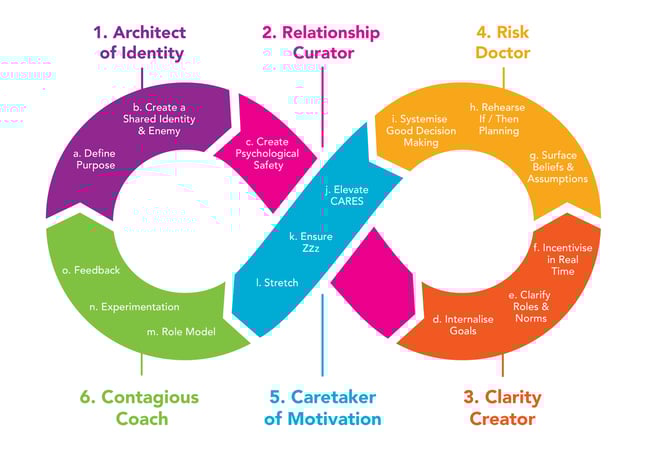
    In a business context, specifically regarding leaders and teams, there are three areas in which every leader can start to focus on to promote high performance, and this relates to the fact that the brain is always doing three things:

    1. Looking for meaning and purpose

    The brain is always searching for meaning and purpose in life and in work. If leaders can create a team environment where a team is connected to a purpose that really motivates them, then the brain is naturally going to be in a far more comfortable and motivated state. If these conditions within the environment can be created by leaders, each member of the team will be moving more towards a higher purpose and Finding their Why. It’s incredibly important for a team to be able to do this collectively by creating a shared team identity, much like sports teams who achieve success, through songs, uniforms, shared history. If leaders can do these things, it starts to activate empathy and dopamine and helps build the foundations for high performance.     2. The brain hates uncertainty

    Uncertainty means we don’t know what is coming, and that is a survival threat to us. If leaders can create an environment that has as much certainty as possible, then this is an incredibly powerful way to stop the brain from worrying about uncertainty. This means that more focus can be applied to higher-order tasks, such as decision making, complex problem solving and interpersonal and social connection.

    An example of what can be done to reduce uncertainty, is scenario planning to cover different eventualities of what ‘might’ happen, so when it does happen, it will have been anticipated and not perceived as a threat. For example, if a business is about to move into a new market, this may bring about a great deal of uncertainty for team members, whose brains will go back to the primitive survival techniques of ‘what if?’, and persistently worrying about outcomes. Scenario planning enables leaders to act out scenarios with different eventualities. Consequently, when these eventualities come up, uncertainty will be reduced among the team.

    1. The brain always wants to grow and progress

    Our brain is always wanting to grow and to progress. As a leader, it is hugely important to make sure that team members are generally, professionally, and personally growing. Incorporating things like stretch goals to ensure that team members are getting better and can feel the progress that they’re making will ensure that they are engaged psychologically and subconsciously, in line with this innate need from the brain. Great leaders will coach and support their team members in their constant growth and progress.

    coloured shead

    Inclusivity within teams

    We know the paramount importance of ensuring that organisations are inclusive. Andy says that, by definition, a business cannot have an exclusive team and be high performing.

    Again, we can go back to the brain and its innate needs. Human beings are incredibly socially driven and have a need to be around other people. The level of social nuance that is picked up on both consciously and subconsciously is phenomenal – much more than any other species. Therefore, if we detect that we are not part of a group or cannot be our true selves, this activates hyperarousal in the brain (a symptom of the fight/flight response). This, consequently, means that we are not able to focus on higher order functions.

    Teams need to focus on how to create the conditions for inclusion within the workplace. Leaders need to create an environment which fosters inclusivity. This is about making sure that everybody within the team knows each other and has psychological safety, where people can be their true selves, can share different opinions and have good, challenging discussions and debate in a healthy way.

    Leaders must ensure the conditions are created which enables everybody in the team to contribute – meaning that they feel as though they are part of the team and belong to the group. If leaders do this effectively, not only will it result in high performance, but as a building block for organizational culture, because how we experience our organisation is how we experience our team. Ultimately, teams need to capitalize on the cognitive diversity that everyone brings in, and this will be the grounds for creating cultural change for the organisation to be more inclusive.

    Andy’s views on how to build and foster company culture

    Companies can build a culture that they want, intentionally, from the start. Founders need to identify what are the key values that are really important to the organisation. To do this, you need to establish what these values mean today, are they the values we want to have now and are they the values we want to represent us in the future, to ourselves and to our clients? Once your values have been broadly established, really get to the bottom of each of them… do they represent us? Are they authentic? Challenge these values as a team collectively. Get to the point where everybody within the organisation believes in them and feels passionate about them. Once established, organisations should start designing people processes around behaviours linked to these values and incentivizing these behaviours through performance management. This will help to develop the right type of habits across that the organisation wants to build, which will align with this culture.

    Organisations also need to make sure that employees are being held to account (leaders in particular) for being consistent and authentic with these behaviours and values, and the processes and incentives that have been brought in to foster them – because if organizational culture drift comes along, it’s incredibly difficult to reverse this – particularly among fast-growing organisations.

    Finally, it’s hugely important that organisations constantly and intentionally monitor the overall organizational culture. Make sure that the values, behaviours, and attributes that we have in place are still what we want. Organisations should review this at least annually.
    ÔÇóMIN3364_Infinity loop_(1)_w copy

    teamup products

    teamup has designed and built four innovative psychometric assessments, which are all based on the teamup proprietary model of applied neuroscience to develop high-performing teams and leaders. I’m incredibly proud to say that the Evolve platform powers these psychometrics for teamup. Andy has given us some info about all of them – and you can access more information by following this link.

    Neuroselfie

    This is a short self-report in which team leaders can self-assess against the teamup framework, using likert questions. Upon completion, users will receive a custom report to show where they’re tracking against the six areas of high performance.

    180/360 degree feedback

    teamup has built a 180/360 degree feedback. This looks at whether a leader is creating an environment for others to thrive, again, based on the teamup model of applied neuroscience. The 360 will provide leaders with feedback against the areas of high performance, which is delivered via a teamup accredited coach.

    teamup For Teams (TUFT)

    teamup’s flagship product, teamup for Teams, is a team assessment. All members within a team will answer a diagnostic questionnaire and get their own customized team report, that shows how this team – with its collective accountability and responsibility, is performing, and what can be done practically in order to improve that.

    The psychometric tools that Andy and his team are incredibly powerful, and have already been used by large clients on a global level.

    To find out more about any of the teamup products, or how Andy and his team can support, please contact him on:

    Andy.longley@teamup.inc

    Andy’s LinkedIn

    The teamup Website

    Thanks for reading/watching!

  • The Importance of Account Management

    The Importance of Account Management

    Account Management – Why is it so important?

    ‘Customer/Client Success’, ‘Account Management’, ‘Customer Service’; No matter which title you use, looking after your customer base is arguably the most crucial function to sustain growth within your business. It’s no secret that a business needs an excellent sales and marketing strategy to be successful, but who looks after all those exciting new clients you sign up?

    Account managers become the main contact for new clients and are responsible for focusing on customer retention to create and nurture long-lasting, profitable relationships. With current customers spending on average 67% more than new customers, this is where your best growth opportunities are hiding!

    Being an account manager can involve many responsibilities. Quite often we take on the role of project manager, software tester and occasionally therapist, but these are the things that make this role so rewarding. Engrossing ourselves in a holistic understanding of a client’s solution allows us to provide consultative recommendations that are right for the business. Sometimes these recommendations may be at a cost to the client, but based on a strong relationship they will understand that investing additional funds now will allow for a mutually successful solution in the long term.  

    How often do you find yourself turning to Facebook, Google or TripAdvisor to leave a review after experiencing bad service? We are 10 times more likely to leave a review after bad service than we are with a good experience, and with customer feedback so readily available online, a bad review can damage your business reputation. That’s why in this digital age we need to ensure we do all we can to ensure our customers have a great experience.

    At Evolve Assess we pride ourselves on providing the best possible service for our clients, delivering a tailored solution and approach to meet each individual client’s needs. If you would like to know more about what sets us apart from other assessment platforms, you can contact us at info@evolveassess.com.

  • How to Reduce Attrition Rates

    How to Reduce Attrition Rates

    High attrition rates can result in increased business running costs, productivity losses, low team morale and even a damaged reputation. 

    Recognising that your organisation is suffering from high attrition or that you have an issue keeping staff in certain roles is the first step towards fixing the issue. The next steps are a mix of understanding why people leave, optimising the evaluation and recruitment process and improving the communication during the hiring process. 

    By taking these different steps and ideas into account, it’s possible to reduce attrition rates, aiming for a sweet spot of around 10% attrition across the company.

    Assess The Current Situation

    In order to go about reducing employee turnover, it’s crucial that you understand why people are leaving the business. 

    This can be achieved through two main methods: one is to speak to existing staff to learn more about how attrition impacts them and how they view the situation, the other is to ensure you have a strong exit interview process in place. 

    Using a combination of the two methods, you can begin to unpick why the attrition rate is high. 

    Start by asking current employees (anonymously) if they think the organisation has enough quality, well-trained staff and what the effect of someone leaving is on them. 

    As for the exit interviews, try to use these as a way to dig deeper into what’s making people move on – this is usually best carried out by an independent interviewer, so not the leaver’s line manager. 

    Optimise Your Evaluation Process

    Bad hires lead to higher attrition rates – either through people being let go as they can’t perform in the role or because people leave the company unsatisfied with the job and the company. 

    To avoid this happening, make sure you’re hiring the right people using a Situational Judgement Test (SJT) or similar. 

    An SJT is a psychometric assessment that presents applicants with role-specific scenarios that they might experience after joining the company, in order to gauge how they would respond when in these scenarios. 

    With an SJT, you can evaluate:

    • Attitudes – how candidates think and feel, ensuring that this aligns with what you are  looking for
    • Behaviours – how staff will conduct themselves within the working environment
    • Values – do their values match those of your company?

    As well as SJTs, consider getting someone involved in the recruitment process that already works in the role being interviewed for – this will help the hiring manager to understand better the qualities and values that are needed to succeed in the role. 

    Improve Your Communication During The Recruitment Process

    This isn’t so much about how you contact the candidates during the process (although that’s still important), it’s about what you communicate and how well you communicate the true nature of the job. 

    While it’s great to provide the benefits of a role, don’t over embellish or paint a picture that simply isn’t true as it will only leave the eventual hires feeling unsatisfied or even feeling cheated if the role doesn’t match up to the description. 

    It’s important to communicate both the favourable and unfavourable parts of the job, for example:

    • Favourable – reward schemes, holidays, benefits, culture
    • Unfavourable – fast-paced culture, tight deadlines, high pressure, long working hours

    Even the best jobs have parts that are less favourable and that’s not something to hide, it’s just about balancing the good and the bad and allowing people to make an informed decision as to whether the role is right for them. 

    Providing this detail will also improve the candidate pool as those that do apply are likely to be more interested in the role. 

    As well as carefully considering how to communicate the actual role, think about how you talk about and describe the culture of the company. Does pizza and beer on a Friday actually translate to ‘everyone stays an extra couple of hours doing work before some food and drink are provided?’

    What you see as a ‘fun’ company culture might not translate that way to others, so be honest and describe what it’s like to work at your company and keep in mind that it might not be for everyone!

    By taking the steps above and learning more about why attrition happens, optimising the evaluation process and improving communication during the hiring process, you can begin to reduce your organisation’s attrition rate. 

    Find out more about identifying attrition in your organisation and how to reduce it in our guide: The HR Guide to Employee Attrition (with Scorecard tool). 

  • Measuring People in the Workplace, with Ben Williams

    Measuring People in the Workplace, with Ben Williams

    I recently had the pleasure of talking with my colleague Ben Williams to discuss how we can measure people in the workplace. Please watch the video above for the full discussion, or if you’d prefer, we’ve captured the key points here:

    About Ben

    Ben is Managing Director at Sten10 and I’m delighted to say he’s now a Director here at Evolve Assess, having a major input towards our strategic direction and platform development to ensure optimal performance for psychometric test delivery. Ben wrote a brilliant piece on our partnership together recently, which I’d recommend checking out: Sten10 and Evolve Assess Partnership. The main purpose of our discussion, was to talk about some of the key terms when it comes to psychological assessments. But first, a little about Sten10… 

    An introduction to Sten10

    Sten10 is a firm of business psychologists, set up in 2012. The business was fuelled by Ben’s personal passion of trying to map out the human mind – specifically in business and recruitment. Sten10 design bespoke psychological assessments and are independent, trusted advisors to clients who make assessment recommendations based on clients’ unique requirements. Sten10 work in very close partnership with Evolve Assess, designing many assessments that are delivered via the Evolve platform.

    In addition, Sten10 also develop assessment centre materials for later stages in the recruitment processes and design competency frameworks for their clients.

    How do we measure people in the workplace?

    Ben has always been fascinated by the idea of measuring a person’s psychological make up. For example, when psychologists look at personality, time and again 5 distinct factors are identified in the research, regardless of age, culture, gender et c. Similarly, when it comes to cognitive reasoning, psychologists have found people can generally keep about 7 chunks of information in their memory before they start to forget it. Ben was fascinated by the fact that you can measure something that’s as seemingly intangible as people’s psychological makeup – and that’s what he loves about the challenge of his job as a psychologist.

    Why it’s so important for businesses to know about personality and psychological makeup

    The idea that everyone has their own unique blend of personality traits, reasoning skills and motivation hasn’t always been widely recognised. Businesses more often now recognise the value of this deeper understanding of people’s makeup.There are a wide range of benefits for the organisation itself in being able to measure people’s traits:

    • When matched to the role, it is likely individuals will perform better and stay longer.
    • it is able to match those who may have a ‘halo effect’ on others around them, as they’re more likely to be a valued member of the team through coaching and supporting others.
    • It helps to feed into the company’s culture, values and brand.

    There are benefits for the individual, too:

    • It is better for mental well-being.
    • Nobody wants to be in a job that they are ill suited for – staff who are expected to be constantly behaving contrary to their natural preferences will be more likely to leave.
    • It allows for better career development when they’re better matched.
    • It’s more likely that an individual’s skills will be recognised.

    Tools for measuring people

    There are a number of tools that can be used to measure these traits. Sten10 develop a range of psychological assessments, which – broadly – fall into two categories: tests of typical performance, and tests of maximum performance.

    Tests of typical performance

    These are tests that may be used when businesses are looking at personality or motivation. This is how an individual will typically tend to think, feel and behave, or what tends to motivated to work harder, or demotivated, resulting in them working less hard.

    Tests of typical performance are usually self-report, so users must have a reasonable degree of self-insight and be completely honest when answering them. We tend to refer to these assessments as questionnaires rather than tests, as there’s no objective right or wrong when it comes to personality or motivation. These questionnaires are untimed and should be answered by candidates based upon their initial response, rather than thinking about it too long.

    Tests of maximum performance

    These types of tests are most frequently used when more of a particular skill is required. For example, more verbal reasoning or numerical reasoning skills, or greater attention to detail. Unlike tests of typical performance, these tests are typically timed, and are not self-report – they actually involve giving people a sample of problems to solve, based within a realistic workplace context.

    Tests of this nature are often called ‘reasoning’ or ‘ability tests’.

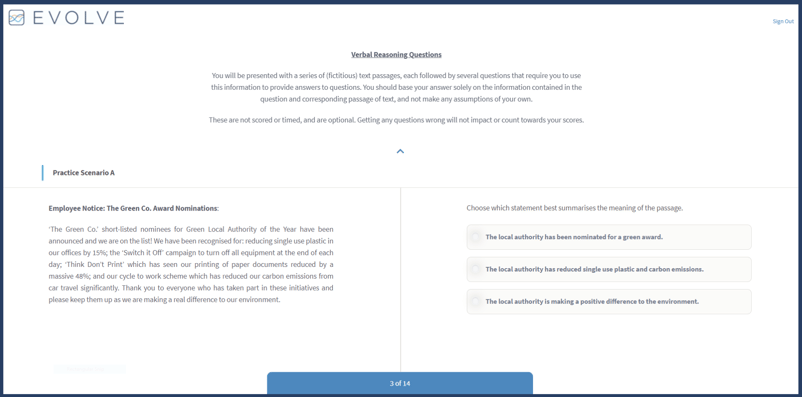
    These tests assess an individual’s intellectual horsepower. You may of heard of IQ tests, which are a general measure of reasoning skills. However, in business, we look to focus more on the skills that are relevant for a particular role. For example, if a company is recruiting for a role that requires them to have high numerical reasoning skills, a test can be designed that asks candidates to look at some data, make some calculations and draw a logical conclusion as a result of it. With verbal reasoning, candidates are usually given a passage of information and asked to read and interpret implications of the different parts of the passage. There are also measures of ‘pure reasoning’ skills, which are completely independent of language. These are called ‘abstract reasoning’ tests, and candidates are provided with a series of abstract shapes and are asked to identify which shape comes next in the sequence, for example.

    Pictured above: an example of a verbal reasoning test question

    As opposed to personality questionnaires, which look to assess what is happening underneath the surface of a candidate, behaviour is what you actually see candidates doing. For example, an individual can have a personality trait which makes them more introverted or shy than others inside, but that candidate may have developed a repertoire of behaviours and coping strategies that mean you are a very effective presenter, for example.

    In a testing sense, in order to look at people’s typical behaviours you may look at a Situational Judgement Test (SJT), because you’re providing candidates with a hypothetical scenario, and gauging how candidates would be most and least likely to behave. These tests are carefully designed to try and link to the behaviours within the job.

    Demonstrating how predictive a test is

    In order to prove that a test or questionnaire is predicting what it should be, we have to take an individual’s test score, and then we have to take a score which represents that person’s job performance (or some sort of criteria for success) and the two must be correlated. This correlation identifies the strength of the relationship between two things. An example of a correlation would be: sales of umbrellas tend to go up when it’s raining. In a workplace setting, we are looking for a correlation between test performance and job performance (i.e. the better someone performs in a test, the better the job performance).

    The challenge is how to measure job success. You can do this through ‘hard criteria’, here are some examples:

    • How long candidates stay in a role (attrition).
    • The value of sales made.
    • Error rates on the production line.

    The other way to measure job success is through ‘soft measures’.

    This could include things like:

    • Manager feedback or a full 360 feedback. For example, managers could rate their employees on a scale (e.g. 1-5) on certain skills.
    • Customer satisfaction.

    When Sten10 build an online assessment, they will work closely with clients to identify success criteria right from the outset, so that the test is built to predict exactly what the clients wants it to predict.

    When it comes to predicting job performance of individuals who have performed well in an online assessment, it is advised that this is done after at least six months within the role, but more commonly this would be between 12-24 months. For attrition, you can start measuring right from the beginning how long staff have been in the roles.

    How many different tests should we use for selection?

    Ben, with a psychologist’s hat on, would – of course – like to measure every single trait possible. However, in the real-world, for candidates, it is probably not recommended to put too many assessments in place because competitors could be quicker to offer a job, or candidates may drop out because they find the process too onerous; there’s a law of diminishing returns of with the number of assessments included and how much predictive power this provides.

    The research says that an ability test predicts performance the best, as a single measure.  SJTs have been shown to predict performance over and above Personality Questionnaires, and they tell us something different.

    Personality questionnaires are more towards the acceptable level when you look at multiple scales. SJTs have been shown to predict performance over and above questionnaires and ability tests and they tell us something additional. For this reason, the last 5 years have really seen an explosion in the use of SJTs.

    What is a Situational Judgement Test?

    Companies were wanting to go for the perfect blend of automation and predictive power, Ben would recommend using an ability test and an SJT, with the SJT being completed first. Although they’re not quite as predictive as ability tests, they have a huge benefit in that, because they give the person applying some insight into the company they’re joining – meaning that they can self-deselect from the process, saving a huge amount of time.

    Although there are some SJTs that are available off-the-shelf, if businesses don’t go bespoke with SJTs, they are missing the huge benefit of giving people an insight into the role. An off-the-shelf SJT will have a set of generic or ‘vanilla’ scenarios that are could be applicable to a range of businesses; the scenarios will not be tailored to your business and, as such, candidates won’t be able to get a realistic insight into the role or company , and they are potentially less valid as a result.

    A good example was an SJT designed for use with a large regional police force. They were facing a lack of applications from people from ethnic minority groups. In order to help with this, an SJT was designed with instructions written to evoke a positive motivational mindset for everyone taking the test before they begin. As a result, not only did drop out rates between different ethnic groups equalise, but also actual performance in the test. 

    Ben and his team at Sten10 do work across an array of organisations, from health care, to public sector, banking to utilities, and we’re delighted to have partnered together by providing the assessment platform for many of these projects.


    If you’d like to contact Ben, you can do so via ben@sten10.com.

    Thanks for watching/reading!

  • Will’s first week at Evolve

    Will’s first week at Evolve

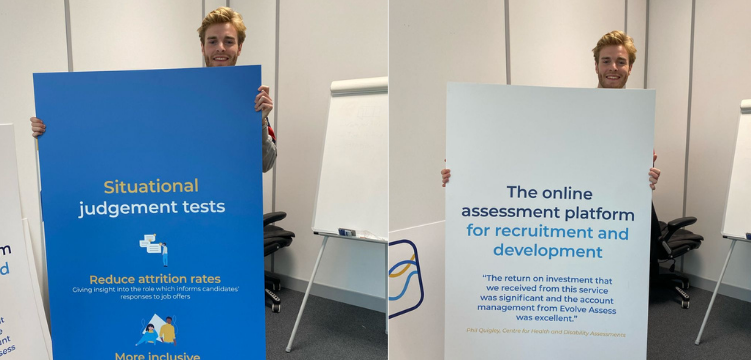
    After his first week here at Evolve Assess, Will and I sat down to discuss how he was settling into his new role as SDR, covering what about the role caught his interest when applying, what he’s gotten up to during his first week and what he’s most looking forward to in his role. Here’s what he said:

    What about the role caught your interest?

    Originally through a recruitment agency, I started looking for roles in Sales after recently graduating Newcastle University with a Finance and Accounting degree. I enjoy talking to people, so a customer facing role in Sales seemed like the right move for me. After discussing the role at Evolve with the recruitment agency and researching the company my interested was piqued – learning Evolve is a relatively young company, the element of development and growth opportunities, for myself and the company, was very attractive. To be honest, the way things are going, I thought that software was the right industry to get into as opposed to some more traditional, tangible sales roles.

    Applying for a few different jobs, I saw a lot of those types – where you’ve got a set script to pick up, but I was never really looking for something like that. The tech side and being a smaller company was a big bonus to me, I’d applied for some bigger companies when I was looking for a sandwich-year placement. Upon closer inspection I didn’t think that’d be my cup of tea and after talking to some friends in roles like that, they didn’t look anywhere near as interested in what they did or who they worked with as I would have wanted. I didn’t want to end up in a place that was just like a graduate churn-out factory, leaving after a few years and never relating to those I worked with after.

    Once I’d met Rich and had an informal chat, I immediately understood the culture and atmosphere of the company, and he ran through the flexible working approach Evolve employs – something that was also very appealing to me.

    What have you been getting up to in this first week, and how have you found it?

    A lot of this week has been spent getting brought up to speed because, in all honesty, I didn’t know a great deal about this industry – software and HR. I did some work around HR at Uni, but not to this extent and especially not going down the route of recruitment and L&D. I’ve done a fair amount of work around building ideal customer profiles, looking into what we can do for people and how we can help them solve any problems they may have, like how we fit into their solutions. I’ve spent a lot of my time outside of training and meetings just consolidating what we’ve gone over so I’m thoroughly informed in what I’m talking about. Obviously, I’ve been getting to meet the team too in spurts – I met everyone in the office on day one, of course, but I’ve had some Teams calls to meet those who don’t work in the office too. So, meeting the team, finding out about all our ICP’s and having Sales coaching sessions, mostly internal but I’ve had, so far, a really insightful session externally with Mark Ackers. I’ve been reading a lot of his book anyway, that’s what I’ve been mainly trying to occupy myself with this past week in the remainder of the time that I’m not in meetings or training sessions.

    I’ve really liked it because it’s been really quite autonomous, but I’ve always been offered plenty of support should I need it, which has been helpful. I always worked my best in that way throughout Uni too, never really getting too involved with tutors and attending lectures online, learning in my own way and at my own pace sort of thing. I’ve always been very results orientated, and that’s always been what drives my motivation – and although I’m only a week in, I definitely see it continuing in this sort of way.

    What are you most looking forward to in your role?

    I’m looking forward to actually starting with some calls, although I’m a bit nervous for it – I’m not sure if I’ve got all my scripts sorted but I don’t think I’ll have them perfected until I really start doing it, seeing how I actually sound and how it’s all perceived. Rich and I are going to work closely on my first few calls, which I know he’s also looking forward to so it should all be quite fun. I can imagine those first few calls will be the most difficult, but I’m really looking forward to just getting stuck in. I’m definitely looking forward to booking my first meeting and getting my first sale. I know our sales cycle is quite long, just due to the nature of the development of our product and the time that goes into each project, but I’m hoping to book a fair few meetings each week. Being successful at prospecting and sales requires a lot of skill, and I know in those first few weeks it may be frustrating when I’m still learning but I know I’ll get there – the satisfaction from getting it all right will be great. I’ve never really done anything like this before, I did a mock call for my interview which of course I was convinced afterwards I could’ve done far better on, but for my first call I was pleased with it. So mostly, I’m really looking forward to getting to call people.

    There’s also the In-House Recruitment Exhibition next week, that’s going to be quite interesting – just one of those different opportunities I wouldn’t have found in other roles. With the company being smaller, I can get involved beyond the remit of my role. I wouldn’t have thought I’d already be going to Exhibitions, just coming into the company. Ben Williams will be doing a talk whilst we’re there, and that should go well. I’m not sure if I’m going to be able to watch his talk, as I’ll be manning the stand – it’ll mostly be Rich going to the talks and what not, and Ash and I will be talking to people at the stand. I think getting to speak to recruiters and HR Leaders will be really helpful for me going forward, seeing as they make up a fair chunk of our customer base that we can help with our platform. There’s a networking event at the end, which should be a good laugh too. Overall, the Exhibition should be great.

    I’m looking forward to the social aspect of the team too – planning a Christmas do with the team too – maybe a Christmas market, or maybe even something for Halloween. Getting to know the team both at work and outside of work seems like it’ll be good fun.

    Will has been a welcome addition to the team, and we’re looking forward to seeing what the future holds for him and Evolve.

  • Hiring for Cultural Fit

    Hiring for Cultural Fit

    The concept of ‘company culture’ is a very hot topic these days; as we’ve previously discussed, it’s of huge importance for companies to fully establish and define its culture, well in advance of hiring for cultural fit, but there are many tips and tricks that can be implanted by hiring managers to hire for cultural fit. We’ve highlighted some thoughts below: 

    The majority of what needs to be done in hiring for cultural fit is to ascertain whether the individual’s values align to those of the company – and remember, that’s their beliefs, vision, and preferred working environment.

    It’s generally considered good practice, once a company has established a values model, to then create a core set of competencies (competency framework) and associated behavioural indicators (actions or behaviours that exemplify the competency in practice). This will provide a framework in how to assess somebody’s cultural fit during the application process. Additionally, a series of Realistic Job Previews (also in the list below) will help candidate’s gain a realistic gauge of life within the organisation – transparency is always key!

    Cultural fit interview questions

    In interviews, start with describing the role and the company environment generally. Ask candidates examples of times in the past that they performed tasks or behaved in ways that are aligned to your values, core competencies and behavioural indicators.

    For example, let’s say you’re interviewing a candidate against the core competency of ‘communication’ – the behavioural indicator for ‘communication’ may be ‘have the ability to receive feedback from others and learn from this feedback’. Ask candidates for examples when they have received feedback in the past and what was done from this feedback.

    As you can probably see, these types of questions start to profile how the candidate has behaved in the past, and how they are likely to behave in the future. This question may ultimately step from the core organisational value of ‘transparency’ or ‘integrity’. By asking these types of questions, you can start to ascertain how aligned to your culture the prospective employee is.

    Accurate job descriptions

    Unfortunately, many job descriptions are a little ‘best-case scenario’ and often fairly unrealistic. This certainly does not provide a RJP to job applicants and does little to demonstrate the culture of the company. Make sure that, when creating job descriptions, it is done so by ensuring that the day-to-day responsibilities are an accurate reflection of the reality of the role. Furthermore, the ‘About us’ part of any job description should be information not just about what the company does, but how it does it and why it does it; steeped in organisational values – it’s a great opportunity to be demonstrating your company culture. If you’re a creative bunch, get creative with your job adverts/descriptions, if you’re fun, be fun! It’s hugely important and a very easy way of communicating the company values and culture.

    Employee testimonials/day-in-the-life videos

    Who better to get a flavour of an organisation and its culture than an existing staff member? By getting existing employees to create testimonials and day-in-the life videos, they will be able to document what it’s like working for your organisation on a day-to-day basis. This includes the good, the bad and the ugly. Show these videos and testimonials to prospective applicants alongside job descriptions and before they apply, which will help to provide that final rubber stamp of approval that they are certain this is the role for them!

    Situational Judgment Tests

    Situational Judgement Tests (SJTs) are a type of psychometric assessment that look to gauge a candidate’s behavioural fit to a particular role. They do this by presenting the candidate with a series of role-specific scenarios and ask them to choose their most and least likely courses of action from three/four options. It’s a great way to let the recruitment team know if a candidate is likely to fit in with the organisation on a behavioural level. 

    However, that’s not all they do: SJTs are designed to be bespoke and specific for each role/organisation, meaning that you can provide, within the scenarios, a Realistic Job Preview to candidates. This means that the company culture can be communicated to candidates through the scenarios within the assessment – it’s a beautiful two-pronged approach to ascertaining cultural fit: for both the hiring manager and the candidate and should certainly be considered as a RJP tool to gauge cultural fit.

    Don’t forget – it’s hugely important to establish and define a company culture well before it can be hired for: it’s the fairest way all round, and is much better in the long term.

    Please don’t hesitate to contact us via info@evolveassess.com for any support in helping you hire for cultural fit, through the use of online assessment.

  • 3 Myths of Attrition and The Impact It Has on Your Business

    3 Myths of Attrition and The Impact It Has on Your Business

    Attrition, sometimes referred to as employee churn or turnover, is a part of everyday business. Whether it’s voluntary or involuntary, the idea of someone leaving a job isn’t anything unusual, and in some cases is even good for business.

    Where it does become an issue is when an organisation has a high rate of attrition. The actual point at which an attrition rate is considered high will vary depending on the industry and type of work.

    So, differences aside, what is the impact of high attrition on an organisation?

    The impact of attrition on your business

    Firstly, it can increase business running costs. The hiring process can be expensive in terms of money and time, especially if your business works with recruitment agencies, as additional fees apply. 

    Each time a staff member leaves and you choose to replace them, you have to go through this process every time, and if your rate of attrition is high, so is the cost of keeping jobs filled. 

    Secondly, there are productivity losses as multiple people in the business may need to be involved in the hiring process – that could be heads of departments, managers and various people in HR. For anyone where recruitment isn’t their main role, it’s taking time away from potentially more valuable tasks. 

    Further to this, each time someone new joins the team, there is a period of onboarding where someone might need to take time from their days, weeks and even months to support the new hire – if you have to keep going through this process, it can have a huge impact on productivity. 

    Next is the impact on team morale – if you’re working within a team where people are often coming and going, or even being released by the company, it can affect morale for others in the business and can damage the potential for strong teams to bond. 

    And finally, high levels of attrition can affect your reputation as a business. If your organisation becomes known for not being able to hold on to its staff, it becomes harder to attract talent into your business.

    With a better understanding of how a high attrition rate impacts your business, it’s good to know some of the myths:

    1. Attrition isn’t a significant problem
      As seen above, if you have high attrition rates, it can impact the business in multiple ways. It’s best not to be ignored and organisations should be looking carefully at why anyone leaves the business (for good or bad reasons).
    2. You can’t do anything about attrition
      If this was true, businesses would regularly grind to a halt with no one to do the work. There are definitely circumstances where it’s beyond a company’s potential to keep someone, but there are actions a company can take to reduce attrition across the business.
    3. You don’t want to deter people from applying
      Quality, not quantity. The more people that apply for a role, the more you have to turn down – plus, for every applicant, there is work involved with assessing whether they’re the right person or not. Unless the role you’re hiring for doesn’t require any skills at all, then you’ll always want to deter bad fits from applying. 


    Learn more about the impact attrition can have on your business as well as how to get started with reducing attrition in our guide: The HR Guide to Employee Attrition (with Scorecard tool).

    Download it here:

  • Making sense of Diversity & Inclusion, with Martin Mason

    Making sense of Diversity & Inclusion, with Martin Mason

    Last week, I had the pleasure of sitting down and chatting with Martin Mason from Unleashed with the purpose of learning more about Diversity & Inclusion. Please watch the video above to hear our discussion.

    Martin gives us some brilliant insight into the world of D&I and provides some actionable steps and recommendations that businesses (of all sizes) can be making to ensure they have a diverse workforce and an inclusive organisation. The discussion is summarised below:

    About Martin and Unleashed

    Martin has a wealth of experience in Talent Management, Performance and Learning & Development. He was most recently Global Head of Talent and Performance at The Body Shop, after having worked in Talent Management roles within Halfords and Wolseley. In early 2020, Martin set up Unleashed, with the aim of helping organisations become more successful, by making them more inclusive.

    Martin and his team at Unleashed are incredibly passionate about unleashing people’s potential and have a deep-routed belief that everybody is talent, and that each person will apply that talent differently. The business ethos is about placing tools, services, and products in the hands of their clients, to remove the barriers that exist for entry into the workplace, as well as some barriers that people might experience at work, with the purpose of developing and fostering inclusive cultures. 

    Why Unleashed was formed

    The forming of Unleashed was very personal for Martin, having worked in corporates from the age of 15. Although the businesses that Martin worked in were all in different industries, he saw some common themes across all: many people were struggling in certain organisations to fulfil their potential, and it was nothing to do with lack of potential or ability, often it was to do with their gender, sexual orientation, or ethnicity. This was something that didn’t sit right with Martin, and he set out to start making subtle changes to the infrastructure within Talent and L&D to influence senior leaders, in order to prove how successful it is to have a diverse workforce. Now that Diversity and Inclusion has been much more accepted within society and business, Martin has loved being able to go into a diverse range of organisations and support them with D&I.

    What is Diversity and Inclusion?

    Diversity focusses around difference. Being a diverse organisation is about having representation of different characteristics, cultures, beliefs, opinions, and views across the entire organisation.

    Inclusion is about bringing people together and creating an environment where people feel that they belong. The nirvana point is to have a diverse set of people in an inclusive workforce, so that everybody across the organisation can feel safe to be themselves and hold their own unique talents, views, beliefs and opinions in a respectful environment.

    D&I for business performance

    Diversity and Inclusion isn’t just an ethical practice that businesses are recommended to get involved in from a moral or societal standpoint – those things are hugely important, of course – but having a diverse and inclusive business genuinely affects bottom line – it’s been proven time and again.

    As Martin mentioned in our discussion, the reason that Rihanna’s Fenty Beauty has been so successful is because she has tapped into a market in which the make-up does not cater to different skin tones. In the beauty industry, senior teams are predominantly made up of white people. As such, the lack of variety in skin tones for make-up was never deemed to be a problem. Rihanna’s organisation has demonstrated that, by having diversity at the senior table it can and does make a huge difference to the bottom line.

    How to be more inclusive within recruitment and development

    Recruitment

    One of the terms that we regularly hear is ‘unconscious bias’. Unconscious bias happens to everybody, and is the concept of an individual unconsciously making judgements about people based on how much they are/are not “like myself”.

    Although everybody has unconscious bias, Martin and Unleashed subscribe to the notion of ‘Conscious Inclusion’ when it comes to recruitment of staff. This is about being mindful of the unconscious bias that everybody has, but taking additional steps to make sure that everything possible can be done to make the recruitment process more inclusive.

    Many businesses will advertise for roles and heavily focus on the candidate being a ‘team player’, ‘be collaborative’, ‘part of the family’, ‘one of us’ etc – these are all ways of subliminally telling candidates that if you are not like us, you’ll struggle to do well here; this is a huge problem for many businesses when it comes to D&I. There has been extensive research undertaken by Harvard University around the psychology of language and the research has been able to pinpoint certain language used within job descriptions as being a deterrent for certain ethnicities and genders.

    There are many tools available that can be used when formulating job descriptions, such as https://www.totaljobs.com/insidejob/gender-bias-decoder/ and https://textio.com/ that can help with this.

    The other thing that Martin recommends is for organisations to really think about what they need for the role itself. Martin often talks to business leaders who inform him that they’re looking to fill a leadership role and the skills required are, for example: adaptability, good decision making, emotional intelligence and problem solving sills – then when the job advert comes out, it says: ‘must have X amount of years’ leadership experience must have a 2:1 degree etc, so there’s a clear discrepancy.

    Really thinking about removing some of the barriers to applications, such as experience and qualifications and focussing on what is really needed from the role can have a huge impact on the numbers of diverse applications for roles.

    There are other ways and means in which recruitment practices can cater for diversity and inclusion for organisations of all size. Making sure that hiring managers are supported by another member of staff that is different to them, and who could offer another viewpoint on the applications and interviews of candidates. This mitigates the risk of unconscious bias and gives another person the ability to provide feedback. For small businesses that might not yet have a diverse range of staff, look to network with other organisations and buddy up as part of the interview process, in the spirit of small business collaboration.

    Development

    In addition to ensuring businesses are adopting the best D&I practices within recruitment, there are also ways in which D&I can be implemented as part of staff development.

    Martin developed ‘You Unleashed’ as a passion project in early 2020, which was focussed on developing the person as a whole: Martin was keen to produce a psychometric assessment that looked at identifying what someone’s potential is, what their emotional intelligence is, how quickly they learn and how good they are at problem solving. The idea was that if somebody was recruited and on-boarded into an organisation, the tool could very quickly and easily identify where somebody’s strengths lay, but also where they needed additional support and development.

    Unleashed has been able to use this tool with many of its clients. As a recent example, Unleashed has rolled out ‘You Unleashed’ to a well-known brand to support them in hiring more women into a previously male-dominated team. Martin and the team ascertained, through using the tool, that there were some clear gaps around how certain team members interact with others. Some training was provided around communication and empathy which enabled this team to reach its diversity goals.

    To learn more about Unleashed

    In addition to the ‘You Unleashed’ psychometric tool (which is very proudly powered by Evolve Assess), outlined above, Unleashed provides an array of consultancy services to its clients: more information can be found via the Unleashed website. Unleashed is proud to work across a broad range industries, and are passionate about bringing together many clients in their online network:

    The Arena Network

    The online Network that Unleashed has developed is called ‘The Arena Network’. The network was originally established because, during COVID, many people in the HR community were feeling pressure and needed help and support within D&I. The result was ‘The Arena’, which was founded to bring all of these people together who had common problems and challenges and to help them work through it as a collective. For individuals and businesses who have common D&I or Talent challenges or issues, they are placed into teams with some facilitation from Unleashed. The membership volume has almost trebled in recent months and is a fantastic community to be a part of.

    Enter the Arena

    Summary

    Being aware of Diversity & Inclusion and having a strategy in place is absolutely paramount for business success. Society is changing, we’re getting better, but we all need to act together to ensure that our recruitment and development processes are as fair as they can be.

    Adopting small changes in all sized businesses can make an enormous amount of difference, and by incorporating some of the tips, tricks and recommendations that Martin has talked through in this discussion will make huge differences to the success of businesses – not only to ensure an enriching and diverse environment, but also to the organisations’ bottom lines.

    Evolve Assess is proud to work in partnership with Unleashed, by powering the ‘You Unleashed’ psychometric tool; we can’t speak highly enough of Martin and the work the guys at Unleashed are doing. Head over to their website, to see how they can support your business.

  • A ‘Week in the Life’ as an Apprentice at Evolve Assess

    A ‘Week in the Life’ as an Apprentice at Evolve Assess

    Personally, I like reading about what other people are getting up to in their week. Is it because I’m a little bit nosey? Possibly… But seeing how others organise their week makes me feel an almost second-hand productivity, as odd as that may sound. So, I thought why not write one myself!

    Firstly, I’ll introduce myself; I’m Morgan, and I joined Evolve Assess as a Business Admin. Apprentice in March this year. For me, this is a completely new realm of work, as previously I’ve predominantly worked in the equine industry. Finding a new way of working, suiting a new routine with a new staff team was a slightly scary prospect to me – but now? I wouldn’t have it any other way!

    Enough about just me, let’s talk about what I’ve been up to this week!

    Monday

    We start our week with a team meeting, have a catch up on what was achieved last week and what we plan to work on this week. I update the team on not only my planned tasks work wise, but also where I’m up to with my college work and any pressing assignments I have that I may need help with. So, what does this week hold for me? Content uploads, a slightly beefy college assignment, HubSpot Academy courses, testing and marketing scheme plans!

    Tuesday

    The majority of today was spent uploading assessment content to our platform. Our Devs have recently created a new function to improve our multilanguage campaigns, meaning a lot of content requires translated. Now on the surface, that’s easy, right? With a good sum of questions (doubled, accounting for the 2nd language), making sure they’re in the correct order, they match their scoring types, they all have the ‘require an answer’ box ticked, pop ups work et c. – as you can imagine this kind of task ends up taking some serious concentration and a generous amount of time!

    Wednesday

    Testing day! For me, this means a day of testing through our existing campaigns and, essentially, trying to break them. Now when I say ‘break’ I mean find how they could be broken (accidentally of course!) by any of our clients and their candidates. So, I run through the tests as a candidate would with a very attentive eye to make sure that none of our new content uploads or dev changes have had a negative effect on any of pre-existing work. Nine times out of ten, this runs through seamlessly – however there will always be the odd occasion where there are bugs to fix (thankfully, I just pass that over to our trusty Devs and they work their magic from there!).

    Thursday

    When all goes to plan in terms of testing, and minor bugs that may appear are fixed – we deploy. Once that’s done, we plan our next Sprint. We work in fortnightly Sprints, and to plan them we account for admin and development work required over the next two weeks. Generally, this isn’t too lengthy a process. So, after our morning Sprint plan, I got back on the task of uploading content for updated campaigns.

    When I’d uploaded all the content, I got on with some college work. My most recent assignment fell under documentation. I had to show how I use IT programs, create documents and how I communicate with others – whether that be colleagues or clients. A few screengrabs and paragraphs of analysis later and that was sorted!

    Friday

    I started the day proofreading my college assignment and sending it away with a generous amount of time before the due date for any possible tweaks that may be needed. After that, I picked up where I’d previously left my HubSpot Academy course – after completing a Digital Marketing course, I thought I’d look more specifically at a course on Inbound Marketing. This took up most of my day, other than a break here and there to do some content changes as per client requests when they arrived!

    Working for a small business means no two days are ever the same. Being flexible and adaptable to whatever the day has in store is so important. With a great team around me, I know I’m supported daily and I’m always ready for the day ahead.

  • Developing a Company Culture – and hiring for it!

    Developing a Company Culture – and hiring for it!

    What is Company Culture?

    Company culture is a bit of an abstract concept; many think they understand it, but few can define it or explain how their culture was developed and maintained. What is company culture and how important is it to get right?

    Let’s start with a definition of company culture. I’ve had a look at a few definitions online, and I think the one from Indeed is probably as good as any other I’ve seen:

    ‘Corporate Culture is an organisation’s values, ethics, vision, behaviours, and work environment. It’s what makes each company unique, and it impacts everything from public image to employee engagement……..Companies with good corporate culture often have a high workplace morale, and highly engaged, productive staff’

    I like this definition of company culture: It seems logical, straightforward, and concise. The problem is, I’m not convinced that many companies define their culture this way. Moreover, don’t all companies (especially their leaders) purport to have a ‘good corporate culture’?

    The problem with misunderstanding your culture

    It seems logical that business founders will be responsible for establishing a company culture and defining what that culture should be. This culture is typically based on the company founders’ own personal values, vision, and their preferred working environment – and that culture will be imparted to the next member of staff, then the next, then the next … this seems like a logical strategy – but this is where many businesses start to struggle.

    When a company culture is defined this way, the first few members of staff all end up being just like the company founder(s) – they may all share the same personal values, vision and work environment preferences. This all sounds great, and the recipe for a productive work environment – but when you start to dig a little deeper, is the best recruitment policy to employ people that the founders would enjoy having a beer with?

    A fairly common example: ‘we have a great company culture…we all go out for a beer after work on a Friday!’ But does this really mean the company has a great culture? Who says? Does it also mean that those people who can’t/don’t want to join the Friday beer club, won’t be model employees, who fully buy in to the business’ values and goals?

    Although the beer example might be quite extreme, the point is that the ‘pint after work’ definition of good company culture does, in my opinion, nothing for the long-term success of the business.

    As a business increases its revenue, inevitably, more staff are required to meet demands; new staff with new skill sets to be brought in and new processes are to be implemented to streamline operations. This requires recruiting a very different set of individuals, with different personalities and unique personal aspirations.

    A badly-defined company culture leaves the hiring manager asking all the wrong questions in interviews: is this person going to get on well with the rest of the team? Do I have anything in common with them? Are they like me? Will they be a good cultural fit (will they fancy a beer on Friday after work)? Now this is where mistakes are made by some:

    It’s not so much unconscious bias on the part of the hiring manager, as it is them genuinely believing this person doesn’t represent a cultural fit with the company. The issue is, the very cultural fit against which the candidate is being measured, has been defined in the wrong way!

    This means that the hiring manager, all through wanting to perpetuate a poorly- defined company culture, is potentially missing out on the best person/people for the vacancies.

    The above ‘Friday beer’ example was only provided to illustrate a point; there are so many other examples of badly defined company culture that are far more common, and often detrimental. And it’s not always driven by the founders’ own personal values, vision and preferred work environment – it’s often erroneously defined by other ways. For example, wanting to present a culture that the company thinks that staff and prospective hires will want… but the reality is far different from the concept.

    This ‘unlimited holidays’ policy, with staff expected to work until 10pm, and only when targets are hit. Having break-out areas, cool, edgy office furniture, and free snacks – the whole ‘work hard/play hard culture’, often translating to staff having to work 60 hours a week to be rewarded with a free Dominos at the end of the month, doesn’t feel like a great culture.

    Of course, I’m not suggesting that every company that has these policies and perceived benefits in place are disingenuous – far from it! But it does happen far too often that staff are misinformed about the role, and that many hiring managers are assessing cultural fit by asking internal questions such as ‘if we mention all of these great things we do, will this candidate work 10-hour days and weekends when we need them to?’

    Okay, so if many growing businesses are struggling to effectively define their culture, we need to know how best to do it before we can start to hire for cultural fit – how can this be done? That probably requires a full blog in itself, but I have listed below some examples before we get into some ways you can hire for cultural fit.

    The Employee Attrition Scorecard

    How to develop and define a company culture

    Step 1 – Establish an organisational values framework

    Nowadays, it’s becoming more and more important to develop an organisational values model. Company values are the core set of beliefs that a company has and gives all staff the opportunity to get behind the same goals. Some examples of company values include the following:

    • Openness
    • Transparency
    • Accountability
    • Creativity

    When developing company values, take plenty of time to get it right; it’s pivotal and will underpin everything from hiring to strategy, process to profits. Brainstorm with your team, involve as many stakeholders as possible. Include staff, shareholder, customers, and suppliers – what are the traits we have as a business that we want to keep, what do we want to eliminate and what do we want to do that we don’t currently? Having a core set of company values sets in place will help to shape the company mission and vision.

    Step 2 – implement a mission statement and document your vision

    If you don’t have one already, implement a company mission statement, and a written vision that is communicated to all staff. It’s something that everybody can get behind if it’s done properly. Alongside values, it forms the foundation of company culture. Although it’s a decision for company owners and leaders, it’s hugely important that collaboration with staff occurs to build this mission statement so everybody is bought in from the outset. The mission statement should encapsulate the business vision and why the business exists; it’s crucial. Additionally, Mission-driven workers are 54 percent more likely to stay at the company for 5 years.

    A crucial step in building your new culture is to assess against your newly developed values. Carry out anonymous staff surveys to see how your current staff feel you’re performing against values. If, for example, once of your values is “we are open”, anonymously survey your staff to see if they believe the business is as open as it can be; ask open-ended questions to find out where the company is performing well, and not so well, and look to provide interventions based on areas of perceived weakness.

    Step 3 – assess against your new values and mission

    360 feedback assessments are also a crucial way of seeing how aligned an individual (particularly a manager – as they’re often responsible for employee dissatisfaction) is aligned to the organisational values, and its culture. Structure a 360 assessment around organisational key values and competencies and have their managers, direct reports, peers, other colleagues and even customers rate the individual against these competencies and values. This is a fantastic way of being able to highlight how aligned, or misaligned an individual is to the values and culture of a company, and gives an individual the opportunity to receive constructive and honest feedback from people they work with.

    By incorporating these tools into your internal processes, it gives each member of staff the opportunity to feed back and contribute to the cultural shape of the business, whilst at the same time giving ownership of individuals’ personal and professional journey. For the business, it hugely helps to shape the internal culture, ensuring that all members of staff know exactly what the culture is, how it’s been developed and how it should be upheld.

    Step 4 – foster the culture

    Once the above steps have been carried out, the management can start to foster the organisational culture. This will not happen overnight but done properly it can work wonders for businesses. It is the responsibility of, initially, the leadership team and subsequently the entire staff base to maintain a positive company culture, based on the values and mission. And it’s incredibly important for the culture to be inclusive for all.

    If one of the values that is developed is ‘team spirit’ – don’t just put a pool table in the office: look to reward the entire team when things go well – organise team days that are inclusive to all. In addition to the pub Fridays, offer a suitable alternative to those staff that are unable to join – use some imagination and creativity!

    For businesses that have ‘integrity’ as a core value, make sure you’re as ethical, fair, and honest with your staff as you are with your customers: update them on company financials, future plans and your expectations of them.

    If a core value is ‘quality’, ensure that staff receive the same quality from the company that they’re expected to deliver to the clients – quality equipment, work environment, training programmes and personal feedback.

    The list is endless, but you can probably see how having a robust core set of values in place, should impact all your stakeholders in the same way – it builds consistency and supports in building an incredible organisational culture.

    The last thing to consider is how to hire for cultural fit.

    Step 5 (final step) – hiring for cultural fit

    This question, of course, is a full topic in itself. We know the importance of hiring for cultural fit, and it’s as important for the candidate as it is for the hiring company. There are several ways that cultural fit can be hired for, but it’s truly best to do this once you’re highly confident that you have gone through a thorough and robust process to develop and define your company culture.

    The majority of what needs to be done in hiring for cultural fit is to ascertain whether the individual’s values align to those of the company – and remember, that’s their beliefs, vision, and preferred working environment.

    It’s generally considered good practice, once a company has established a values model, to then create a core set of competencies (competency framework) and associated behavioural indicators (actions or behaviours that exemplify the competency in practice). This will provide a framework in how to assess somebody’s cultural fit during the application process. Additionally, a series of Realistic Job Previews (also in the list below) will help candidate’s gain a realistic gauge of life within the organisation – transparency is always key!

    Cultural fit interview questions

    In interviews, start with describing the role and the company environment generally. Ask candidates examples of times in the past that they performed tasks or behaved in ways that are aligned to your values, core competencies and behavioural indicators.

    For example, let’s say you’re interviewing a candidate against the core competency of ‘communication’ – the behavioural indicator for ‘communication’ may be ‘have the ability to receive feedback from others and learn from this feedback’. Ask candidates for examples when they have received feedback in the past and what was done from this feedback.

    As you can probably see, these types of questions start to profile how the candidate has behaved in the past, and how they are likely to behave in the future. This question may ultimately step from the core organisational value of ‘transparency’ or ‘integrity’. By asking these types of questions, you can start to ascertain how aligned to your culture the prospective employee is.

    Accurate job descriptions

    Unfortunately, many job descriptions are a little ‘best-case scenario’ and often fairly unrealistic. This certainly does not provide a RJP to job applicants and does little to demonstrate the culture of the company. Make sure that, when creating job descriptions, it is done so by ensuring that the day-to-day responsibilities are an accurate reflection of the reality of the role. Furthermore, the ‘About us’ part of any job description should be information not just about what the company does, but how it does it and why it does it; steeped in organisational values – it’s a great opportunity to be demonstrating your company culture. If you’re a creative bunch, get creative with your job adverts/descriptions, if you’re fun, be fun! It’s hugely important and a very easy way of communicating the company values and culture.

    Employee testimonials/day-in-the-life videos

    Who better to get a flavour of an organisation and its culture than an existing staff member? By getting existing employees to create testimonials and day-in-the life videos, they will be able to document what it’s like working for your organisation on a day-to-day basis. This includes the good, the bad and the ugly. Show these videos and testimonials to prospective applicants alongside job descriptions and before they apply, which will help to provide that final rubber stamp of approval that they are certain this is the role for them!

    Situational Judgment Tests

    Situational Judgement Tests (SJTs) are a type of psychometric assessment that look to gauge a candidate’s behavioural fit to a particular role. They do this by presenting the candidate with a series of role-specific scenarios and ask them to choose their most and least likely courses of action from three/four options. It’s a great way to let the recruitment team know if a candidate is likely to fit in with the organisation on a behavioural level. 

    SJTs are...

    However, that’s not all they do: SJTs are designed to be bespoke and specific for each role/organisation, meaning that you can provide, within the scenarios, a Realistic Job Preview to candidates. This means that the company culture can be communicated to candidates through the scenarios within the assessment – it’s a beautiful two-pronged approach to ascertaining cultural fit: for both the hiring manager and the candidate and should certainly be considered as a RJP tool to gauge cultural fit.

    In summary

    Company culture is absolutely paramount and is pivotal to the success of a company. Making sure that your business has a culture to be proud of will help you get the most from your current staff base and ensure that you recruit those that align with your organisation – and who feel your organisation aligns with them!