Category: Podcast

  • Psyched For Business Podcast Episode 2

    Psyched For Business Podcast Episode 2

    Episode 2:
    How to maximise your sales team’s performance

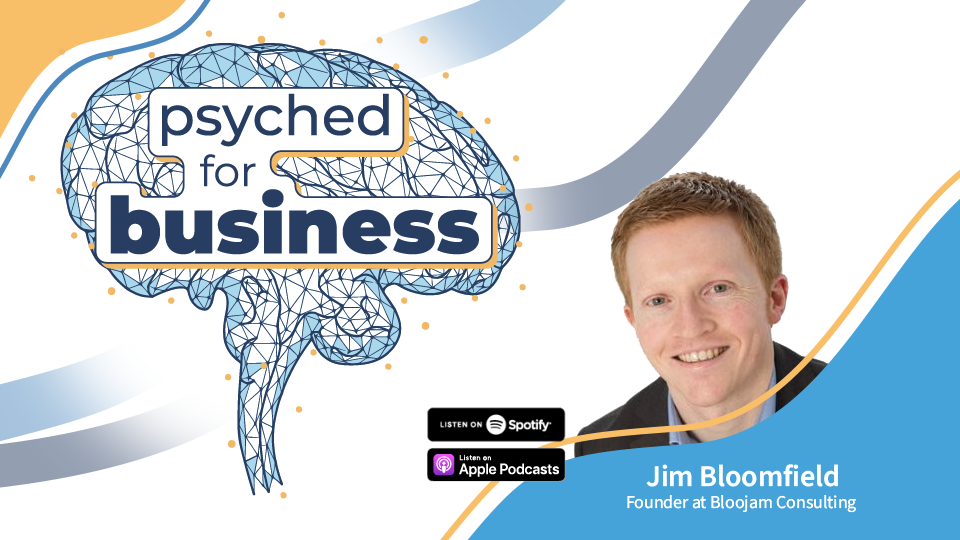
    In this podcast episode Richard Anderson is joined by Jim Bloomfield from Bloojam Consulting.

    Jim is a sales leadership development and assessment expert, who specialises in helping companies identify, attract and retain sales professionals.

    In this episode, we cover:

    ✅ Our own experiences of working in B2B sales roles.

    ✅ The key behaviours required to be successful in any sales role.

    ✅ How anybody, even those who have never worked in sales before, can apply these behaviours to be successful in sales and client-facing roles.

    Subscribe to the podcast on your favourite platform:

    Apple Podcasts

    Spotify

    Amazon/Audible

    Pocketcasts


    Episode 02 – Transcript:

    Voiceover (00:01):
    Welcome to Psyched for Business, helping business leaders understand and apply cutting edge business psychology principles in the workplace.

    Richard Anderson (00:11):
    Hi, and welcome to the Psyched for Business podcast. Thank you very much for joining me. I’m your horse Richard Anderson. In this episode, I’m joined by Jim Bloomfield founder at Bloojam Consulting. Jim is a sales leadership development and assessment expert who specializes in helping companies identify, attract and develop sales professionals. In this episode, Jim and I talk about our own experiences in working in business to business sales. He talks through the key behaviors required to be successful in any sales role and also how anybody, even those who have never done sales before can apply these behaviors to be successful in sales, but also any client facing role. Thanks again for listening. So Jim Bloomfield, welcome to the show. How are you doing?

    Jim Bloomfield (00:57):
    Yeah, I’m good. Thank you, Richard. Thanks for having me.

    Richard Anderson (00:59):
    Thanks, Jim. Really excited to have you on Jim, loads and loads to talk about a subject I’m very, very interested in, so how you return and maximize your sales team’s performance. But before we get into the detail of that, I’d be really interested to learn how you got into this whole world of sales consultancy.

    Jim Bloomfield (01:19):
    Yeah, well, it’s, it’s probably a game of two hards really. So first started off in sales. So graduated from university, had no idea what I wanted to do with a career. I was living with couple of guys who had been at university with one of whom was a year above me. So he was a, he was a year out in the workplace and he had a sales role and he came home every night in a nice, shiny LDA three and seemed to have lots of money to splash around. So I thought, okay, let’s get, get myself a sales role. So that’s how I started. And I joined psychometric test publisher on the sales side of their business as they were just sort of scaling up their sales team and professionalizing their Salesforce. And I spent four, five years with them to be honest, I wasn’t very good at sales.
    It wasn’t the right time for me and I, wasn’t confident in selling. And I think that’s something that is, is really key to successful performers that I’ve come to realize. You know, now that I’m a bit more mature in my career. Yeah. so what, what ended up happening was I, I, I moved across into the consultancy delivery team, really enjoyed that, learned a lot, lot about psychometric testing and assessment and development. And that, I suppose what I’ve done really is to, to marry the two together in, in, in terms of the, the acuity tool that we’ve developed now.

    Richard Anderson (02:46):
    Fantastic. It’s interesting that you, you touched on the confidence element that, that, that maybe took you away from sales in the first instance. I mean, I have to say, although I’ve remained in sales pretty much exclusively in my career, there’s definitely been times and there’s still are times where I have a lack of confidence if I’m, if I’m completely honest, I think that’s probably quite a common thing. Do you find that a lot of people in sales suffer from, from that, that, that challenge of, of confidence?

    Jim Bloomfield (03:13):
    Yeah, I think, I think you can, and I think you’re right, that that can happen at different times in your career and can be down to a huge range of different factors. You know, some of them may be work related. Some of them, some of them may not be. So you know, I, I guess there’s no sort of one particular remedy for that. I think if I reflect back on my early career, my lack of confidence came from the fact that I was, you know, 20 years old going out and talking to huge businesses and very senior people in those businesses about psychometric testing, which actually I knew nothing about apart from having had some training from, from the business that I joined. So I didn’t feel comfortable in the subject. I didn’t really understand how psychometric tests sort of fitted into the wider HR and L and L and D agenda.
    and so I wasn’t really able to add any value to those conversations. I mean, fortunately I was working for the market leader, so I could pick up the phone and say, hi, I’m from X. And generally, you know, the client would take the call and generally they’d be quite happy to meet, meet me at least the first time anyway. <Laugh> yeah, yeah. And so, you know, there was a case, it was a case of, you know, I was, I, I did. Okay. But I, I think that was despite my capability rather than because of my capability at that time in my career.

    Richard Anderson (04:35):
    Okay. No, it’s, it, it is really interesting. And, and when I cast my mind back to when I started my sales career in my early twenties or, or whatever it was, it was probably around that time where I thought, well, I could quite easily leave this. This is, this is too much. And I think that was that for, I mean, my personal experience, it was all about targets and, you know, needing hit targets and obviously an expectation of any sales person that they’re gonna have a target in place, but it was that level of pressure. And I think for me, if I’m honest, it was probably due to a lack of experience and expectation or, or what, what was expected of me. And I have to be honest again, you know, I saw a lot of people who would come and go in sales roles. I, I managed to stick it out and as time went by, I became more confident and did better in the role, but I did see a lot of people come the profession and, and then leave. I mean, do you find any common themes with the, the reasons that people leave sales? Cause I mean the, the attrition in sales is still pretty high.

    Jim Bloomfield (05:33):
    Yeah. I, I think you know, my, my, my personal experiences, well actually, I’m gonna say something that, that, you know, feel free to challenge me on this, but I don’t think that sales is actually that complicated when you break down the, the behaviors. Yeah, yeah. Of a good salesperson. I think that there’s a, certainly in the UK, there’s a, there’s a sort of stigma associated with sales and people be, feel very uncomfortable being seen as a sales person. Yeah. and maybe, maybe because of that, there’s a sort of, there’s a lot of people have that have that discomfort and, and therefore shy away from, from perhaps some of the things that you need to do consistently well, to be effective as a salesperson. So, you know, again, thinking about my early sales career, I had targets, they were in terms of activity targets pretty easy to achieve, I think when I, when I joined my first organization, they were quite an immature sort of sales function.
    and at the time they didn’t, they were just building up a an office based sales force. So they didn’t have, I don’t think they had a field sales team at all. So I joined and, and essentially I was going through a database ringing clients. Yeah. And my target was to have 20 conversations a day. Okay. Which is not very many at all. No. But I failed to achieve that target probably more often than I managed to, because I would always find other things to do, like, you know, update the database or yeah, yeah. You know, do some research or, you know, X, Y, and Z. But actually I could E I could have easily done that. I could have easily had 20 conversations with clients, as I say, people were quite happy to talk to me if I got, you know, if I managed to get through, to, to the right person and, and, you know, being market leader that was relatively easy to do. Yes. I mean, if I think about my, my business now, you know, we’re a small business. And if I pick up the phone to you know, a potential prospect and say, I’m from blue jam, they’ll say, well, they won’t take the call in the first place, but they won’t know who I am when I, when I say who I’m calling from. Yeah. so it’s quite different. And now I’ve forgotten any questions. So <laugh>, you might wanna answer it again.

    Richard Anderson (07:54):
    No, no, that, no, that, that, that was perfect. Jim, I think just again, just to, just to go back to another another example of mine, and you’ve just, you’ve just mentioned the fact that you were targeted against a certain amount of calls that you had to, to do every day or 20 conversations. I think you said that you had to have every day and, and you mentioned that, you know, you didn’t get, you didn’t get through them. And I’ve had very, very similar experiences in my career because I started out in, we used to call it telesales. I mean, it’s, SDDR is the, is the, I mean, these things changed so often I can keep up with ’em to be honest, but SDR and the idea was that I would put on meetings for the field sales staff, but it was almost if I was, you know, if I was perceived to be a salesperson, I almost felt like I had to apologize for my own existence.
    And it’s that quantitation about being a salesperson. And then they started with all these fancy job titles. You’re not sales you’re business development, or your business consultant, or see yourself as a consultant or whatever that might be. And the, the reality was, for me, it was still very, very difficult to, to make those phone calls. And I used to hide quite a bit behind email prospecting just to, just to take a slightly different direction here. Do you, I mean, in terms of sales prospecting, how do you see, or what do you see as the best method to do that now? Or is there a mixture

    Jim Bloomfield (09:13):
    <Laugh> I’m not sure I’m the best person to, to ask to be honest. I mean, the way I, the way I view it is there are a number of behaviors, which from our own kind of re research, and the model that we use in, you know, are supportive of success in sales. Now, I, I think as a salesperson, you need to be authentic and do what feels comfortable. So if you are sending emails, when that isn’t perhaps your natural communication method, or you are trying to make calls, when that isn’t your natural communication method, it isn’t, you know, that that will come across to a prospect. And I think that’s the bigger issue is just finding out, finding out what is your, you know, kind of preferred style and you know, thinking about the behaviors that do determine success, what does that look like for you as an individual? Because the way that I exhibit those behaviors might look very different to the way that you exhibit those behaviors. So there’s no point in me copying you.

    Richard Anderson (10:09):
    Yeah.

    Jim Bloomfield (10:10):
    I need to do it authentically

    Richard Anderson (10:12):
    And ultimately it’s all about results, isn’t it? It doesn’t really matter how you get there as long as you do get there.

    Jim Bloomfield (10:17):
    Yeah. And it’s been quite interesting over the course of the, the, the pandemic, seeing all this sort of research and best practice coming across in terms of, you know, how sales people should reach out to prospects and the different channels and communication methods they should use. And there’s, you know, depending on which piece of research you pick up, there’s different stats about what’s most effective and how sales people should do things. But again, I, you know, personally, I think that should, you should just do that in a, in a way that that’s, that’s authentic really, and, and, and whatever you feel comfortable with.

    Richard Anderson (10:58):
    Yeah, no, absolutely. And, and just to go back to, cause you, you had a a webinar that I, that I watched with interest with a, a friend of mine, Stu Taylor from a Lego fairly recently, and you, you talked a length about coaching sales coaching. So again, I think what, maybe one of the reasons that people leave sales roles is, is maybe lack of coaching, even looking back at my career, I’ve, I’ve attended sales courses that might last a day or two, but, but I think it’s, it’s accepted that a lot of sales leaders don’t coach there, not enough sales leaders coach there, the teams, what do you think the reasons are for that, Jim?

    Jim Bloomfield (11:39):
    Yeah. And I, and I think I quoted a start on that webinar, which I’ve now forgotten, but I think it was something like sales leaders spend less than 10% of their time coaching and mentoring their, their teams. Yeah. you know, know, yeah, absolutely. I mean, my, my background is, you know, having talked about the sales side on the consultancy side, I spent 15 years working in leadership development. And there’s a huge amount of investment that organizations make in developing leaders and assessing their suitability to lead teams. And obviously with that comes a lot of often comes a lot of coaching and, and mentoring as well. So for me that, you know, the same thing should be, should be applied to a sales organization. You know, what’s good for a leader in any other part of the business should just be a, a, should be as good for a sales leader. Yeah. they’re no different really.

    Richard Anderson (12:33):
    Absolutely. And just because you are, you’re an excellent individual contributor as a salesperson, as many people who get promoted into those rules are doesn’t of necessity mean that you’re gonna be a great leader, does it? And especially, you don’t know what you don’t know the money, if you’ve never managed people before it’s gonna be difficult.

    Jim Bloomfield (12:47):
    Yeah. And, and it’s the same for, again, it’s, it’s kind of the same for anyone in, in any part of the business, but, but other parts of the business tend not to promote you just because of your technical expertise. Yeah. They, they try to understand your people, management people, leadership style. Whereas in sales often that’s very much secondary to, this is our top sales performer and therefore they should be the leader we need to, we need to sort of mirror that person and replicate that person. And this is where I come back to. Well, actually, just because that person’s really great at selling in that way. Let, what you need to understand is what are the under underlying behaviors that are driving their success and how can other people think about the way in which they might demonstrate those behaviors in their own authentic way, as opposed to just copying that guy, because if it’s not natural, it would, they won’t sustain it.

    Richard Anderson (13:39):
    So obviously you’ve mentioned behaviors there, Jim, I know that you’ve done extensive work around this and it formulas your acuity model, but I I’d be interested to learn. And I know that the listeners will be interested to learn what it is that you’ve researched and what you’ve learned about sales people’s behaviors, that and what behaviors they should be exhibiting to, to make them successful in the

    Jim Bloomfield (13:58):
    Role. Yeah. So if I, if I take a step back, the the reason for doing the, the, the research really was that we were getting asked to develop recruitment processes and, and assessments for people and given our, our background that I referenced earlier in, in leadership assessment and development, the focus there is very much on behaviors and the behaviors of a leader. So, you know, we, we try to apply the same approach to, to sales. And, and we, we did a, a, a literature review of, of studies from psychology and, and, and looking at sales studies as well, which amounted to, I think, around about 20,000 plus sales people in total, once we kind of brought together all of that analysis to, to try and understand, you know, what are the key behaviors that drive success in a, in a sort of complex B2B sales role.
    So those sales that are high value you know, maybe technically complex involve selling to multiple stakeholders on the client side. And, and therefore I like it to be high value and take place over a long period of time. So there’s an element of that kind of stakeholder management and trying to coalesce people around a solution for that type of, of sale. We’ve built this, this model called acuity, and we now have thanks to our work with you, Richard, that, that online psychometric assessment of those behaviors. Yeah. and that’s something that we can use in, in both a, a recruitment and a development context to help people to, to develop their sales capabilities.

    Richard Anderson (15:41):
    Brilliant, Jim, and, and, and you’ve been kind enough to allow me to sit the the acuity tool and when I went through it and I was looking through the report and kind of dissecting my profile, if you like it, it did, it did really ring true. And I think, and Stu said the same to you when, when you had the conversation on the webinar. I learned things about myself that when I went through it, I thought, well, actually, hang on. That, that does resonate. That does make sense. But previously you do live in, in blissful ignorance. I mean, I have some idea of certain things that I do well but there are of of course, and, you know, I’ve seen that on the report. There are things that I don’t do so well that I need to improve on. And I think what it said to me was that if I hadn’t gone through this, would I have ever known it because now I, I, I run a business, I am a salesperson, but I’m not the best in the world. I haven’t had a huge amount of coaching. And I think that’s what, what, what the tool really did. So I did find it very interesting now, given that we are on an audio podcast here and, and we’re not able to unfortunately share screens or, or show people, would you be able to, to talk through how the, how the model is comprised, Jim?

    Jim Bloomfield (16:48):
    Yeah. Well, I I’ll, I’ll keep it to, to a high level, but yeah. First of all, glad to hear that you found it, it useful, and that’s exactly our intent is to help people to sort of better understand themselves and what they can do to, to develop their capabilities as a sales person, the acuity model effectively has three broad dimensions that are measured. And I’ll just talk about the model that, that kind of dimension level for the purpose of the, the, the podcast. So the first one is around personal drive. So this is about the individual’s underlying motivation to, to sell and to sell consistently it’s about their goal focus. So do they understand what they’re trying to achieve and do have they mapped out the steps in order to get there, to, to sort of maximize their chances of success? Yeah. and it’s also about self-belief, which is about being positive and optimistic about what you can, can influence yeah.
    In the sales process. It’s also about being resilient when you’re faced with setbacks as well. So coming back all the way to the start of the conversation, I would say, you know, my early self was very low on the personal drive factors that I’ve just outlined. Yeah. I, wasn’t confident in myself, I wasn’t confident in my ability to, you know, influence the sales cycle. And I was very much a reactive passenger within those conversations with clients. Yeah. The next dimension is, is sales focus. So we call this the, what piece it’s about understanding the, the client and the market in which the client operates. So it’s about gathering knowledge and being knowledgeable it’s about then using that knowledge to educate the client and to provide insight. So you’re starting to position yourself as a trusted advisor. Yeah. and then it’s using that status as a trusted advisor then to influence and drive the sale forward.
    So you’re moving from reactive to proactive in that sales cycle. And then the third dimension is, is more about the, the sort of interpersonal engagement with stakeholders in, in the, in the sale. It’s about perspective taking, so reading your audience, you know, bearing in mind if it’s a complex. So you’ll be having multiple meetings with multiple individuals that requires you to essentially read the room. Yeah. then to adapt your own style to, to, to get the most out of each, each of those interactions, you know, a conversation with someone in procurement versus someone you know, in marketing is likely to look quite different yes. And may require you to adapt your style. And then the other element within that is around being connected in the cl within the client organization. So knowing the influences and you know, the, the, the influences upon your stakeholders in the, in the client organization, but it’s also about being connected within your own business so that you can bring the, the, the sort of whole service and, and firm capability to bear on that opportunity. So that would sort of encompass elements of, of cross selling and, and, and upselling and things like that.

    Richard Anderson (19:55):
    Yeah. It’s, I mean, going, you know, you’ve, you’ve talked through it and, and, and having gone through it yourself, it’s a really, really comprehensive model. And it, it does, it does really resonate. And I would imagine Jim, I know that we talked about salespeople working in a complex B2B environment. I would imagine that that would be used within any, any sales role in that environment. It would be useful for, for you. We talked about titles before, but SDRs BDMs, or as they’re called now, is that, is that fair coming?

    Jim Bloomfield (20:23):
    Yeah, absolutely. So the, so the model is, is really about the behaviors required in that type of sale sales environment. So it can work across multiple sectors. It can also work across different job roles within the sales function within the selling organization as well. So the key thing there would be to dissect for an individual who’s an SDR, as opposed to someone who’s a, an account manager or relationship manager, you know, what, again, what do these behaviors look like for you? What should they look like in this role? Yeah. And, and what are you gonna do differently going forwards, having had this insight.

    Richard Anderson (21:01):
    Yeah. And, and, and typically when, when people will go through this assessment, this Sacome will, will the results be, is it the results mainly for their, their, their, their team leader, the sales leader? Is it for themselves? Or how, how does that work?

    Jim Bloomfield (21:17):
    Well, it’s a bit of both really. So there’s a personal report that, that you can give to the individual who completes the questionnaire and that will show them their own profile, highlight where they have strengths and, and perhaps development needs against the benchmark. So all of the results are, are benchmarked against people who have been through the, the questionnaire before. So we can start to show individuals and organizations how their sales capability matches to, to others who, who have done done the questionnaire. Yep. so the personal report will give individuals, then development tips and activities related to their own pro profile. There there’s a manager report that, that managers and coaches can use to develop individuals bearing in mind that sales leaders tend not to spend much time doing that. This is a, this is a tool that when enable them to facilitate those conversations, perhaps a bit more easily, and then we can do group sort of cohort analysis as well. So we can start to say to a sales organization, this is how your sales organization, or perhaps break that down by, by region or job type within the sales organization. But we can do analysis on how they then benchmark as an organization compared to other organizations who’ve used acuity as well.

    Richard Anderson (22:34):
    I think that’s really interesting as well, because presumably if you’re looking at group strengths or group weaknesses or development areas, you can then put in interventions across, across the group itself or the department or the team or whatever that might be.

    Jim Bloomfield (22:47):
    Yeah. I mean, we originally developed the tool because we wanted to give people something that they could access and own themselves and, and start to make changes themselves without being reliant on their organizational, their manager, to provide training and support, but equally when you scale up and, and undertake the, the, the sort of organizational level analysis, then, then obviously the findings of where we’re strong and where we may have development needs as a cohort, become very powerful in terms of helping organizations to determine what sort of support and development activities they can put in place going forward. So, yeah, it, it, it enables both sides really, I think, to, to to support sales development within an organization.

    Richard Anderson (23:32):
    Yeah. And, and, and for participant as well. It’s, it’s, it’s just nice to have a report. It’s nice to have information about yourself to learn more about yourself, obviously. Until I’ve, I, I, I did this job, if you like, and did, did evolve assess, I hadn’t really sat that many psychometrics, but, but this particular psychometric, because it’s about the career that I’ve always had. It’s really interesting. It’s nice for me to know. And it’s because ultimately, now I know the areas in which I need to improve.

    Jim Bloomfield (23:59):
    Yeah. And we, you know, essentially we develop the tool because we couldn’t see anything else out there in the market. Yeah. So, so for us, it’s a, it is a sort of it’s an opportunity to apply a level of, of sort of rigor and analysis that we’re used to seeing in the leadership space that, that I don’t think has existed previously in the sales space and it, and you know, I’m not sure why, because sales is such a key part of any organization.

    Richard Anderson (24:25):
    Yeah. Oh, absolutely. So, Jim, one of the areas that, you know, that I’m interested and passionate about is small business. Now I find through many people that I speak to who start their own businesses. They’ve never had any sales experience that they’ve been an expert in their area. They’ve now become a consultant. They’ve started off their own business as an example. And now they’re faced with the daunting prospect of becoming a salesperson. Everybody has to sell, especially when they start a new business, regardless of, of what your history or your background has been. But what advice would you give to those people? Based on what we talked about through the behaviors, what advice would you give to those people who find the prospect of sales dawning?

    Jim Bloomfield (25:05):
    My first piece of advice would be to read a book by Daniel pink, which is called to sell is human. And he’s a New York times journalist who’s, who’s become a, a published author and a bit of a guru in this space. And he, his, the book is all about the fact that if you are a, a working professional, then you are selling a lot of the time, whether it’s selling to a client or you are working internally selling an idea to your boss. So his strap line is we’re all in sales now. So to some degree or, or another, all of us will have had experience of selling. And even if we, if, even if we’re not working, you know, we’re selling ideas or trying to influence our friends, family, children, whatever. So we’ve all got a broad base of experience.
    Now, I think for me coming back to that idea that that sales is a bit of a dirty word in certain environments. I think there’s a bit a, a lot of people I might, I might just be transposing my own experience here, but there’s a bit of a dis disconnect between what we see as selling as being something different and other, and scary and actually the behaviors that from our own research, we know drive good sales performance. Yeah. So those dimensions that I talked you through earlier, actually, they’re just, they’re just good client facing client management, ways of behaving. Yes. And actually, if you apply those behaviors, they will lead to good sales outcomes. You don’t need to do anything different, but often it’s just that mental shift that’s required in order to kind of embrace those behaviors, see them as good things, see them as positive, and then think about how you can apply them more rather than sort of shy away from them in a sales context.

    Richard Anderson (27:05):
    Yeah. Love it. I’ll have to read that book as well. I’ve I’ve made, I’ve made a note there. Brilliant. I, I should have read it clearly, but, but, but haven’t yet. Okay. Well, Jim, I’ve, I’ve really enjoyed this discussion as I always do whenever we, whenever we chat. It’s been nice to record it and put it up as a podcast. Hopefully people have found it interesting. I’m very keen for you to let the listeners know how they can get in touch with you if they’re interested in exploring the acuity tool.

    Jim Bloomfield (27:32):
    Great. Thank you. Thanks, Richard. Yeah, so the easiest way is probably via LinkedIn. So if you look me up Jim Bloomfield at blue jam you’ll find me on there. Our website is blue jam.co.uk. Or you can email me Jim dot Bloomfield blue jam.co UK.

    Richard Anderson (27:51):
    Brilliant. Thanks Jim. Enjoy the rest of the day.

    Jim Bloomfield (27:54):
    Thank you. Good to speak, Richard.

    Voiceover (27:56):
    Thanks for listening to psych for business, for show notes, resources, and more visit evolve, assess.com.
  • Psyched For Business Podcast Episode 1

    Psyched For Business Podcast Episode 1


    Episode 1:
    Supporting Start-up Founders Become Leaders with Pavel Golenistsev

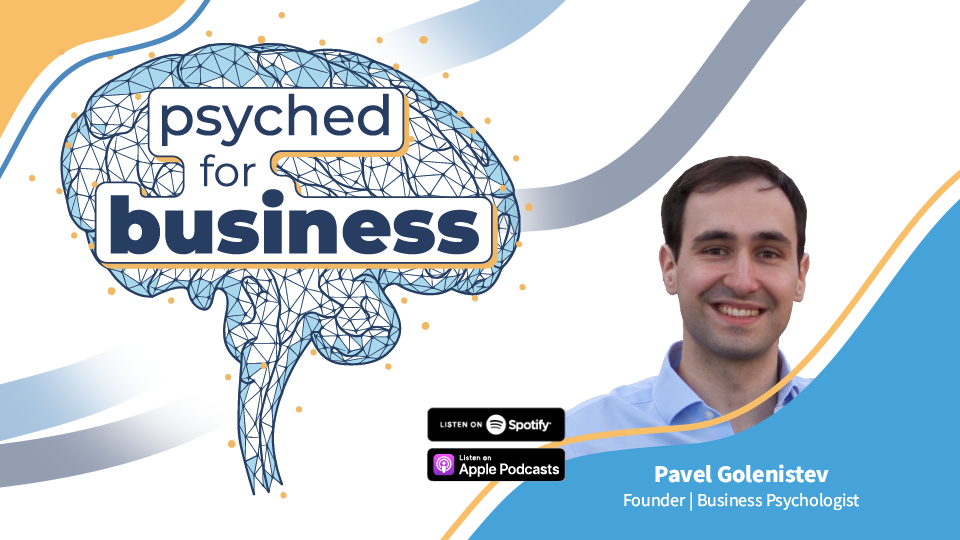
    In this our first podcast episode Richard Anderson is joined by Pavel Golenistsev from Business Purpose Coaching.

    Pavel is an organisational psychologist specialising in people, analytics and talent management.

    His goal is to make sure that organisations have healthy leadership practices and a sustainable talent strategy in place and works as a business coach and assessment expert.

    Although Pavel has a wealth of experience working across large organisations with thousands of staff, he’s incredibly passionate about supporting ambitious startup leaders as they scale their businesses. And that’s what this episode is all about.

    In this episode, we cover:

    • The challenges startup founders face when their business starts to scale.
    • How to establish and maintain a business culture when it grows.
    • How to get into good habits when it comes to staff development, right from the outset.
    • The benefits of working with a business coach

    Subscribe to the podcast on your favourite platform:

    Apple Podcasts

    Spotify

    Amazon/Audible

    Pocketcasts


    Episode 01 – Transcript:

    Richard Anderson (00:11):
    Hi, and welcome to the Psyched for Business podcast. Thank you so much for making the time to listen to the show. I’m your host Richard Anderson. In this episode, I’m delighted to be joined by Pavel Golenistsev from Business Purpose Coaching Pavel is an organizational psychologist who specializes in people, analytics and talent management. His goal is to make sure that organizations have healthy leadership practices and a sustainable talent strategy in place and works as a business coach and assessment expert. Although Pavel has a wealth of experience in working across large organizations with thousands of staff, he’s incredibly passionate about supporting ambitious startup leaders as they scale their businesses. And that’s what this podcast is all about. In this episode, we’ll cover the challenges startup founders face when their business starts to scale how to establish and maintain a business culture when it grows, how to get into good habits when it comes to staff development, right from the outset and the benefits of working with a business coach for your start of business. Thanks again for listening. Hi Pavel. How are you doing? It’s great to have you on the show. How’s things.

    Pavel Golenistsev (01:16):
    Yeah. Hi Richard. It’s very great to be here. Thanks for inviting me doing well. Thank you. How are you?

    Richard Anderson (01:20):
    Fantastic. Yes, I’ve had a good week so far. It’s, uh, the sun’s shining and, uh, although this is gonna be audio, you’ll probably see that it’s, uh, it’s blazing, uh, through the windows here, but I’m not Ling and put it that way. P

    Pavel Golenistsev (01:32):
    That’s all good.

    Richard Anderson (01:33):
    Absolutely. Anyway, we’ve got a fantastic, uh, subject or I think it’s a fantastic subject. It’s something I’m incredibly passionate about. We’re gonna be talking about supporting startup leaders as they step up into more senior roles, but before we get into that, um, Pavel Golenistsev will you please introduce yourself please?

    Pavel Golenistsev (01:51):
    Yeah. Uh, thanks research and hello everyone. So, my name is Pavel Golenistsev, I’m an organizational psychologist. I’ve previously worked as a corporate consultant with, uh, a couple of large consultancies and worked with organizations, both counting, uh, over a hundred thousand employees with medium size organizations and with startups and very ambitious scale apps that are scaling. I work with employee engagement and experience culture, diversity and inclusion surveys, bringing the people analytics perspective to things while also working with talent development, assessment and coaching. So trying to really, to be that bridge between the data side of things and the people side of things and bringing psychological perspective into all of it,

    Richard Anderson (02:35):
    A very important bridge that is as well, of course. Fantastic. Well, that, that that’s brilliant public. So, um, I, I know of course why this is a really important subject about, um, supporting those startup leaders as the business starts to scale and they start moving into more, more senior roles. But what, from your perspective, why is this an important thing? What do you, what do you see with these people?

    Pavel Golenistsev (02:56):
    So I think there are a few things to it. One of them is, is that when a startup scales, when a startup is growing, it begins to face very different set of challenges. If before it was about the initial growth about getting the minimal viable product, right? It’s becoming more and more about main maintaining the culture. First, it was startup culture where everyone knew each other, everyone knew each other’s birthday, and now it’s really changing into something much bigger. And with more people involved, there are more interactions between people. So there’s a challenging question for the startup. That’s looking to scale to also scale this culture, to maintain that friendly, let’s get the work done environment where also linking that to the more complex processes that are needed for a growing business.

    Richard Anderson (03:46):
    Brilliant. And at what stage in a businesses scale do you think that this is a really important thing? At what point, for example, do we get past the stage of just having an MVP and maintaining that, that culture of a few people there when you see this being a big challenge, how many staff normally is the, is the case where, where, where this is a, a bit of a challenge,

    Pavel Golenistsev (04:04):
    I guess there are a few considerations first off, uh, founder of the business or a team of founders they’d want to be thinking about the culture early on, what sort of leaders do they want to be? What sort of culture do they want to have under a business? And sometimes this can depend very much on the founder’s personality, how much it’s affecting, uh, how the things are. Are we focusing more on numbers? Are we focusing on sales? Uh, are we focusing on giving each other feedback? And there are some things, there are some blind spots that people may not even consider that are very important. So thinking about that, the first place, but sort of culture do we want to create in here and what sort of culture do we want to maintain? And then how do we do that? That’s an important consideration early on, uh, then, uh, to your question on this size, I’d say when business is around 20, 30, people now is a good time to really start thinking about how, uh, how are we scaling that there are several teams, those teams may or may not have their own subcultures that are dependent on the managers and leaders of those teams.

    Pavel Golenistsev (05:11):
    Now, the founder or the executive team, they can no longer, uh, see how everything is done. They just don’t have enough bandwidth. They, they cannot be working on the business while also caring about the people related matters and the culture full time. That’s very important. And then when it really gets complicated, when it’s, uh, 50, 80, over a hundred people, when you cannot expect everyone to know each other’s birthday, when there might be development of certain groups where politics may, uh, become forming, which is just a natural thing of how things work for business and for humans, for organizations. But it’s very important to make sure that the culture is in the right place. So to answer your question, Richard founders should start talking about it and thinking about it as early as possible, but then it really becomes important when the business scales pass 20, 30 employees.

    Richard Anderson (06:04):
    Brilliant. And, and you talk about culture, then culture is something that I’m almost admit I’m very, very interested and I’ve, I’ve read a little bit about the subject and by no means an expert, it was one of the things when I started evolve was to try and ensure that we had a, a great culture. Well, what does a great culture mean? And, and I, I think I, I worked out, it was all about business values and I have to add that we haven’t, um, finalized our business values just yet. But how would you say, you know, use me as an example, if you want problem. I mean, I, I, I run a, a small business. We are starting to scale. We’re not at the, the stage of having 20 staff yet, but how would I ensure that, that the culture that, uh, I suppose I slash we as business founders have have established so far, how do, how do I ensure that, that, that remains with the future staff that we, that we take on? So culture drift doesn’t occur when we get the 20 or 30 or 40 stuff.

    Pavel Golenistsev (06:56):
    That’s such an important question to be asking now at this stage, Richard, and I’d say as a general rule of thumb focus on some of the basic principles, one of them, a very basic principle, probably as all this humanity itself, due to others, what you want others to do to yourself, and to translate that into the environment that you’re currently operating in, what sort of culture do you want to be part of? What sort of leader would you like to be? What sort of leader would you like to have? Would you be inspired to follow and how can you be more of that? And don’t just stop there answering that question. Cause once you’ve answered that question, start thinking, well, is there something that someone else might have replied to that, that you’re not thinking of? We all tend to think that our ideas about how things should run are slightly better than average are better than others.

    Pavel Golenistsev (07:46):
    And sometimes it may be the case. Most often there can be a bit of self deception involved for everyone because someone who is running a business, who’s a founder. It’s, it’s like their baby. They’re very close to it. They, they really care about it and they really want to get it right. They also probably have the sort of free spirit that got them into business in the first place and a certain amount of confidence to be able to persevere at that what this means sometimes though, is that the good thing of having confidence can also result in, uh, developing certain blind spots? Are there some things that founders may not be understanding due to how they normally appear or prefer to work as professionals? For example, someone who is very focused on the numbers, working with the data may shy away from exploring things that are sometimes referred to as soft skills, like giving feedback or coaching, their direct reports and the rest of their team and vice versa or anything in between. So it’s really important to first answer the question of what sort of leader you want to be, but then also to try and understand, is there something else that you may may be missing just because you all of us tend to look at the world through certain lenses?

    Richard Anderson (08:59):
    Of course. And I think it’s a, it’s a really interesting point you make regarding blind spots. And again, I I’ll just use myself as an example because it’s so topical, this, this, this, you know, this particular topic in of itself. I previously, when I started the business, it was all about what you were talking about before it was that entrepreneurial spirit. It was, it was to have an MVP. It was to try and demonstrate that this actually works. And it was never about how best to recruit staff and how to lead people. That was, that was almost a secondary thing to why I initially started, started the business itself. And it was fairly recently. One of my employees, I was a little bit embarrassed, uh, about this. And I’ll be, I’ll be a hundred percent honest. One of my employees had come up to me and asked for some feedback.

    Richard Anderson (09:40):
    And I thought, well, I haven’t, you know, had, I haven’t put in place an established model here whereby I give enough feedback. It’s all been done a little bit because there’s so few of us and we’re all kind of in the same office, it’s all been done sort of informally and during catchups. But one of the, one of the things that, that, that I’ve I’ve put in place is to have proper quarterly and, and annual reviews. But do you find that many business leaders in startups don’t put them processes in from the beginning and they, they, they may be regretted a little bit later on because all of a sudden they’ve got however many staff and they’re not, they haven’t got a formal process in place. Do you, do you see that quite often? Or am I, am I unique?

    Pavel Golenistsev (10:19):
    Uh, <laugh> we, we, we like Tahi, we’re quite unique and every situation has its own challenges, but, uh, what you’re bringing up there is a very, uh, real challenge for many startups. There may often be like in one thing or another, and it’s so happens that for a company that’s very successful, that’s growing very quickly getting a lot of customers, things like employee experience and the culture may just be overlooked. And that’s not a problem when again, everyone knows each other when it’s 10 people working together very closely on slack, but when it’s more people, when they’re groups, when they’re different departments in the business, that’s when it becoming more challenging. And that’s where the like becomes really obvious when leaders may have overlooked some challenges around culture, around communication, and some of those things may be quite basic. And, uh, what’s more important is that for those who have been with the company from the very inception, they may not even notice that. And many people may be promoted into more senior roles just because they’ve been around for longer and they may or may not have the management and leadership skills. So it’s very important to make sure that they have the skills to scale the business and to step up to the roles of managers and leaders. And it’s very important that the founder and the executive team, uh, keep in mind what sort of culture they want to have for the business, and really think strategically how they can maintain and scale that culture.

    Richard Anderson (11:43):
    So, so when you talk about the, I guess the founders and the executive team establishing what culture they want for the business, I mean, how many other people do you get involved in that? Or is it typically, would you say just the founders and just that exec team to decide on, on the culture, would you, I mean, do you get any other staff involved ever? Do you give, do you get feedback from the wider team and at what stage does that stop?

    Pavel Golenistsev (12:02):
    Yeah. Uh, all of those are great questions. Now, I’d say it’s, uh, very good idea to involve as many people as possible and creating organizational values in making sure that everyone’s clear about those things. There is a big danger for some businesses as they grow and acquire more processes acquire and get more stuff that hasn’t had the experience of the initial startup culture of the early stages to feel that the values don’t quite connect resonate with them. Let’s say if a business grows from 10 people to a hundred plus people in a few years, then there are only a few people who really remember how it used to be back in the world, west times of building a startup and how different things are now with, uh, company with processes, with all of those things. And the culture’s very different. They notice that, and they still want to maintain a bit of that entrepreneurial culture, but it’s very difficult. And when fewer people were involved in initially defining, creating the set of values, expected behaviors, and defining that culture together, they’ll just feel like, ah, it’s that corporate speak. We are becoming a larger organization. So people just become a bit cynical about things, and that’s where real sort of inertia kicks in. And that can be very destructive for the culture and counterproductive for creating this sort of culture that startup initially wanted to promote.

    Richard Anderson (13:27):
    So it’s, so it’s about once you’ve, you you’ve established those values, making sure that they’re, um, and you always hear about the, the values that have just been stuck on the wall and just ignored by everybody, but you wanna make sure that they’re involved heavily presumably across the business, within all of the processes. So everybody’s, I suppose, ad adherent to them.

    Pavel Golenistsev (13:46):
    Yeah. And there’s a question of values, but then how are they actually represented in day to day behaviors? And here are very important exercise will be, and something that, uh, head of people, head of HR should, should be working closely with is how to translate values into expected behaviors and how to encourage those behaviors through feedback processes, through performance review and promotion processes, and in the interviewing process for competency based interviews and other exercises that will help to find the sort of people who would be displaying behaviors that company wants to encourage.

    Richard Anderson (14:25):
    So, so let’s just dissect that a little bit further if, if that’s okay. Pav. So we talked about values and then we talk about behaviors. Obviously there’s a, there’s a distinction between, between the two there. So once the values have been established by the organization, then, then we need to work out how the expected behaviors of, of staff is that, uh, how you would behave according to those values. Yeah. Yeah.

    Pavel Golenistsev (14:49):
    It could be one way of going about this exercise. Yes.

    Richard Anderson (14:53):
    So essentially across the employee life cycle, you mentioned from competency based interviews. So that, that would be, is that, is that again, based around, you would ask questions as an interviewer, based around those values, you would incorporate those types of processes into the, into the, into the recruitment

    Pavel Golenistsev (15:07):
    Process. That’s, that’s something that, uh, many companies can choose to do and to do it successfully. They do need to make sure that there is an element of consistency, but also an element of everyone feeling those are the actual value set behaviors that we want here. And as we’ve discussed earlier, Richard, sometimes, uh, it can be the case of, we will define some values and they make us sound amazing. Uh, we, we can give ourselves a pat on the back because of how good we sound according to those, but is it actually how we are as a culture? Is it actually how people communicate in this company and on someone’s team? Is it different? So what sort of behaviors do we see that work and what sort of behaviors don’t work and are, are there some behaviors that we can easily address and change if we want to, and are there some behaviors that have second order consequences and that actually are in that productive overall for our culture.

    Pavel Golenistsev (16:05):
    So all of those things can be really important to consider. And some of this really requires some tough decisions for the leaders, for the founders who are working so closely with the business and for everyone on the team, when they actually say, well, the sort of culture and values and behaviors we want to have, are we actually encouraging that effectively? Is it actually helpful? And I’d say the big part here starts with the leaders and with the founders themselves, they’re making sure that they’re actually living according to their values. They want to be living with.

    Richard Anderson (16:37):
    Yeah, it, it seems that that’s a paramount importance and I’m learning a lot here as I’m, as I’m speaking to you. And I wonder because again, in my, in my situation, so very quickly I’ve only ever worked for small businesses, startup businesses, essentially. I’ve had no real corporate experience and in truth, I haven’t had any real formal development. And that’s just me being completely honest in terms of the, the, the jobs that I’ve had. You know, I’ve, I’ve certainly had line managers, I’ve certainly received an element of, of feedback, but it hasn’t really been a formal process. Like we see with a lot of the, the bigger organizations out there. Do you find that there’s for, for, I guess, startup businesses and founders of startup businesses that that’s often often the case, or is it, is it a genuine, is it a genuine mixture that will come from all different sorts of backgrounds?

    Pavel Golenistsev (17:24):
    I it’s a mixture. You know, it, it may or may not be the case. I guess something that is very generally speaking, uh, uniting for all the, uh, founders in the first place is that they chose to build something themselves. They weren’t just happy to accept whatever was, uh, set up before and felt that they could do better in one way or another. But then the lack of experience, uh, let’s say, in the corporate frameworks, I’d say it’s not necessarily something that is an obstacle for anyone. There are lots of very successful, uh, business leaders who don’t have any of that experience with corporate experience as well. Sometimes it may also be an obstacle because what works for a large corporate doesn’t necessarily isn’t necessarily going to work for a smaller company and more so in sometimes in large organizations, some behaviors that are actually unhelpful, maybe reinforced, but because the company is so big, what’s unhelpful is actually getting lost in there. There is a lot of very successful and helpful corporate training and a lot of it isn’t. So at all, so there is always nuance and it’s worth exploring that, but on a case by case basis.

    Richard Anderson (18:33):
    Yeah. I mean, that’s a great, that’s a great answer probably makes sense. And the reason that I, that I was just keen to find out about that if, if there were any, um, trends there is just because for me personally, who’s never really had a great deal of formal L and D if I’m honest, learning in development, I guess the thought of providing that to other people is, is challenging. If, if I’m, if I’m completely honest and, and especially endeavoring to take on those processes personally, um, I know I have to do it, and it’s definitely an area that I need to get better in, but because I’ve given development to other people when I’ve never had a huge amount myself, it’s a bit of a, it is a bit of a challenge. So what would the answer for myself be to do, do you think to, to, to work with a coach or, or something like that to, to support these things?

    Pavel Golenistsev (19:17):
    Yeah. And it’s very understandable that it feels like a daunting task at times. And I think what, what, what you’re so openly sharing here, that it is a challenge. Uh, we need to be having more conversations like that. Of course it is challenging, of course, for someone who has experience in one area, it may not come naturally to work in a, in another area and working with, uh, leadership with the people matters. So to say, it’s, uh, it’s more of an art than science. Uh, so it’s, as you said, it’s very important to keep in mind the nuance of that, but also knowing where is your moral compass as a leader? What is it, what sort of legacy do you want to live as a leader and making sure that you find your authentic style of doing things. And that really comes back to that idea of it being an art rather than a science, although there is some great science around the psychology of leadership, but the question really is, instead of let’s say going, looking at some article on LinkedIn that says, here are five top behaviors for a leader or something like that, which may or may not be helpful for some people, but there are people who are reading that and thinking, oh, I can only do like three outta five, or none of the supplies doesn’t mean I’ll never be a good leader.

    Pavel Golenistsev (20:35):
    Well, no, uh, probably that research or that set of conclusions was arrived to based on a sample of those, for whom it makes sense, or it was oversimplified or whatever else happened there. But what’s really important is fighting this sort of authentic style that works for the individual while keeping in mind some of the basic principles and one of those basic principles being that we need to do right by people, we need to be honest, we need to inspire people and make sure that people are treated well.

    Richard Anderson (21:07):
    Okay, then puzzle. So if, if you were in my shoes now, and let’s say that my business was slightly bigger, and let’s say we were getting towards that, um, that 20, 30, uh, amount of staff, which won’t be ever. So, so, so long into the future, I wouldn’t think, but, but given the, the, the, sort of, some of the challenges that I’ve had previously with these things, the lack of formal, um, training in the past, and, and all of a sudden going from being an entrepreneur and starting a business to, to then managing people, what would you say would be if, if you had to choose kind of two or three really important things for me to consider as I move forward, what, what, what would those be in, in terms of priority?

    Pavel Golenistsev (21:44):
    So, uh, as I respond, I’m going to sort of build, I guess, um, a aggregated profile of different people I’ve worked with because I’ve been working with a lot of professionals who are moving, stepping into those leadership roles from operational technical or sales or delivery background. I think it, as a first step of helpful exercise would be, uh, for you to map out and decide what sort of things are you really great at? What sort of things do you enjoy doing, then you would want to think what sort of those things you’re likely won’t have time for as the business is growing. And how can you make sure that there are more people to whom you can delegate the sort of work that you probably shouldn’t be doing. And here we need to be very careful. You also need to make sure that you’re still motivated.

    Pavel Golenistsev (22:32):
    Let’s say, if you really enjoy your technical stuff and coding, for example, then giving it up completely, just because you are stepping into more challenging, strategic role. Like it may make you feel miserable at some point, and you may really miss that sort of building things. So how much of it can you, uh, do yourself, but also understanding how much of it, like, can you pass over to others and make sure that you’re building scalably, a team who can, uh, take on some of the challenges that are more operational and administrative in nature. And then, uh, once you’ve identified, what are your strengths and what sort of things can you delegate? How can you enable your team to take that home? You also want to be honest with yourself, what sort of things aren’t quite your strength and making sure that you’re hiring for that, or outsourcing that, and making sure that you are addressing some of the questions through personal development and the personal development bit will probably be not so much about the technical side of things like financial knowledge, which is important to have a basic understanding of, but you also want to bring in a professional, who’s an expert and who really loves their numbers, but the leadership side of things, are you giving feedback effectively?

    Pavel Golenistsev (23:44):
    Do you know how to coach your team? Those are some of the questions that you would also need to explore and develop yourself as a leader. And the good starting point here is to be honest with yourself, where is it that, you know, you may be following short, but also very importantly, and this one’s a bit more complicated, but understanding what, where maybe some of the thinks that you don’t know that you don’t know what may be some of the things that you don’t even realize that might be a challenge that can be a very important blind spot that’s affecting a lot. And you may not even realize that.

    Richard Anderson (24:17):
    And what do you think the best way of, of if it was me, for example, ascertain and what, what my strengths and my blind spots are. There are things of course that I know I’m good at. Of course there are mm-hmm <affirmative>, but there are things equally that, that I know I’m not good at, but there will be things that I, I haven’t got a clue about. So some people might say, well, he is not very good at that, but I think I’m, I’m great or whatever. So what would be the best way of, of, of trying to establish where, where, where those strength almost objectively, where are those strengths and where are those areas for development?

    Pavel Golenistsev (24:46):
    There are several ways of measuring that. And there are some of, so to say, traditional ways of measuring that like 360, uh, feedback where everyone gets to evaluate, let’s say you as a leader, both your peers, your co-founders, uh, teams you’re working with, but also the employees and people that you’re managing directly, but then it can also be helpful to use a psychometric assessment to understand what is your perception of yourself? Where do you think your strengths are, and how do you compare with others now, uh, people listening to this may say that there are lots of limitations to 360 assessments and to psychometric assessments and all of this should be taken over grain notes of salt. And I very much agree with that. We should never conclude that something is a definite truth just based on one assessment, just based on one piece of feedback, just based on a psychometric assessment.

    Pavel Golenistsev (25:44):
    That seems like it’s really looking into our soul and telling us the sort of thing that, uh, feel very personal, but we should look at different, uh, places, different data points to understand that. And once we look at that, we, it’s very helpful to have a nuanced approach. It’s very helpful to combine those different sources of data and to have someone as a coach who can guide us through that, who can help us understand that getting the data is very helpful. It’s a very helpful first step to visualize what may be potential strengths and blind spots. But we should also consider that as a starting point in a journey, it’s an important step, but it’s just the first step and the coach can help understand how can that look for a person going forward.

    Richard Anderson (26:32):
    Yeah, so, so, so there’s lots of different approaches there that, that, that you’ve discussed. I think, um, one of the things I’d be, I’d be interested to, to find out about, because we’re talking about small businesses here, startups, uh, essentially, and investing in learning and development. And I know as a startup, um, founder, every investment that we make has to be thoroughly, thoroughly calculated, particularly, uh, particularly at our stage in business. So in terms of, I guess, return on investment for the tools that you talk about. And I don’t just mean the tools that you talk about. I talk about, um, investing in a, in a, in a coach as well. What are the, what are the things that people what’s the real return on investment that people are gonna get in terms of output from, from investing in these things problem?

    Pavel Golenistsev (27:14):
    Well, uh, you know, the return of investment question has been a big one. It’s challenging to say, like, if you hire a coach, then after, after one quarter, then after half a year, your business will perform this much better. Uh, with complex things like that, I recommend looking at them through the negatives, what is the cost of not solving that? What is the cost of not getting a, a coach? And I think that’s when it becomes much clearer. So, uh, I think as a general rule, if you don’t know, then just ask the reverse question. What’s the cost of not getting coach and just to, uh, put this also in perspective, sometimes people think, oh, that that question that’s on top of my mind, is it really I related to business? Or is it more of my personal life sort to think, uh, where I would argue that if it’s bothering you, if there is a particular question, if that doesn’t feel like a business question, or if it’s something that you feel is a priority at the moment, like giving feedback to someone and a person’s really worried about it, or a, person’s not very comfortable in their shoes as a leader, and this is <inaudible> their self-confidence and they feel that it’s not a business related question.

    Pavel Golenistsev (28:30):
    Well, if you are thinking about it, uh, when you should be taking rest to recover, if you’re thinking about it, uh, when you should be preparing your pitch meeting, then it is a business problem. And what is the cost of not solving that? What is the cost of not clearing your mind out of that challenge, overcoming it, and also seeing what else you might be missing, because you’re not addressing that question. And I think that’s the ultimate question that someone needs to ask when deciding whether to get a coach or not.

    Richard Anderson (28:58):
    Yeah. I mean, it’s a great answer B and, and, and you’re absolutely right. It’s funny because if you, if you think, if you’re not willing to invest in, in, in your people, in, in development, in providing feedback to them, I suppose the not wrong effect of that is that people, you know, essentially gonna leave the organization. And we know that the cost of attrition is absolutely sky high. Um, typically, so, so yeah, I mean, it’s it, yeah, that, that makes complete sense. And, and I guess just, just, just, just finally, to, to wrap up with P um, you know, just, just a minute or two for, from yourself to, to explain how you can, how you can help small, or, you know, any size, any size businesses with some of the, some of the coaching that you do.

    Pavel Golenistsev (29:37):
    Yeah. Thanks Richard. Uh, so there are a few ways I help businesses and I help businesses by combining the data centered approach to very, to an approach that’s really grounded in supporting people. Some of my past clients U usually bring me in to help them with evaluating what may be the challenges with their culture, with hard to define, but difficult to master constructs like psychological safety sense of belonging, overall employee experience. That’s where I help companies gather employee feedback about that in a way that’s anonymous. So employees can actually feel that they can trust, uh, that the data they share will not be seen by anyone in the company and facilitating conversations around some of the challenging feedback that’s coming from employees and translating that back for leaders and supporting them. And following up on this conversation with employees, I also help senior leadership teams understand what their peers and the rest of the team thinks about them through, uh, bespoke 360 feedback that’s, uh, that we co-design mapped to their organizational values and behaviors, things that are really important and meaningful for them, but also making sure that it’s not just sort of nice things that they’re collecting there, but really something that I know has worked for some companies and has, uh, generated some challenging, but very helpful conversations.

    Pavel Golenistsev (31:06):
    And then I provide coaching on top of that. That’s very different for different organizations. It can be ranging from building up self-confidence and people who were just promoted into leadership role. And aren’t quite, uh, sure, uh, how to navigate that to conversations where a founder or an experienced business leader is wondering, how can they scale the culture of their business effectively maintaining that startup field that made everyone work so well at the first place, but making sure that it’s translated into, into processes throughout recruitment, performance development and, uh, overall organizational communications cycle.

    Richard Anderson (31:47):
    Fantastic. And if anybody wants to get in touch with you P what’s your, what, how do they best do that?

    Pavel Golenistsev (31:53):
    Uh, the best way to connect with me is through LinkedIn and also through my website, which is www.business, purpose.com.

    Richard Anderson (32:03):
    Well, P thank you so much. I really, really enjoyed the discussion. It’s really great having you on the show and, uh, yeah. Thank you very much.

    Pavel Golenistsev (32:09):
    Uh, Richard, thank you very much for inviting me. I really enjoyed our conversation today and your, uh, insightful questions and thank you everyone for listening.

    Voiceover (32:17):
    Thanks for listening to psych for business, for show notes, resources, and more visit evolve, assess.com.