A buyer persona is a semi-fictional character made up of behaviours and characteristics associated with your company’s target audience (the people who will buy our product/service).
Buyer personas are an important part of sales and marketing as they allow you to be more specific in your messaging and talk directly to the audience you want to sell to. For example, if you understand that your buyer persona’s key challenge is employee attrition, you can engage in a conversation with that persona about how to reduce the rates of attrition in their business.
As these semi-fictional characters essentially represent your target audience, it’s good to have some strong buyer personas when working on new sales and marketing content especially if you’re looking to grow your psychometric services , and we recommend starting with 2-3 personas.
What does a buyer persona look like?
A buyer persona, whether nicely designed in a printout and stuck on the office wall, or a simple PDF that you access from time to time should make clear all of the behaviours, characteristics, challenges and triggers that a prospective buyer might have.
When working on the buyer personas, it’s really important to take the time to fully consider the position your personas have within the business, whether they have decision making authority (or act as influencers to those more senior), what their interests are and what motivates them.
A good way to develop a buyer persona is to start with a persona workshop.
Running a Buyer Persona workshop
The purpose of the buyer persona workshop is to understand the interests, frustrations, concerns and challenges of these people – it is not to focus on your company message to them.
It’s best carried out with a few people in the business, although we understand in start-up and small businesses, this might only be a couple of people – regardless, it’s a good exercise to carry out.
Describe your ideal customer – include size by geography, size by employees, turnover, industry, maturity, type, market conditions and consider the problems you can solve for the customer.
Break down the buying centre – who makes the decisions in the companies you want to sell to and what is the decision-making criteria they use? For example, if you’re targeting people in the recruitment department of a large organisation, who has the buying power? Possibly the recruitment director? And who are the influencers for this role?
Consider the competitive landscape – who’s in the marketplace already and what changes are happening/coming down the line and how will this interest/affect our ideal customers?
Triggers – this is anything that could trigger your persona to look for a product or service like yours – whether that’s high attrition rates, new hires not performing, new employees not being a good cultural fit etc. List as many triggers for each persona as possible!
Describe your personas
Who are they – in their business, but also what are they interested in?
What do they read?
Where do they consume information?
What do they subscribe to?
What do they really care about?
What are their challenges and the implications of these challenges?
What frustrations do they have?
What would they do to alleviate them?
List all of the ways that we can currently help, and how we could potentially help in the future.
The last step can be repeated for each persona you want to create.
From the persona workshop, you can create a report that clearly shows and defines each buyer persona, which is then used to help plan out your sales and marketing messaging for future campaigns and sales tactics.
How you design the buyer persona report is up to you, but the most important thing is that everyone who needs to can access it and that they understand why it’s important and the value it serves!
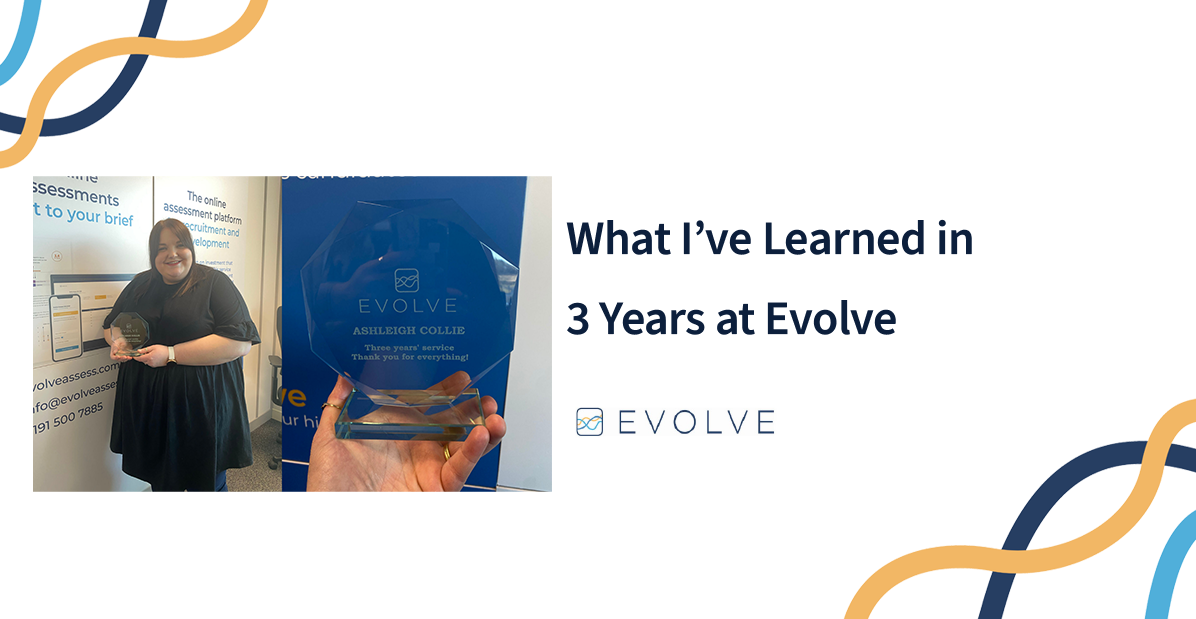
Two years ago I started to write a blog on what my first 12 months of working with Evolve Assess had been like, and what I’d learned in that time. The day after I started my blog, I had some sad news in my personal life and took time away from work. After that, my blog was forgotten about and has lived unfinished in the notes on my phone since.
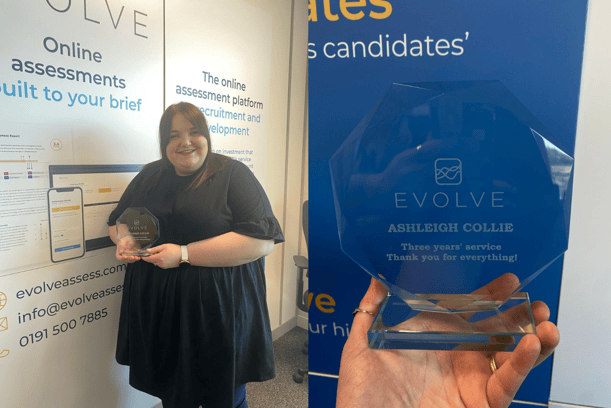
Now that I’ve been here for three years, (time flies when you’re having fun!) there’s inevitably a lot more that I’ve learned since then, so here I am finishing my blog! To start, I feel its important to share the (short) intro that I had written at the time, because it still reflects how I feel two years on –
“Sitting on Sunday night after a very busy weekend, I’d normally have that back to work in the morning dread. But not tonight, because in my 12 months at Evolve Assess I have genuinely never had that feeling, and that is because I love my job. The last year has been filled with lots of hard work, laughs and vanilla Nespresso pods, but what have I learned working in a micro business?”
Now, my experience doesn’t mean that working in a small business is everyone’s cup of tea (or vanilla coffee), as it isn’t for everybody. Having grown our team and recruited for a number of roles over the last 18 months, we’ve experienced first hand that not everyone likes or is suited to working in a smaller business, and that’s okay. As a team we recently took the Type Dimensions questionnaire to explore our personality styles, and after a session to digest our reports, we learned that some personality types just prefer to work in smaller or larger organisations. As an ISTJ, I have worked in large, corporate organisations and in small businesses, with Evolve being about as small as you can get at the time I joined, so I have seen both ends of the scale in terms of business size. Based on this, I know that I am happier and more satisfied in my role within a business like Evolve Assess.
Here’s what I’ve learned:
– “That is not my job” Well actually, yes it is! When you’re part of a small business, there are no defined Project Management, Finance or Admin teams, which means that you get the opportunity to be all of those things depending on what is needed at that time. As cliché as it sounds, this means that no two days are ever the same here! My role is, and will always be varied, which is something that I love. This also means that sometimes there may be tasks such as admin jobs that aren’t as exciting, however a good album and noise cancelling headphones can get you through any amount of content upload!
– Making the most of what you enjoy I joined Evolve as Client Success Manager with my main responsibility being to look after our existing clients and help with new business wherever needed. My role quickly changed, as we were taking on new bespoke projects that required more development work, and therefore my role then required a lot of project management. I quickly realised that PM and delivery was something that I really enjoyed, so have been able to shape my own role here and go down a route geared towards the tasks that I like most. I have been lucky that to have this opportunity as the business has grown, but allowing staff to explore their areas of interest creates a happier, more productive workforce who are performing the tasks that are based on their strengths.
– “We are one big family” Controversial, I know! There has been a lot of conversation recently around whether you should think this about your team, but as the “Mam” of Evolve Assess, my thoughts are clear. I mentioned that I’ve had some loss in my personal life, and I have had the most challenging couple of years yet. However, what I gained through that loss, was a new, caring work family. I genuinely believe that if we didn’t have the culture that we do at Evolve Assess (more on that later), my experience would have been very different. There is no hiding when you work so closely in a small team, but that means that you never face anything alone. If you’re having a bad day, the team feel it with you, and that means there is extra laughs, walks around the business park or just an ear to listen when you need them. Working within a larger organisation can often feel like you’re a small fish in a very big pond, but with us every single member of the team is so vital and appreciated for who they are as a person.
Company culture is massive A little while ago, Richard wrote an interesting blog on defining company culture, and we try to ensure that we practise what we preach. Building a company culture, specifically in a small business is a hard job, as anyone who shares different values, ethics, vision or behaviours can quickly damage the culture you have worked so hard to establish. Here at Evolve, we sat together as a team to define our “Why?” statement. This allowed us to discuss our own values and align our focus towards a shared mission, making us overall more productive and driven in our individual roles whilst committed the main goal of the business.
–Pros vs Cons Don’t get me wrong, working within a business like Evolve Assess inevitably has some downsides. You don’t get the security that you do within a corporate organisation who has mega bucks in the bank, and depending on your role, this may feel like a lot of responsibility. However, what we offer far outweighs any of the less attractive aspects of a small business. With us you are a big fish in a small pond. Your ideas, thoughts and achievements will never go unheard and will always be welcomed and celebrated, how often can you say that you contribute to the key decisions of a business as an employee?!
– Trust Lastly, my biggest learn over the last three years has been how important trust is in a small business. Trusting your employer, your staff, your colleagues, your customers and most importantly yourself is key. Being part of a business of our size means trusting the directors to make wider decisions that could inevitably affect your livelihood. And this means that they have to trust you in return, to respect and value their business as they do themselves. Trust your colleagues to put their heart and soul into their own responsibilities. Your client partnerships will be based on trust, allowing for mutual success through a shared objective. And trust yourself in your own capabilities, new challenges may be daunting, but trusting in yourself allows you to perform to the best of your ability, and as Amy Cuddy said – fake it until you become it.
My three years here have shown what a successful small business can look like. In the last three years we’ve grown immensely! We’ve had four offices, our team has gone from two to seven and we’re on our second Nespresso machine! If that doesn’t demonstrate success, I don’t know what does!
I am genuinely so proud to be part of the Evolve family and everything that we have achieved so far. Our successes have not been without blood, sweat and tears, however, there hasn’t been one day yet that we haven’t laughed together. I am looking forward to seeing what the next three years has in store for our little business!
Ashleigh Collie – Project & Operations Manager
My passion at Evolve Assess is helping you bring your assessment solutions to life. Whether it be for recruitment, development or accreditation, our question types and analysis ensure that you can make the right business decisions from the use of online assessment.
Regardless of the level of management, leadership is an important ability.
At a top-level, such as C-Suite roles, leadership is important for co-operation in devising procedures and policies. At mid to entry-level, leadership is required for the interpretation and implementation of procedures and frameworks as outlined by top management.
Leadership can be applied through guidance and support of the staff working below throughout the execution of plans and procedures.
Management Study Guide1 provides an excellent list of roles of leaders, which is broken down below:
Representing the organisation:
Any leadership role, like a manager, is an ambassador of the company. They must represent the business in the best possible, honest light, and communicate the mission of the company to the wider audience, they represent the values of the company – values that their own beliefs and actions should be based upon. In a more, inside-the-business sense, a leader represents the department in which they are leading.
Integrates personal goals with organisational goals:
A leader is expected to merge the personal goals of employees with the goals of the organisation, through coordinating the efforts across the business towards a common purpose, in turn working towards and achieving targets. This can only be done when a leader holds influence and obtains willing co-operation.
Providing a support system:
A leader is expected to invite the support and cooperation of employees – having a strong, encouraging personality and plenty of experience as well as being aware of the assistance employees need in order to implement support should provide positive results.
Leaders have to be open to suggestions and willing to apply these to future plans. This way, the full support of employees creates more willingness to work, therefore creating a more effective team.
Offer guidance and build rapport
A leader offers guidance through supervision and communication of plans and policies to secure co-operation.
It is important that alongside this role of guidance, that solid rapport is built with employees; having conversations with employees and gaining understanding, as well as utilising intelligence and experience to manage employees.
When developing leaders, gaining feedback from employees allow opinions to be shared from multiple angles in order to plan goals for personal and professional development.
With Evolve as the assessment engine, online tests and examinations can be delivered while maintaining traditional testing conditions.
All jobs require some level of training for new employees, and unfortunately for some organisations, induction training is as far as it goes.
When building an L&D strategy, there are multiple influential factors to consider, these include, but are not limited to:
Business Strategy:
The business strategy establishes the training requirements for current and future job skills, and recognising the effect of internal and external context of the organisation allows you to see:
The unique offerings and advantages of the organisation
Future predictions of changes in the sector
The need for adaptability to change in economic circumstances
How customers’ needs and expectations change over time
Evaluating the effect of these factors is a key factor in building an effective L&D strategy.
Use and availability of internal vs. external resources:
It is useful to consider whether you’re able to offer purely in-house training, or if you will require external training for the true benefit of your employees and organisation as a whole. Generally speaking, a mixture of both internal and external training reaps the most benefit – however dependent on various factors, such as company size and industry sector, there isn’t always opportunity to do this.
Internal stakeholder assessment:
L&D has many stakeholders, all of various roles and responsibilities. By assessing internal stakeholders to identify and understand their learning and development needs, it clarifies what to do when training to address all of their needs suitably, all whilst ensuring whatever aspect of L&D they’re involved in is beneficial to them as well as other stakeholders.
Future requirements:
L&D must evolve with the business, as your requirements, resources and tools progress, your strategy for L&D should reflect those changes. By reviewing goals and objectives and ensuring your L&D strategy aligns with them, you’re guaranteeing they progress together.
Learning and Development isn’t just about teaching people the baseline skills they require for their job, it’s about engaging and helping them build a career, bringing them a sense of feeling valued by, loyal to and committed to their place of work. Creating a strong development culture for your people is undeniably the key to engaging your staff and reaching goals.
For further information regarding the use of online assessment in your Learning and Development strategy, book a call!
A Learning and Development (L&D) Strategy refers to any process a company has in place to enhance their employees’ skills, knowledge, and ability to improve their performance at work in order to ensure the success and sustainability of an organisation.
The importance of Learning and Development
Over the past few years specifically, L&D has continually changed to adapt to the shift in organisational needs; L&D is an essential factor in the success of organisations across all industries and sectors. Despite this, many organisations still hesitate to commit financially to employee development without extensive justification.
Not only do L&D strategies strengthen employees, it also greatly benefits leadership across all levels of an organisation; more efficient employees result in a more efficient team, thus the team leaders have the trust in their teams that tasks can and will always be completed to a more than sufficient standard.
Applying employee beneficial solutions at all levels with specific goals in mind increases confidence and performance, and for employees in managerial roles such solutions provide them with a sturdy support system which, again, will increase their confidence and performance.
Further to this, an L&D strategy creates positive outcomes for employees before they even begin their role. Induction orientation and training is now more noticeably important than it has been previously. Specifically, during COVID, many companies have faced the challenge of introducing new staff purely remotely.
Although the use of an online approach to induction loses the personal touch and can occasionally bring about a sense of isolation in new recruits, the ease of the process for both employees and employers reaps great benefits.
The online approach is easily replicable, flexible and can provide L&D experiences that guide future hiring. An online approach can also be applied to further professional development, and, again, is greatly beneficially in that it is more accessible, convenient, and well-situated.
Benefits
Learning and Development is essential to organisational success, and it is greatly advantageous:
Increasing employee engagement and motivation:
When there is a sense of opportunity for employees, they are more motivated in their work. Poor employee engagement is financially detrimental to a business; it results in reduced productivity leading to less drive towards business goals, a higher likelihood of staff turnover as employees themselves are unsatisfied and when employees are unmotivated and disengaged, subsequently, your client satisfaction will suffer.
Counteracting specific skill gaps:
When skills gaps are addressed through collaboration and development strategies, the gap – obviously – lessens. An L&D strategy ensures targets are not only set and understood by all involved but ensures the work towards meeting such goals is in place.
Attracting and retaining talented employees:
When employee development is valued, employees certainly notice; in an ever-growing market where employers are continuously in contact with your employees across many platforms, it is critical to retain talented staff. When employees feel valued, there is no reason for them to feel tempted by another company offering the same role, regardless of their loyalty to their employer. Providing performance support and employer engagement through use of L&D makes your employees feel valued and important to the company, as well as feeling like they’re furthering themselves professionally.
Staying ‘up-to-date’ with industry trends:
To put it bluntly, organisations that do not put the effort into developing their employees will simply be less successful than the organisations that do. A key element in success is creating a culture of support and encouragement towards personal development as well as offering resources that help employees develop themselves.
Developing and reaching long-term goals:
Programs and processes that are geared towards development set an organisation for success are vital and mustn’t be overlooked. When needs are sufficiently targeted, and a continuous learning environment is instilled in a company, knowledge and efficiency will become continue to grow.
There is no ‘one-size-fits-all’ approach to L&D – there’s various objectives, budgets, resources etc., but there is a clear universal upshot: encouraging a culture of development to strengthen an organisation.
There are numerous reasons an organisation should provide training and development for staff, and there are many ways to put that training in place.
Training Needs
Providing your staff with training not only benefits the organisation in the sense that it increases productivity and reduces the need for constant supervision and direction, it evokes a feeling of value among employees. It shows the organisation is committed to providing staff with the required resources to ensure they can complete their job to a high standard. There are three main different types of ‘training need’:
Organisational needs:
Asking questions such as ‘What are the aims of the organisation?’ and ‘What are our strengths and weaknesses as a whole?’. These questions often result in very broad terms, which require being broken down into greater detail before they can be acted upon. A lot of the time, these needs will need to be identified at a team level.
Team needs:
Reviewing team competency needs and skill sets with team objectives and goals in mind – this also considers the individual needs of each member at a high level.
Individual needs:
Using appraisals or one-to-one reviews allow for individuals to self-reflect on their own training needs with the support of their team lead/manager. This is an assured way to identify areas for development – whether this be through training courses or continual professional development.
Training Methods
Understanding your employees’ training needs determines the most suited methods of delivering L&D. Knowing the appropriate method and focus of training ensures your employees learn efficiently, allowing goals to be met.
On-the-job training:
Employees receive training whilst remaining in the workplace, during this training, employees are familiarised with the environment of work that they will be involved in. Whether this be the induction and orientation, working with a mentor or shadowing, or even ‘refresher’ training, it’s an opportunity to give the employees ‘hands-on’ experience of using specific equipment and procedures etc.
Off-the-job training:
This is training undertaken outside of the day-to-day duties and learned away from the ‘job floor’, it can be courses/sessions towards a particular qualification or certification and it still takes place during normal working hours. This can be through use of online courses, seminars and lectures (online or in person), case studies etc.
Effective Strategies – Improving L&D Strategy
There are multiple ways to improve your L&D strategy. Here is just a selection of the ways in which you can implement such a strategy:
Target soft skills:
Yes, technical skills are of great importance, but consider this: let’s say you need to book an appointment of sorts. When you ring the reception, you’re greeted by a bubbly and personable secretary who asks how they can help you today, they book your appointment and wish you well before you hang up. What a lovely experience, right? Now, let’s say you call up again, but this time another secretary answers, they may be slightly sterner in tone, but still book your appointment and are polite enough, but there’s not the same sense of happy, cheery exchange as previously. Who are you more likely to wish is on the end of that line again in the future?
While technical skills inevitably open opportunities for employees, soft skills will develop them further. Work ethic, attitude, communication skills, emotional intelligence and multiple other personal qualities are soft skills that are crucial for career success. When soft skills are undervalued, less training is provided for them which ultimately blocks off a whole pool of possibilities for employees – ultimately the employers too.
Motivate and engage employees:
Providing learning opportunities is one of the most import ways to increase engagement and develop competency. When engaged employees are challenged and given skills for career development, they’re more likely to get excited by new opportunities at work and remain happy with their place of work.
Make use of reviews and appraisals:
Appraisals demonstrate the need for improvement, whilst also recognising achievements already achieved. Without a clear understanding of performance, employees may struggle to have the motivation to upskill. They prevent long-term problems in that they recognise any problems as they’re rising – if a specific employee or even an entire team is missing targets an appraisal is a perfect opportunity to discuss why this may be occurring and put provisions in place to prevent this from continuing.
Develop a mission statement:
Mission statements are a vital navigational tool when considering the future of an organisation; regardless of your overall goal, you must make your mission statement clear and communicate them well throughout your organisation. It encompasses an entire company, and is essential to all involved by creating identity, developing purpose and envisioning the future. It is also important to note that mission statements will change overtime as an organisation evolves, as focus may change. Making small adjustments to a mission statement reflects growth – however the mission statement should never change drastically or repeatedly as this creates confusion around the identity and purpose, which may result in lack of employee belief and commitment to the goals.
This is just a small selection of the many possible ways in which you can develop and build your L&D strategy.
Using 180/360 Assessments in Your L&D Strategy:
180-degree and 360-degree assessments are the process of gathering feedback about an individual’s (the ‘subject’) performance from other individuals in different areas of the organisation. Through a 180-degree assessment, peers give feedback and rate the subject to their team leaders. On the other hand, in a 360-degree assessment, the feedback and rating comes from individuals at all levels of relationship with the subject.
These assessments are extremely powerful development tools in any organisation as they assess work-specific and role relevant competencies in the sense of self-assessment and peer-assessment. The feedback is then compared to reveal any discrepancies and which ratings are consistent. They can highlight hidden strengths, possible blind spots and suggest areas for development.
All organisations should create an environment in which continuous learning is not only encouraged, but accommodated. The value of employee development goes far beyond simply improving staff skills – aligning future workplace skills and supporting business objectives will continuously reap benefits for any organisation, and sets up a fantastic future.
For anyone to lead a team effectively, there are certain functions that need to be undertaken and each requires particular skills in order for them to be executed to a high standard.
Some of these functions include:
Planning
Strategic planning through evaluation of company goals and creating a course of action allows for existing activities and targets to be analysed by leaders. Acting as problem solvers, leaders look at the bigger picture and identify specific factors affecting overall success.
Organising
Bringing resources together to achieve established goals; this includes materials, employees, and finances. By identifying necessary activities and assigning them to teams or specific team members, goals are more likely to be met. Tasks need to remain coordinated by leaders to allow for continuous efficient movement towards targets.
Highlighting and making use of talent
It is important to identify key positions and roles of staff to ensure specific duties are met by the correct talent. Once the correct structure is established, leaders need to stay on top of training and development as well as monitoring performance to truly make use of and build upon the abilities and skills within their team.
Guidance
Directing activities is a key function within leadership, letting a team know what needs to be done and providing a timescale for completion allows for efficient and more productive work. There is more to this than simply providing orders; leaders need to motivate staff to offer meaningful contributions and maintain consistently clear communication.
Controlling systems of success
By establishing performance standards and measuring them continuously, required adjustments can be made to policies and procedures within an organisation. Looking at poor performance as a development opportunity as opposed to a failure, required improvements can be made towards achieving desired results.
These are just a small collection of the many key functions we see within leadership roles; however, it cannot go unnoticed that just because these functions are important, it doesn’t mean that all leaders are skilled in every area.
Identifying leaders in the recruitment process can make a big difference for those working in the team and the attributes and skills that someone needs to be a leader can be a key part of what you look for when recruiting.
What Skills & Qualities Are Needed For Effective Leadership?
Effective leaders enhance their team’s success, and work under the expectation that as a leader, they’re responsible for the team and can rise to any challenge they may all have to face.
The effectiveness of a leader determines how successful a business and its teams will be overall. The use of leadership styles and techniques should drive growth and development in an organisation.
There isn’t one singular guaranteed way to effectively lead a team, there are however common qualities and skills effective team leaders demonstrate in their work.
Having the right skills to be a team leader is about more than just being able to have people follow your orders. A good leader is confident, professional, and fair, they know their team – their strengths and their weaknesses – and they know themselves and how others perceive them. They are personable, approachable and act as a mentor to their staff.
Identifying Skills
Find out whether or not the previous leadership skills are present can be done through an online assessment. Generally, these skills can be identified in the recruitment process – and in staff development – through use of an array of question types. Below are examples of how you may assess these skills in a candidate.
Growth mindset with the ability to embrace failure
A leader that constantly strives to develop not only themselves, but their team overall not only creates an encouraging work environment but makes way for team strengths to grow. A strong and effective leader possesses the foresight to view ‘failure’ as an opportunity for development as opposed to viewing it as an all-around disaster.
These skills can be identified through a series of likert questions. For example, using statements such as ‘When I find a task hard, I recognise it is because I am still developing my skills in that area’/’I find certain tasks hard because I am not naturally good in those areas’ or ‘Every task I complete needs to be perfect first time’/’I will work on tasks, accepting help when required, until the solution is reached’ – the subtle difference in these two statements alone, paired with a candidate selection, which is most like them/least like them will give insight into whether they have a growth mindset or fixed mind set.
Strong communication skills
A leader’s ability to clearly articulate plans and vision, as well as the capacity to truly listen and understand what others are saying forms good communication skills. With strength in communication, respect and trust are built by employees for their leader as they are never feeling unsure or unheard, and even when they need clarity or feel they need to share their thoughts more clearly themselves, they are more comfortable in doing so knowing their leader has a strong basis for communication.
Again, could be done in the form of a likert question – but this time with a scale starting at ‘Not at all’ or ‘Rarely’ to ‘Very Often’. Candidates can rate themselves next to statements such as ‘When I finish writing an email, I quickly scan it for any possible typing errors and read it back to myself to be sure I’ve written what I wish to say’, ‘When I’m talking to someone, I constantly think of what I’m going to say next to ensure I get my point across’, ‘I consider any possible cultural barriers when planning communications’ et c.; the statements should generally remain as neutral as possible in tone.
The results drawn from this assessment will give clear insight into the communication skills of the candidate(s). A verbal reasoning test could also be used to assess a candidate’s communication skills. When given a passage of text, or perhaps a video to watch, and asked the key points of the passage, a candidate’s understanding is tested – communication is just as much about what someone takes away from a conversation as it is about what they offer to it.
Empathy and support paired with a positive attitude
Employees place a lot of respect in an empathetic leader. When leadership offers understanding support alongside a positive attitude, teams feel more truly encouraged and have the belief that expectations can be met and will be reached with a higher standard than that of a team doing so under a colder, less forgiving leader. Of course, work is a place for professionalism and high standards, but at the end of the day employees are still only human – and their welfare affects their work, not just their emotions.
These skills could be measured in the form of an SJT (Situational Judgement Test), presenting a scenario and asking how the candidate would react. There would be options that are more empathetic/compassionate, some more direct and the way in which they respond will give insight into their empathy.
Recognising achievements
Too often, employees are more frequently reminded of their shortcomings and under-rewarded for their success. It isn’t a case of over complimenting minor achievements but remembering to frequently encourage employees by recognising when goals have been reached. By noting achievements, teams, and the individuals within them, feel valued and appreciated by their leaders.
Through use of a 360 assessment – in an already established team & leader – it’d be clear whether the employees feel like their achievements are truly recognised and rewarded accordingly, and how this compares to the way in which the leader views themselves.
Motivating and inspiring
The best leaders drive a team passionately and with great enthusiasm. Investing time in employees, determining their strengths and needs allows for prioritisation. Not only does this create a great sense of value to their work, but it also helps them gain a better understanding of their motivating factors.
This could be done in the form of a free text question, as outright as asking a leader/potential leaders would lead their team. Their answer would give insight into how they may go about encouraging their subordinates.
Leading by example – not force – with the desire to learn
Seeing a leader actively engaging with the company and leading by example motivates their employees to work equally as hard and continually push themselves to be better. When employees know that their leaders would only ask employees to complete tasks that they are just as willing to do themselves, it diminishes the risk of a negative culture of bitterness building.
A rank question could be used. The candidate would be presented with a scenario, and given a number of options of how they’d respond. They’d rank them in the order of most preferred to least preferred. This is very similar to an SJT, the difference is cosmetic – how the question is presented differs.
Ability to delegate tasks with realistic expectations – knowing the strengths and weakness of not only the team as a whole, but the individuals within the team
Empowering employees through engagement and development opportunities creates a sense of ownership within individuals of their work. Challenging a team with realistic but high expectations whilst remaining encouraging and offering the correct support gives autonomy over work and creates a greater sense of authority in how work is completed by the individuals as well as allowing innovation and proactivity.
A set of SJT questions would be suitable in identifying a candidate’s ability to delegate tasks. For example, a candidate is presented with a scenario such as ‘You are nearing a deadline for a client project, and realise your teams are slightly behind in some of their work. Please select which statement is most and least like the way you’d respond to this situation.’, the candidate would then be given several statements detailing different responses to the scenario, and they’d select which statement is most and least like them. The statements listed would be a mixture of the most desired response from the employer, a desirable response but not the first preference of the employer and the response in which the employer would hope a candidate chooses against doing. The answers given to an array of scenarios will show the delegating abilities of a candidate across multiple situations they may face in a leadership role within the organisation.
Innovation in problem solving and making difficult decisions
The ability to make tough decisions with limited time and possibly limited information is essential. Being able to determine what is required and offering alternative options creates ease in the decision-making process. With confident decisions come greater chances to capitalise on opportunities as well as gaining respect from employees.
The use of an abstract reasoning question would offer insight into the problem-solving abilities of the candidate. The ability to understand verbal and non-verbal ideas is measured, for example a candidate is given a series of images and asked to predict a pattern by selecting which image may come next in the sequence.
Resilience
When a leader is resilient, they can recover quickly from difficult situations or changes. With resilience comes adaptability, relying on confidence and optimism – essential in supporting a team in the pursuit of meeting targets as well as offering guidance in times of transition or uncertainty.
Drag and drop – asking how they feel surrounding resilience – subjective so they aren’t scored low, it’s dependent on how they view their resilience. Give scenarios in which resilience would be tested, candidate can say how comfortable they are with the scenarios/how they’d be affected by them
Integrity
An honest and trustworthy leader provides employees with a leader they can rely on. Naturally, employees will judge a leader by their character, when integrity is prevalent in a leader, they’ll inevitably be viewed in a more positive light and as someone employees can put faith into and get behind.
Social desirability questions, aimed to look at whether someone is trying to provide a response they think are the desired response as opposed to a true reflection of themselves – they’re blended into the rest of the assessment, so candidates aren’t aware it is a social desirability question.
For further information regarding the use of online assessment in your recruitment process, call us on 0191 500 7885.
I recently had the pleasure of sitting down and having a great discussion with Andy Longley from teamup. I’ve got to know Andy and the teamup guys quite well over the past couple of years, and I love the way they’re going about helping organisations develop high performing teams and leaders using applied neuroscience. I was really eager to learn more, and Andy very kindly shared a wealth of knowledge and information around this topic, which is discussed in the video above, and summarised below:
About Andy
Andy has worked in several different roles, across many countries since he began his career. Originally from New Zealand, Andy initially started working as a Business Psychologist – he has worked in defence, international relations, retail, aviation and is now working in the Berlin start-up scene. He has worked with many people across these industries: multi-lingual teams and multi-ethnic teams, and one thing that remains ever consistent throughout is that humans are humans: we all have the same basic needs and social drivers – and leadership can be looked at through that lens.
About teamup
Andy was working in-house, heading up the talent agenda and strategy for adidas in Germany when he met his now business partner, Ali, who was delivering many of the leadership development programmes at adidas. The two had a shared philosophy around how to develop leaders and teams, and after Andy had left adidas, the two caught up to discuss this in more detail.
They both agreed that there was an absence of a great way of making high-performing teams come to life. They both found that many of the methods and expertise around this area was based outdated thinking around what humans need.
There was, however, a lot of brilliant information in the existing literature relating to neuroscience and about how you can create a ‘brain-friendly’ environment at work. Additionally, the latest technology, which allows us to scan brains, has shown us new information about what is going on in different parts of the brain when certain things are happening in the workplace.
Equipped with this knowledge relating to applied neuroscience, Andy and Ali thought there was a great opportunity to build an organisation which could really help high-performing teams and leaders, and started developing their own psychometrics, consultancy and training, based on applied neuroscience.
Andy’s view on what makes a great team leader
Before Andy started to work within neuroscience, he would have likely had a very different answer to the question – he would have listed some competencies, skills, EQ, ability to delegate etc. However, these days, he has a very different answer.
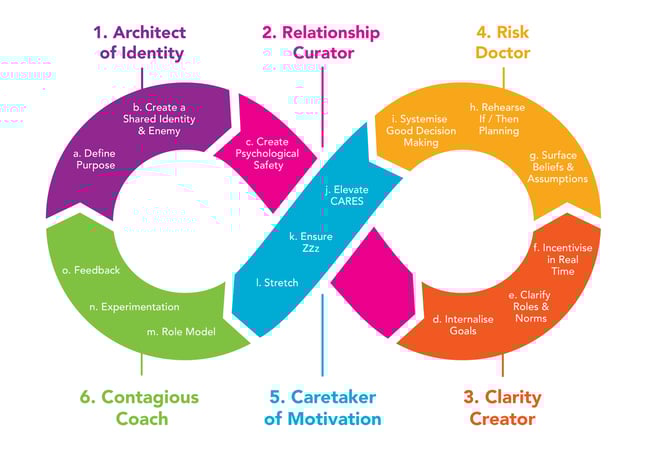
What Andy has found through the science is that skills and capabilities are certainly required, but a hugely important factor around what makes a great leader is having the ability to create an environment in which other people can thrive – and this skill can be taught.
Great leaders need to create an environment that is ‘brain friendly’, and in line with the unconscious mind’s natural wants and needs. In order to achieve the best performance in the work place, the brain needs to be kept in a positive, reward state, rather than an anxious and threat state. If leaders are able to provide this for their teams, then they will create an environment which allows people to genuinely thrive – and this is what Andy and his team specialise in.
For Andy, leadership should be constantly trying to magnify the performance of those people you are working with. In order to do that, leaders need to use the knowledge of the brain, what it is and what is does, and how you can take practical steps to create, that environment which allows others to thrive.
More into the detail around neuroscience
There is a term in the world of neuroscience, known as ‘neuroplasticity’. This is the phenomenon that anybody is able to rewire neural pathways within their brain. This means that people can, over time, change their behavioural habits, so they start to become engrained. The brain never loses its ability to change shape, based on habits that are formed. Therefore, by approaching leadership with the notion that everybody can improve, and can be focused and socially connected, a team will be able to reach its full potential.
In a business context, specifically regarding leaders and teams, there are three areas in which every leader can start to focus on to promote high performance, and this relates to the fact that the brain is always doing three things:
Looking for meaning and purpose
The brain is always searching for meaning and purpose in life and in work. If leaders can create a team environment where a team is connected to a purpose that really motivates them, then the brain is naturally going to be in a far more comfortable and motivated state. If these conditions within the environment can be created by leaders, each member of the team will be moving more towards a higher purpose and Finding their Why. It’s incredibly important for a team to be able to do this collectively by creating a shared team identity, much like sports teams who achieve success, through songs, uniforms, shared history. If leaders can do these things, it starts to activate empathy and dopamine and helps build the foundations for high performance. 2. The brain hates uncertainty
Uncertainty means we don’t know what is coming, and that is a survival threat to us. If leaders can create an environment that has as much certainty as possible, then this is an incredibly powerful way to stop the brain from worrying about uncertainty. This means that more focus can be applied to higher-order tasks, such as decision making, complex problem solving and interpersonal and social connection.
An example of what can be done to reduce uncertainty, is scenario planning to cover different eventualities of what ‘might’ happen, so when it does happen, it will have been anticipated and not perceived as a threat. For example, if a business is about to move into a new market, this may bring about a great deal of uncertainty for team members, whose brains will go back to the primitive survival techniques of ‘what if?’, and persistently worrying about outcomes. Scenario planning enables leaders to act out scenarios with different eventualities. Consequently, when these eventualities come up, uncertainty will be reduced among the team.
The brain always wants to grow and progress
Our brain is always wanting to grow and to progress. As a leader, it is hugely important to make sure that team members are generally, professionally, and personally growing. Incorporating things like stretch goals to ensure that team members are getting better and can feel the progress that they’re making will ensure that they are engaged psychologically and subconsciously, in line with this innate need from the brain. Great leaders will coach and support their team members in their constant growth and progress.
Inclusivity within teams
We know the paramount importance of ensuring that organisations are inclusive. Andy says that, by definition, a business cannot have an exclusive team and be high performing.
Again, we can go back to the brain and its innate needs. Human beings are incredibly socially driven and have a need to be around other people. The level of social nuance that is picked up on both consciously and subconsciously is phenomenal – much more than any other species. Therefore, if we detect that we are not part of a group or cannot be our true selves, this activates hyperarousal in the brain (a symptom of the fight/flight response). This, consequently, means that we are not able to focus on higher order functions.
Teams need to focus on how to create the conditions for inclusion within the workplace. Leaders need to create an environment which fosters inclusivity. This is about making sure that everybody within the team knows each other and has psychological safety, where people can be their true selves, can share different opinions and have good, challenging discussions and debate in a healthy way.
Leaders must ensure the conditions are created which enables everybody in the team to contribute – meaning that they feel as though they are part of the team and belong to the group. If leaders do this effectively, not only will it result in high performance, but as a building block for organizational culture, because how we experience our organisation is how we experience our team. Ultimately, teams need to capitalize on the cognitive diversity that everyone brings in, and this will be the grounds for creating cultural change for the organisation to be more inclusive.
Companies can build a culture that they want, intentionally, from the start. Founders need to identify what are the key values that are really important to the organisation. To do this, you need to establish what these values mean today, are they the values we want to have now and are they the values we want to represent us in the future, to ourselves and to our clients? Once your values have been broadly established, really get to the bottom of each of them… do they represent us? Are they authentic? Challenge these values as a team collectively. Get to the point where everybody within the organisation believes in them and feels passionate about them. Once established, organisations should start designing people processes around behaviours linked to these values and incentivizing these behaviours through performance management. This will help to develop the right type of habits across that the organisation wants to build, which will align with this culture.
Organisations also need to make sure that employees are being held to account (leaders in particular) for being consistent and authentic with these behaviours and values, and the processes and incentives that have been brought in to foster them – because if organizational culture drift comes along, it’s incredibly difficult to reverse this – particularly among fast-growing organisations.
Finally, it’s hugely important that organisations constantly and intentionally monitor the overall organizational culture. Make sure that the values, behaviours, and attributes that we have in place are still what we want. Organisations should review this at least annually.
teamup products
teamup has designed and built four innovative psychometric assessments, which are all based on the teamup proprietary model of applied neuroscience to develop high-performing teams and leaders. I’m incredibly proud to say that the Evolve platform powers these psychometrics for teamup. Andy has given us some info about all of them – and you can access more information by following this link.
Neuroselfie
This is a short self-report in which team leaders can self-assess against the teamup framework, using likert questions. Upon completion, users will receive a custom report to show where they’re tracking against the six areas of high performance.
180/360 degree feedback
teamup has built a 180/360 degree feedback. This looks at whether a leader is creating an environment for others to thrive, again, based on the teamup model of applied neuroscience. The 360 will provide leaders with feedback against the areas of high performance, which is delivered via a teamup accredited coach.
teamup For Teams (TUFT)
teamup’s flagship product, teamup for Teams, is a team assessment. All members within a team will answer a diagnostic questionnaire and get their own customized team report, that shows how this team – with its collective accountability and responsibility, is performing, and what can be done practically in order to improve that.
The psychometric tools that Andy and his team are incredibly powerful, and have already been used by large clients on a global level.
To find out more about any of the teamup products, or how Andy and his team can support, please contact him on:
‘Customer/Client Success’, ‘Account Management’, ‘Customer Service’; No matter which title you use, looking after your customer base is arguably the most crucial function to sustain growth within your business. It’s no secret that a business needs an excellent sales and marketing strategy to be successful, but who looks after all those exciting new clients you sign up?
Account managers become the main contact for new clients and are responsible for focusing on customer retention to create and nurture long-lasting, profitable relationships. With current customers spending on average 67% more than new customers, this is where your best growth opportunities are hiding!
Being an account manager can involve many responsibilities. Quite often we take on the role of project manager, software tester and occasionally therapist, but these are the things that make this role so rewarding. Engrossing ourselves in a holistic understanding of a client’s solution allows us to provide consultative recommendations that are right for the business. Sometimes these recommendations may be at a cost to the client, but based on a strong relationship they will understand that investing additional funds now will allow for a mutually successful solution in the long term.
How often do you find yourself turning to Facebook, Google or TripAdvisor to leave a review after experiencing bad service? We are 10 times more likely to leave a review after bad service than we are with a good experience, and with customer feedback so readily available online, a bad review can damage your business reputation. That’s why in this digital age we need to ensure we do all we can to ensure our customers have a great experience.
At Evolve Assess we pride ourselves on providing the best possible service for our clients, delivering a tailored solution and approach to meet each individual client’s needs. If you would like to know more about what sets us apart from other assessment platforms, you can contact us at info@evolveassess.com.